Synonyms are words that have the same or nearly the same meaning as another word. We use them to make our writing and speech more interesting, avoid repeating the same words, and express our ideas in different ways.
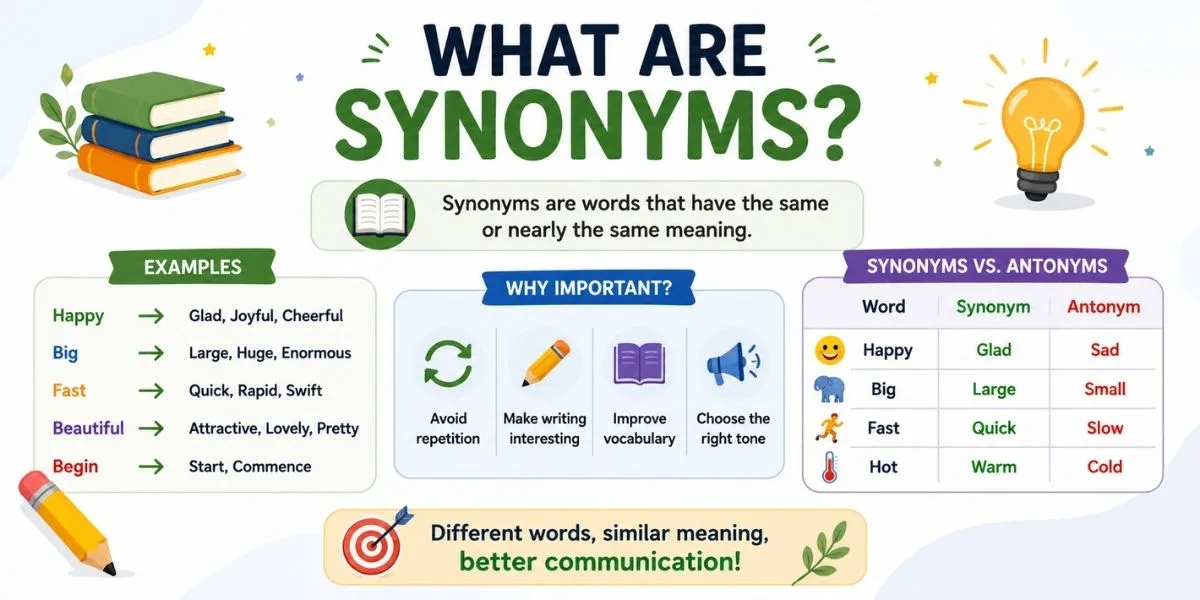
For example:
Happy → Glad, Joyful, Cheerful
Big → Large, Huge, Enormous
Fast → Quick, Rapid, Swift
Beautiful → Lovely, Attractive, Pretty
Begin → Start, Commence
In simple terms, synonyms are different words that express the same or a similar idea.
What Is an Example of a Synonym?
A simple example is:
Happy → Glad
Both happy and glad describe a positive feeling, so they can be used as synonyms in many sentences.
Another example is:
Small → Little
Both words can describe something that is not large.
However, synonyms do not always mean exactly the same thing, and you cannot always replace one with another. The right choice depends on the sentence and context.
For example, big and large have similar meanings, but we usually say “a big mistake” rather than “a large mistake.” This is why understanding the context is important when choosing a synonym.
Why Are Synonyms Important?
Synonyms are useful in everyday conversations as well as in writing. They can help you communicate your ideas more clearly and naturally.
1. They Help Avoid Repetition
Using the same word again and again can make writing feel repetitive.
For example:
The movie was good. The acting was good, and the story was also good.
A little variety makes the sentence more interesting:
The movie was excellent. The acting was impressive, and the story was also entertaining.
The meaning remains similar, but the writing feels more natural.
2. They Make Writing More Interesting
Synonyms give you more words to choose from when describing people, places, situations, or ideas.
For example, instead of always using “said,” you might use replied, explained, whispered, shouted, or asked, depending on what is actually happening.
This can make a story or explanation more descriptive.
3. They Help Improve Vocabulary
Learning synonyms is a simple way to build your vocabulary. It helps you understand different ways of expressing an idea and can be particularly useful for students, essay writing, exams, and everyday communication.
4. They Help You Choose the Right Tone
Some words are more casual, while others sound more formal.
For example:
Help – common and general
Assist – more formal
Aid – often used in formal or specific contexts
Knowing these differences helps you choose a word that fits the situation.
Common Examples of Synonyms
Word | Common Synonyms |
|---|---|
Happy | Glad, Cheerful, Joyful |
Sad | Unhappy, Sorrowful, Upset |
Big | Large, Huge, Enormous |
Small | Little, Tiny, Miniature |
Fast | Quick, Rapid, Swift |
Smart | Clever, Intelligent, Bright |
Easy | Simple, Effortless |
Difficult | Hard, Challenging |
Begin | Start, Commence |
End | Finish, Conclude |
Beautiful | Lovely, Attractive, Pretty |
Angry | Mad, Furious, Annoyed |
Brave | Courageous, Fearless |
Quiet | Silent, Peaceful |
Help | Assist, Aid |
Synonyms vs. Antonyms
Synonyms and antonyms are both related to word meanings, but they work in opposite ways.
Synonyms are words with the same or similar meanings.
Antonyms are words with opposite meanings.
For example:
Word | Synonym | Antonym |
|---|---|---|
Happy | Glad | Sad |
Big | Large | Small |
Fast | Quick | Slow |
Easy | Simple | Difficult |
Hot | Warm | Cold |
So, happy and glad are synonyms, while happy and sad are antonyms.
Are Synonyms Exactly the Same in Meaning?
Not always.
Some synonyms are very close in meaning, while others have small differences. They may also be used differently depending on the situation.
For example, angry, annoyed, and furious are all related to negative emotions, but they can describe different levels of intensity.
Similarly, house and home can sometimes be used in similar ways, but they do not have exactly the same meaning in every sentence.
This is why it is important to look at the context before replacing a word with a synonym.
What Are Synonyms?
Synonyms are words that have the same or similar meanings as another word. They help us avoid repetition, improve vocabulary, and make our writing and speech more varied and natural.
If you need a simple definition, remember this:
Synonyms are different words that have the same or nearly the same meaning.
For example, happy and glad, big and large, and fast and quick are common examples. However, similar words may not work in exactly the same situations, so always choose a synonym that fits the meaning and context of the sentence.
Also Read: what is sthethescope?