Taxonomy is the science of classification . It is the grouping of things based on their similarities and differences. The term is most commonly used in biology where scientists classify living things but taxonomy is also used in websites, libraries, education, data management and many other areas.
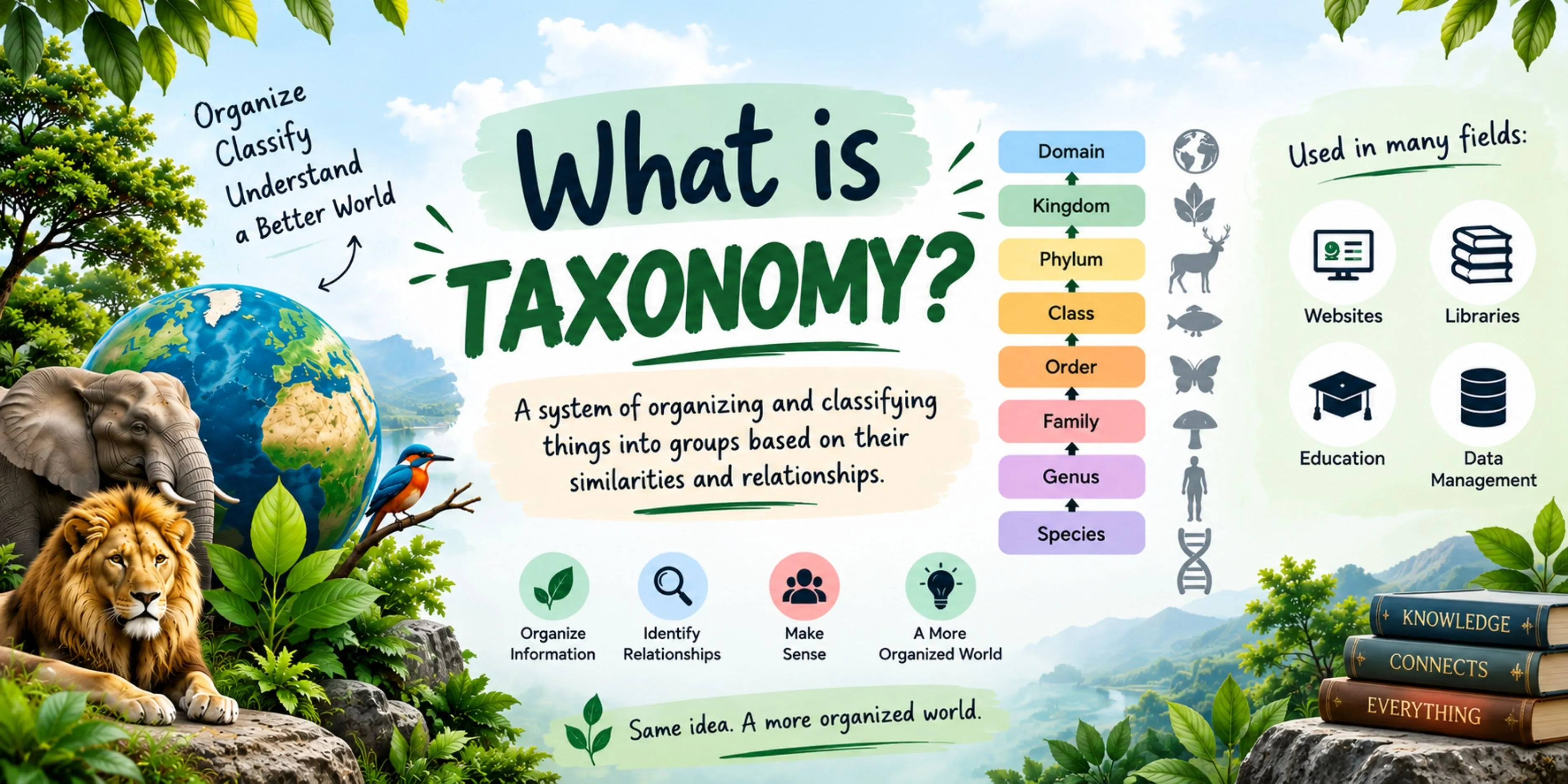
Taxonomy is simply a way of arranging things into classes of similar things.
Taxonomy basics:
Definition: Simple A simple way of arranging and sorting things
The most widely used method of classifying living things
Main aim: To identify, name and sequence objects
Key point: Things that are the same are put into groups of related things
Humans are named: Homo sapiens:
How does biological classification operate?
When scientists talk about taxonomy they are generally talking about how we classify living things.
There are millions of known species on the planet so it is very important to have a clear system to organize them. Taxonomy is the science of naming and classifying living things according to their characteristics and their evolutionary relationships.
The system of biological classification is the:
Rank | Example Humans |
|---|---|
Domain | Eukaryota |
Kingdom | Animalia |
Phylum | Chordata |
Class | Mammalia |
Order | Primates |
Family: | Hominidae |
Genus: | Homo |
Species: | Homo sapiens |
The groups are more specific the lower they are in the hierarchy.
For example , humans and dogs are both mammals , but are of different orders and families . That allows scientists to see what they have in common, and what sets them apart.
Who is the father of modern taxonomist?
The 18th century Swedish scientist Carl Linnaeus is usually credited with creating modern taxonomy . He developed a systematic way of naming and classifying organisms .
Linnaeus also contributed to the development of binomial nomenclature, a system that assigns species a two-part scientific name. For example humans are called Homo sapiens in the scientific world.
His work established the basis for the system of biological classification that we still use today . With the development of genetics and the science of evolution, modern taxonomy has changed substantially .
Why is taxonomy important?
Taxonomy sounds like a hard science word. But the basic idea of taxonomy is actually very simple and practical. This lets us organize things, so that we can understand and recognize them more easily.
Why do we need taxonomy?
Helps you organize huge amounts of data
Helps scientists tell apart different organisms
Standardized species names
Shows relationships of different groups
Science communication, explained
It helps scientist to study the evolution and biodiversity
Without some way to categorize, it would be very confusing to talk about millions of different organisms.
Taxonomy is not only for biology.
No. Taxonomy is used in many different fields.
What is taxonomy ?
Websites use taxonomy to organize their content . Think about a tech site with hundreds of articles. The website could instead show all of this in a structured way instead of randomly.
Android → Tech → Mobile Phones → Samsung
This structure helps visitors find related information more easily.
Taxonomy can also be great for SEO and organizing your website. A logical website taxonomy can help users find related content easier, make navigation easier, and give search engines a better idea of how pages relate to each other.
What is taxonomy in simple language?
Taxonomy is a method of classifying and sorting things based on similarities, characteristics, and relationships.
The classification of living things is called taxonomy by biologists. Categories and sub-categories can help a website to organize pages, products and information.
Final thought
The easiest way to remember what taxonomy means is to remember it as a system of grouping similar things .
Taxonomy can be used in studying animals and plants, classifying products in an online store or organizing content on a website. It helps you to turn a lot of information into something which is clearer and easier to navigate and easier to understand.
Also Read: What is Psychoeducation?