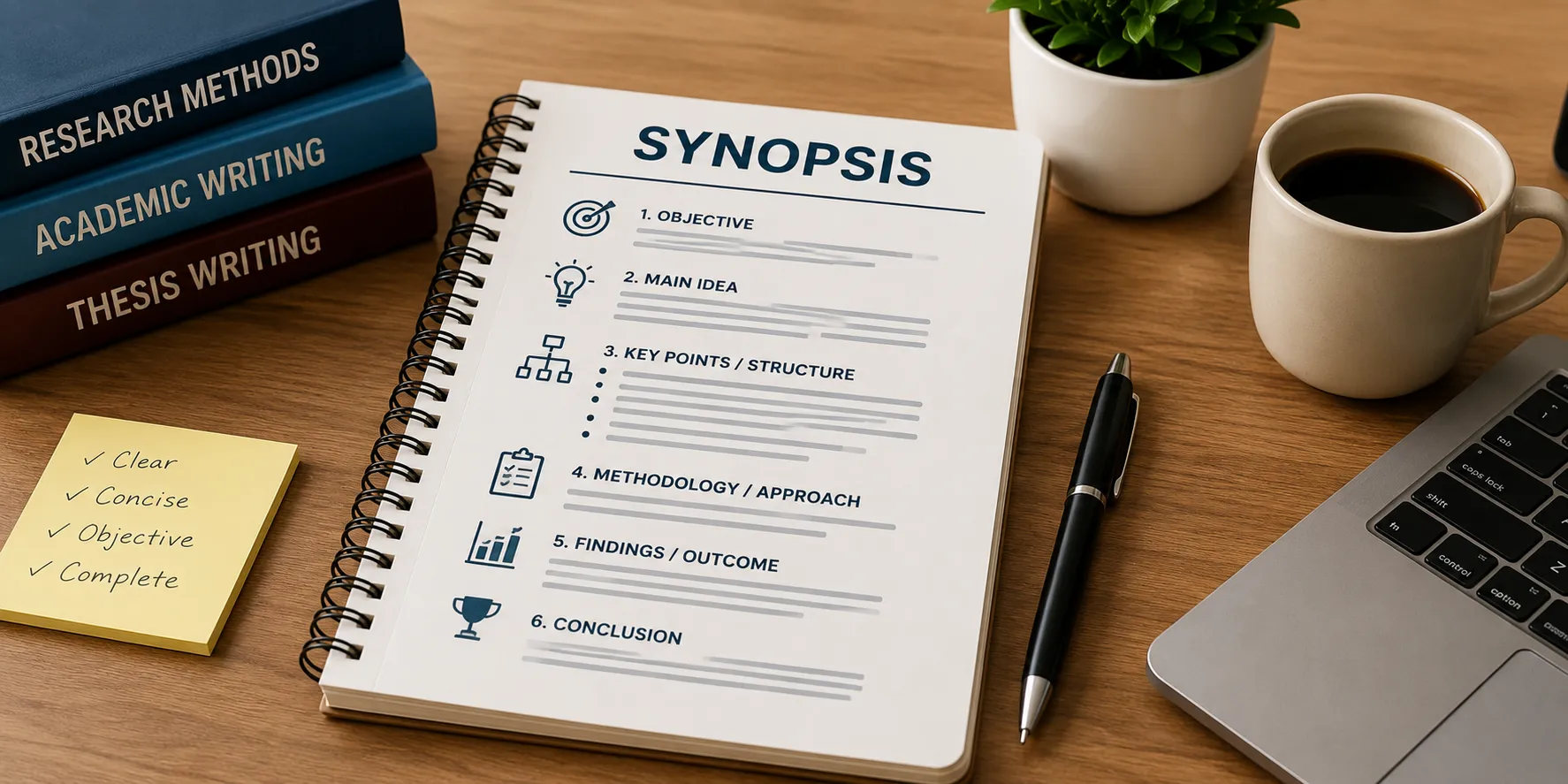
A synopsis is a concise, objective summary of a larger work that presents its main ideas, key points, structure, and conclusion without unnecessary detail or personal opinion. Depending on the context, a synopsis may summarize a book, novel, research paper, thesis, project, report, article, movie, TV show, business proposal, or screenplay. Its purpose is to help readers quickly understand the essence of the original work without reading it in full.
Unlike a teaser or promotional description, a synopsis provides a complete overview, including the central ideas or outcome when appropriate. In academic writing, it summarizes a study's objectives, methodology, and expected findings. In publishing and entertainment, it outlines the complete storyline, including major plot developments and the ending. A well-written synopsis is clear, accurate, concise, and factual, making it an essential communication tool across education, research, publishing, and business.
Purpose
A synopsis is written to communicate the core message of a larger work quickly and efficiently.
Its primary purposes include:
-
Provide a clear overview of a book, article, project, or research.
-
Help readers understand the main idea without reading the complete work.
-
Assist editors, publishers, reviewers, or supervisors in evaluating a submission.
-
Present research objectives and methodology before conducting a study.
-
Save time by summarizing lengthy documents.
-
Demonstrate the writer's understanding of the subject.
-
Serve as a planning tool before completing a larger project.
Because decision-makers often review numerous submissions, a well-written synopsis allows them to assess relevance and quality in a relatively short time.
Types
The format of a synopsis varies depending on its purpose.
| Type | Common Use |
|---|---|
| Research Synopsis | Summarizes research objectives, methodology, and expected outcomes. |
| Book Synopsis | Provides a complete overview of a book's storyline or content. |
| Novel Synopsis | Summarizes the plot, characters, conflict, and ending. |
| Movie Synopsis | Presents the complete story and major events of a film. |
| Project Synopsis | Explains a project's objectives, scope, methodology, and expected results. |
| Business Synopsis | Gives an overview of a business proposal or plan. |
| Article Synopsis | Summarizes the key arguments and conclusions of an article or report. |
Although the format changes, every synopsis shares the same goal: communicating the essential information clearly and concisely.
Key Elements
A strong synopsis usually contains the following elements.
-
Clear title or subject.
-
Main purpose or objective.
-
Overview of the central idea or storyline.
-
Important points or major events.
-
Logical flow of information.
-
Key findings or conclusion (where applicable).
-
Clear, concise, and objective language.
The exact elements depend on the type of synopsis. For example, a research synopsis emphasizes objectives and methodology, while a novel synopsis focuses on plot, characters, conflict, and resolution.
Related Documents
Although similar, these documents serve different purposes.
| Document | Primary Purpose |
|---|---|
| Synopsis | Provides a concise overview of the complete work, including its main points and conclusion. |
| Summary | Briefly condenses the essential ideas of a text. |
| Abstract | Summarizes an academic research paper, highlighting objectives, methods, results, and conclusions. |
| Executive Summary | Summarizes a business report, proposal, or project for decision-makers. |
| Outline | Organizes topics and headings before writing the complete document. |
A simple way to remember the difference is:
A synopsis explains the entire work in a condensed form, while an outline organizes ideas, and an abstract specifically summarizes academic research.
Writing Tips
A good synopsis should be informative without becoming overly detailed.
Some useful writing tips include:
-
Read and understand the complete work before summarizing it.
-
Focus only on the main ideas and essential information.
-
Keep the writing objective and avoid personal opinions.
-
Write in clear, simple, and concise language.
-
Maintain the logical order of the original work.
-
Include the ending or final outcome when required.
-
Avoid unnecessary descriptions or minor details.
-
Proofread carefully to ensure clarity and accuracy.
The best synopses give readers a complete understanding of the work while remaining significantly shorter than the original.
Common Misconceptions
"A synopsis and a summary are exactly the same."
Not always.
Both are concise, but a synopsis often provides a more structured overview of an entire work and is commonly used in publishing, research, and project proposals.
"A synopsis shouldn't reveal the ending."
Incorrect.
In many contexts, especially publishing, research, and academic writing, a synopsis is expected to present the complete work, including its conclusion or ending. It is meant to inform, not create suspense.
"A synopsis includes personal opinions."
No.
A synopsis should remain factual and objective. It summarizes the original work rather than reviewing, analyzing, or criticizing it.
"A synopsis is only used for books."
Not true.
Synopses are widely used for research papers, theses, projects, reports, articles, business proposals, movies, TV shows, and many other types of content.
Frequently Asked Questions (FAQs)
1. What is the correct definition of a synopsis?
A synopsis is a concise, objective summary of a larger work that presents its main ideas, structure, and conclusion in a clear and organized manner.
2. What is the purpose of a synopsis?
Its purpose is to provide readers with a quick understanding of the complete work without requiring them to read the entire document.
3. Is a synopsis the same as an abstract?
No.
An abstract summarizes academic research specifically, while a synopsis can summarize many different types of works, including books, projects, reports, and films.
4. How long should a synopsis be?
There is no fixed length. It depends on the purpose and requirements, but a synopsis should always be significantly shorter than the original work while covering its essential points.
5. What should be included in a synopsis?
A synopsis should include the main subject, key ideas or events, important details, and the overall conclusion, presented in a logical and concise format.
A synopsis is a concise yet comprehensive overview of a larger work that helps readers understand its main ideas, structure, and conclusion quickly. Whether used in academics, publishing, filmmaking, research, or business, a well-written synopsis communicates the essence of the original content in a clear, objective, and organized manner. Rather than adding opinions or unnecessary detail, it focuses on the most important information, making it easier for reviewers, publishers, supervisors, and readers to evaluate the work efficiently. Mastering synopsis writing is an essential skill because it combines clarity, accuracy, brevity, and effective communication into a single document.
Must Read: What is synopsis writing, and why is it important in academic research?