Goods are tangible products that can be seen, touched, owned, stored, and transferred from one person to another. Services, on the other hand, are intangible activities or performances provided by a person or organization to satisfy a customer's needs. Unlike goods, services cannot usually be touched, stored, or owned; they are experienced at the time they are delivered.
In economics, both goods and services exist to provide utility (satisfaction) and fulfill human wants and needs. Together, they form the foundation of every economy, supporting production, trade, employment, and economic growth. Whether you buy a smartphone (a good) or pay for a medical consultation (a service), both create value for consumers in different ways.
| Feature | Goods | Services |
|---|---|---|
| Nature | Tangible (physical) | Intangible (non-physical) |
| Ownership | Can be owned and transferred | Cannot usually be owned |
| Storage | Can usually be stored as inventory | Cannot generally be stored |
| Production & Consumption | Produced before being consumed | Usually produced and consumed simultaneously |
| Quality | Easier to standardize | May vary depending on the provider |
| Return/Exchange | Often possible | Usually not possible once delivered |
| Examples | Mobile phone, book, car, furniture | Education, healthcare, banking, haircuts, transportation |
These characteristics help businesses determine how products are produced, marketed, delivered, and priced.
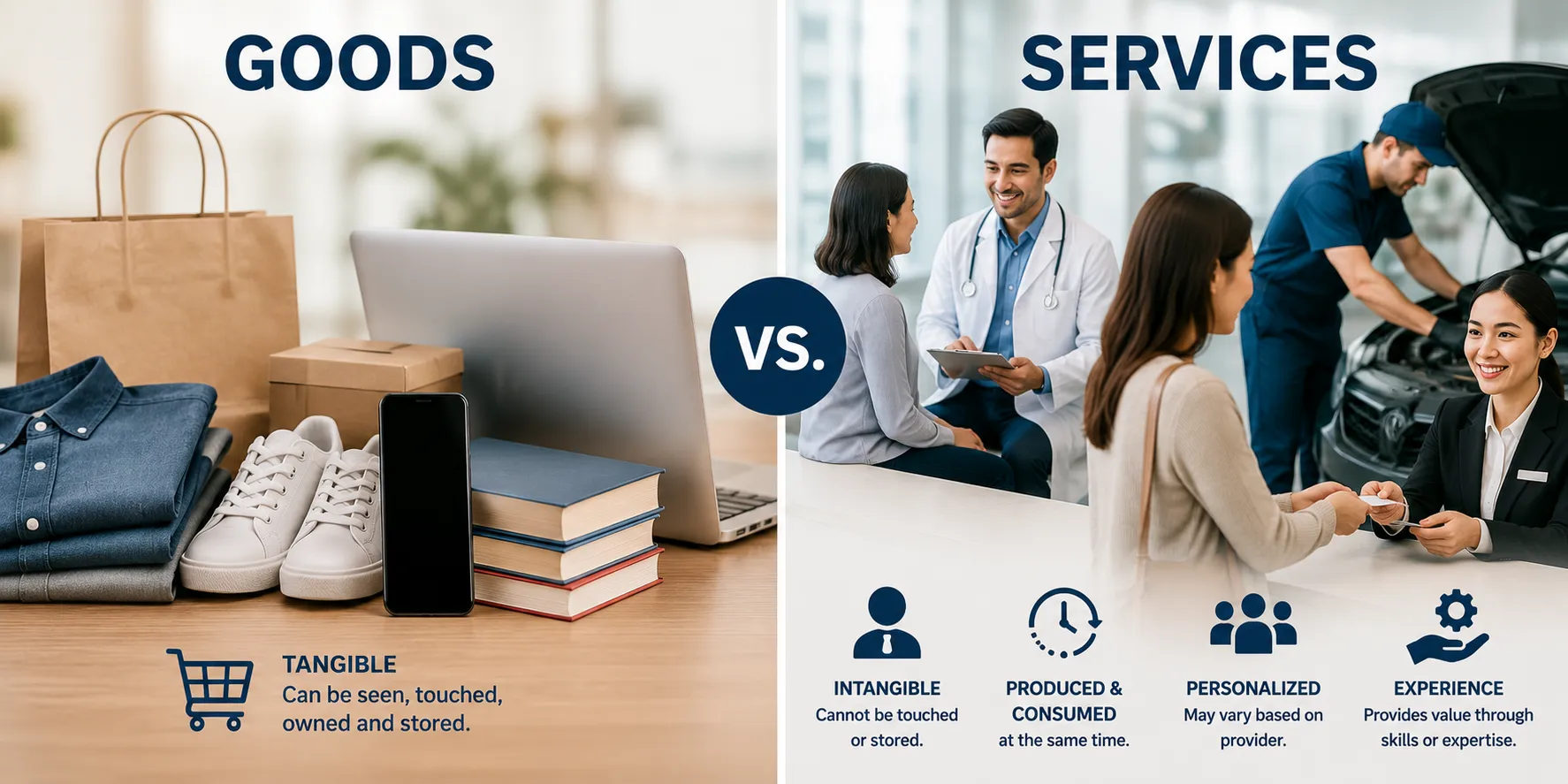
What Are Goods?
Goods are physical products created to satisfy human wants or needs. They can generally be seen, touched, stored, transported, bought, sold, and transferred from one owner to another.
Examples include:
-
Smartphones
-
Clothing
-
Furniture
-
Books
-
Groceries
-
Cars
-
Laptops
Goods may be durable (used repeatedly over time, such as a refrigerator) or non-durable (consumed quickly, such as food).
What Are Services?
Services are activities, skills, or expertise provided by one person or organization for another. Instead of receiving ownership of a physical product, the customer receives the benefit of the provider's work, knowledge, or time.
Examples include:
-
Medical treatment
-
Teaching
-
Banking
-
Haircuts
-
Legal advice
-
Hotel accommodation
-
Digital marketing
-
Software consulting
In most cases, services are consumed as they are delivered and cannot be physically possessed.
Examples
Understanding the difference becomes easier with everyday examples.
| Goods | Services |
|---|---|
| Mobile phone | Mobile phone repair |
| Laptop | Laptop servicing |
| Car | Taxi ride |
| Book | Online tutoring |
| Refrigerator | Appliance installation |
| Shoes | Shoe cleaning service |
| Medicine | Doctor's consultation |
| Coffee beans | Café table service |
Many businesses actually offer both goods and services. For example, a restaurant provides a physical product (food) along with services such as cooking, serving, and customer care. Economists often describe this as a goods–services continuum, where many offerings combine elements of both.
Advantages & Disadvantages
Goods
Advantages
-
Can be owned and resold.
-
Usually easier to inspect before purchase.
-
Can be stored for future use.
-
Easier to standardize in quality.
-
Often have a longer usable life.
Disadvantages
-
Require manufacturing, storage, and transportation.
-
May become obsolete or damaged during storage.
-
Inventory management increases business costs.
Services
Advantages
-
Often personalized to customer needs.
-
Usually require little or no physical inventory.
-
Can build long-term customer relationships.
-
Knowledge and expertise create significant value.
Disadvantages
-
Cannot generally be stored for future sale.
-
Quality may vary depending on the service provider.
-
Once delivered, they usually cannot be returned.
-
Capacity is often limited by the provider's time and expertise.
Economic Importance
Both goods and services are essential for every economy.
Their importance includes:
-
Satisfy human wants and needs.
-
Create employment opportunities.
-
Drive business growth and innovation.
-
Contribute to a country's Gross Domestic Product (GDP).
-
Support domestic and international trade.
-
Improve living standards.
-
Encourage specialization and productivity.
Modern economies rely heavily on both manufacturing and service industries. While factories produce goods such as electronics and automobiles, service sectors, including healthcare, education, finance, information technology, and digital marketing, have become major contributors to economic growth in many countries.
Common Misconceptions
"Goods are always better than services."
No.
Goods and services serve different purposes. Consumers often need both—for example, buying a laptop (good) and paying for internet service (service).
"Services have no value because they are intangible."
Incorrect.
Many of today's largest industries, such as healthcare, banking, software development, consulting, cloud computing, and digital marketing, are primarily service-based and generate enormous economic value.
"Goods and services are completely separate."
Not always.
Many businesses offer a combination of both. For example, purchasing a smartphone includes the physical device (good) as well as warranty support, software updates, and customer service (services). Economists refer to this relationship as the goods–services continuum.
"Services can always be stored like goods."
No.
Most services are consumed as they are delivered and generally cannot be stored or inventoried for future use.
Frequently Asked Questions (FAQs)
1. What is the main difference between goods and services?
Goods are tangible products that can usually be owned, stored, and transferred, whereas services are intangible activities or experiences that are generally consumed as they are provided.
2. Can a business provide both goods and services?
Yes.
Many businesses combine both. For example, restaurants provide food (goods) along with cooking, serving, and hospitality (services).
3. Why are services considered intangible?
Because they involve activities, expertise, or experiences rather than physical objects. Although a service may produce a tangible result, the service itself cannot usually be touched or owned.
4. Can services be stored?
Generally, no.
Unlike goods, most services cannot be inventoried or stored for future use because they are produced and consumed simultaneously.
5. Why are both goods and services important?
Together, goods and services satisfy human needs, support businesses, create employment, facilitate trade, and contribute significantly to economic development and GDP.
The difference between goods and services lies mainly in their nature, ownership, and delivery. Goods are physical products that people can own, while services are intangible activities that provide value through skills, expertise, or experience. Although they differ in many ways, both are equally important because they satisfy consumer needs and drive economic activity. In today's economy, many businesses combine goods and services to create better customer experiences, making it increasingly common for products and services to work together rather than exist separately.
Must Read: Is indian economy driven by service sector?