ICSE stands for Indian Certificate of Secondary Education. It is the Class 10 public examination and certificate conducted by the Council for the Indian School Certificate Examinations (CISCE) for students studying in CISCE-affiliated schools across India.
One of the most common misconceptions is that ICSE is the education board itself. In reality:
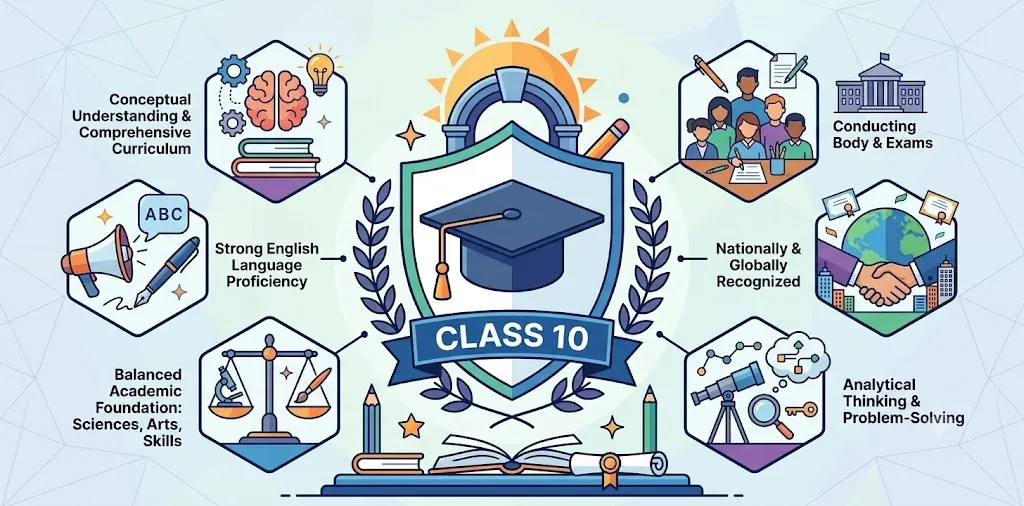
The Indian Certificate of Secondary Education (ICSE) is a nationally recognized secondary school examination conducted at the end of Class 10. It assesses students through a comprehensive curriculum that emphasizes conceptual understanding, analytical thinking, practical knowledge, language proficiency, and overall academic development rather than rote memorization alone.
ICSE schools generally use English as the primary medium of instruction, and the curriculum is designed to provide students with a balanced education across languages, sciences, mathematics, social sciences, arts, and practical subjects. Because of its detailed syllabus and strong focus on English, ICSE is widely regarded as one of India's academically rigorous school education systems.
Conducting Body
The ICSE examination is conducted by the:
| Feature | Details |
|---|
| Conducting Body | Council for the Indian School Certificate Examinations (CISCE) |
| Established | 1958 |
| Examination Level | Class 10 |
| Medium of Instruction | Primarily English |
| Certificate Awarded | Indian Certificate of Secondary Education (ICSE) |
| Higher-Level Examination | ISC (Indian School Certificate – Class 12) |
The Council for the Indian School Certificate Examinations (CISCE) is responsible for designing the syllabus, conducting examinations, issuing certificates, and maintaining academic standards for both ICSE (Class 10) and ISC (Class 12).
Key Features
ICSE has several characteristics that distinguish it from many other school education systems.
-
Comprehensive and detailed curriculum.
-
Strong emphasis on English language and communication skills.
-
Equal importance given to science, mathematics, humanities, languages, arts, and practical subjects.
-
Focus on conceptual learning instead of memorization.
-
Internal assessments along with external board examinations.
-
Encourages analytical thinking, problem-solving, and project-based learning.
-
Recognized by universities and educational institutions in India and abroad.
Curriculum
The ICSE curriculum covers a broad range of subjects to promote holistic education.
| Subject Group | Examples |
|---|
| Languages | English, Hindi, regional and foreign languages |
| Science | Physics, Chemistry, Biology |
| Mathematics | Mathematics |
| Social Sciences | History, Civics, Geography |
| Commerce & Economics | Commercial Studies, Economics |
| Computer Education | Computer Applications |
| Arts & Creative Subjects | Art, Performing Arts |
| Practical & Skill-Based Subjects | Environmental Applications, Technical and vocational options (school dependent) |
Students usually study a combination of compulsory and elective subjects, allowing them to build both academic knowledge and practical skills.
Benefits
The ICSE system offers several academic advantages.
-
Builds strong English communication skills.
-
Encourages conceptual understanding instead of rote learning.
-
Promotes critical thinking and analytical reasoning.
-
Offers a balanced curriculum across multiple disciplines.
-
Includes project work and internal assessments.
-
Provides a solid foundation for higher education in India and abroad.
-
Develops research, writing, presentation, and problem-solving skills.
Many educators believe that the breadth of the ICSE curriculum helps students develop a well-rounded academic foundation while preparing them for future competitive studies.
Similar Systems
India has multiple school education boards, each with its own curriculum and assessment approach.
| Feature | ICSE | CBSE | State Boards |
|---|
| Conducting Body | CISCE | CBSE | Individual State Education Boards |
| Examination Level | Class 10 | Class 10 & 12 | Class 10 & 12 |
| Curriculum | Broad and detailed | More streamlined and nationally standardized | Varies by state |
| Medium | Primarily English | English and Hindi | Regional languages and English |
| Focus | Conceptual learning, languages, balanced education | Competitive exam preparation and national curriculum | State-specific educational requirements |
| Internal Assessment | Yes | Yes | Varies by board |
Each education system has its own strengths, and the best choice depends on a student's learning goals, preferred curriculum, and future academic plans.
Common Misconceptions
"ICSE is the name of the education board."
Not exactly.
CISCE is the education council, while ICSE is the Class 10 examination and certificate conducted by that council.
"ICSE is only for students planning to study abroad."
No.
ICSE is recognized by universities and educational institutions across India as well as internationally.
"ICSE is harder than every other board."
Not necessarily.
ICSE is often considered more detailed in certain subjects, especially English, but the level of difficulty depends on the student's strengths, learning style, and academic interests.
"ICSE students only study English."
Incorrect.
The ICSE curriculum includes science, mathematics, social sciences, commerce, computer applications, arts, and several language options in addition to English.
Frequently Asked Questions (FAQs)
1. What is the full form of ICSE?
ICSE stands for Indian Certificate of Secondary Education. It is the Class 10 examination conducted by CISCE.
2. Who conducts the ICSE examination?
The examination is conducted by the Council for the Indian School Certificate Examinations (CISCE).
3. Is ICSE a board or an examination?
Technically, ICSE is the Class 10 examination and certificate, while CISCE is the education council (board) that conducts it.
4. What is the difference between ICSE and ISC?
ICSE is the secondary school examination conducted after Class 10, whereas ISC (Indian School Certificate) is the higher secondary examination conducted after Class 12 by the same council.
5. Is the ICSE certificate recognized in India?
Yes.
The ICSE certificate is widely recognized by schools, colleges, universities, and educational institutions across India, and it is also accepted by many institutions abroad.
The full form of ICSE is Indian Certificate of Secondary Education, a nationally recognized Class 10 examination conducted by the Council for the Indian School Certificate Examinations (CISCE). While many people casually refer to it as the "ICSE Board," the technically accurate distinction is that CISCE is the board, and ICSE is the examination and certificate. Known for its comprehensive curriculum, emphasis on conceptual learning, strong English foundation, and balanced academic approach, ICSE continues to be one of India's most respected secondary education systems, helping students build the knowledge and skills needed for higher education and future careers.
Must Read: Which board is better in India, CBSE or ICSE?