
There is no single scientific name for all jellyfish because "jellyfish" is a common name, not the name of a single species. Instead, jellyfish belong to a group of aquatic animals within the phylum Cnidaria, primarily the subphylum Medusozoa, which includes several different classes of jellyfish.
When people refer to "true jellyfish," they are usually referring to the scientific class Scyphozoa. However, other jellyfish-like animals belong to the classes Cubozoa (box jellyfish), Hydrozoa, and Staurozoa. This is why asking for the scientific name of jellyfish is similar to asking for the scientific name of "birds"; there are thousands of different species, each with its own scientific name.
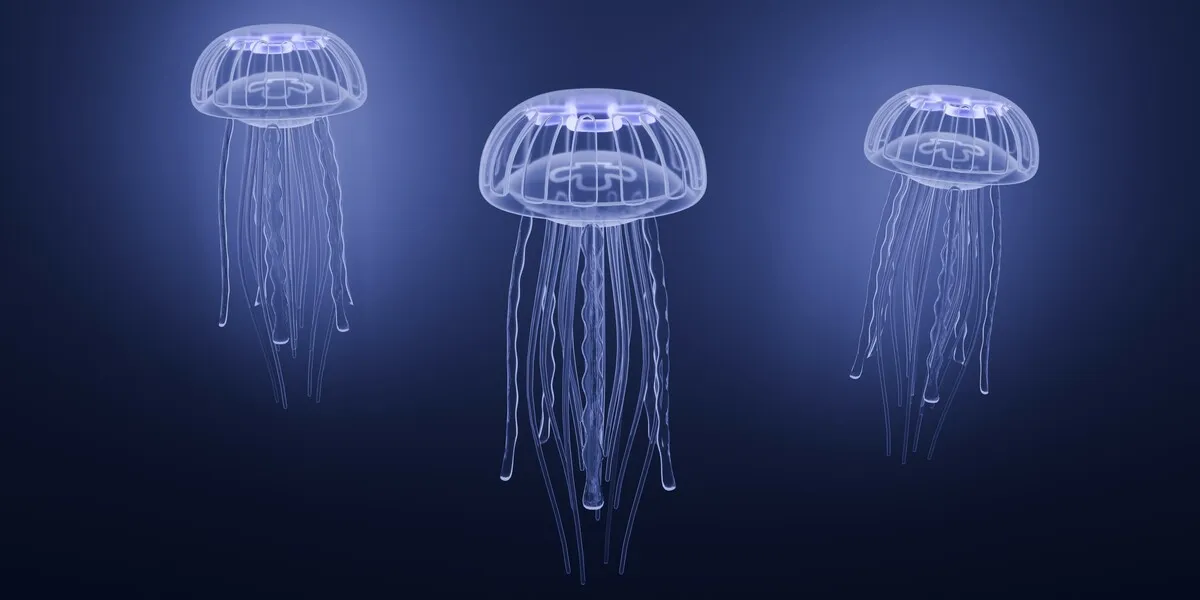
Scientific Classification
The general scientific classification of true jellyfish is:
| Taxonomic Rank | Classification |
|---|---|
| Kingdom | Animalia |
| Phylum | Cnidaria |
| Subphylum | Medusozoa |
| Class (True Jellyfish) | Scyphozoa |
Other jellyfish belong to the classes Hydrozoa, Cubozoa, and Staurozoa, all of which are part of the subphylum Medusozoa.
Explanation
One of the biggest misconceptions is that jellyfish are a single species.
In reality:
-
"Jellyfish" is a broad common name.
-
There are thousands of jellyfish species worldwide.
-
Different species belong to different scientific classes.
-
Each species has its own unique scientific (binomial) name.
For example, when scientists identify a jellyfish, they use its species name, not simply "jellyfish."
This is why there isn't one universal scientific name that applies to every jellyfish.
Examples of Scientific Names
Some of the best-known jellyfish species include:
| Common Name | Scientific Name | Group |
|---|---|---|
| Moon Jelly | Aurelia aurita | Scyphozoa |
| Lion's Mane Jellyfish | Cyanea capillata | Scyphozoa |
| Cannonball Jellyfish | Stomolophus meleagris | Scyphozoa |
| Upside-Down Jellyfish | Cassiopea xamachana | Scyphozoa |
| Australian Box Jellyfish | Chironex fleckeri | Cubozoa |
| Crystal Jelly | Aequorea victoria | Hydrozoa |
These examples show why "jellyfish" cannot be assigned a single scientific name—the term includes many different species belonging to multiple groups.
Characteristics
Although species vary, most jellyfish share several common features.
-
Soft, gelatinous body.
-
Bell-shaped umbrella.
-
Tentacles equipped with stinging cells (nematocysts).
-
Radial body symmetry.
-
No brain, heart, bones, or lungs.
-
Simple nerve net instead of a central nervous system.
-
Mostly marine animals.
Despite their simple body structure, jellyfish have survived for more than 500 million years, making them among the oldest animal groups still living today.
Habitat & Distribution
Jellyfish are found in oceans all over the world.
They inhabit:
-
Tropical seas.
-
Temperate oceans.
-
Polar waters.
-
Coastal regions.
-
Open oceans.
-
Deep-sea environments.
While most jellyfish are marine, a few species also live in freshwater habitats. Their distribution depends on the species, water temperature, currents, and food availability.
Common Misconceptions
"The scientific name of jellyfish is Scyphozoa."
Not exactly.
Scyphozoa is the scientific class of true jellyfish, not the scientific name for every jellyfish. Other jellyfish belong to classes such as Cubozoa, Hydrozoa, and Staurozoa.
"All jellyfish are the same species."
No.
There are thousands of jellyfish species, each with its own scientific name.
"Every jellyfish has a dangerous sting."
Incorrect.
Many jellyfish produce only mild stings, while a few species, such as the Australian box jellyfish (Chironex fleckeri), can be extremely venomous.
"Jellyfish are fish."
No.
Despite their name, jellyfish are invertebrate animals belonging to the phylum Cnidaria. They are not fish.
Frequently Asked Questions (FAQs)
1. What is the scientific name of jellyfish?
There is no single scientific name for all jellyfish. They belong to the phylum Cnidaria, and true jellyfish belong to the class Scyphozoa.
2. What is the scientific name of the moon jelly?
The scientific name of the moon jelly is Aurelia aurita.
3. Are all jellyfish classified as Scyphozoa?
No.
Only true jellyfish belong to Scyphozoa. Other jellyfish belong to Hydrozoa, Cubozoa, or Staurozoa.
4. Why doesn't a jellyfish have one scientific name?
Because "jellyfish" is a common term covering many different species, not a single organism.
5. Which phylum do jellyfish belong to?
Jellyfish belong to the phylum Cnidaria, which also includes corals, sea anemones, and hydroids.
The scientific name of jellyfish cannot be expressed as a single binomial name because jellyfish are not one species but a diverse group of animals. Scientifically, they belong to the phylum Cnidaria, with true jellyfish classified under the class Scyphozoa, while other jellyfish are found in Cubozoa, Hydrozoa, and Staurozoa. Individual species, such as the moon jelly (Aurelia aurita) or the Australian box jellyfish (Chironex fleckeri), each have their own scientific names. Understanding this distinction helps avoid one of the most common misconceptions in marine biology and provides a more accurate picture of jellyfish diversity.
Must Read: What is the scientific name of tulasi?
