
The main sources of photosynthesis are sunlight, carbon dioxide, and water. Green plants use these raw materials to make glucose (food) and release oxygen during the process. Photosynthesis mainly takes place in the chloroplasts of plant cells, where the pigment chlorophyll absorbs light energy.
In simple terms, plants use energy from sunlight to convert water and carbon dioxide into chemical energy stored in glucose.
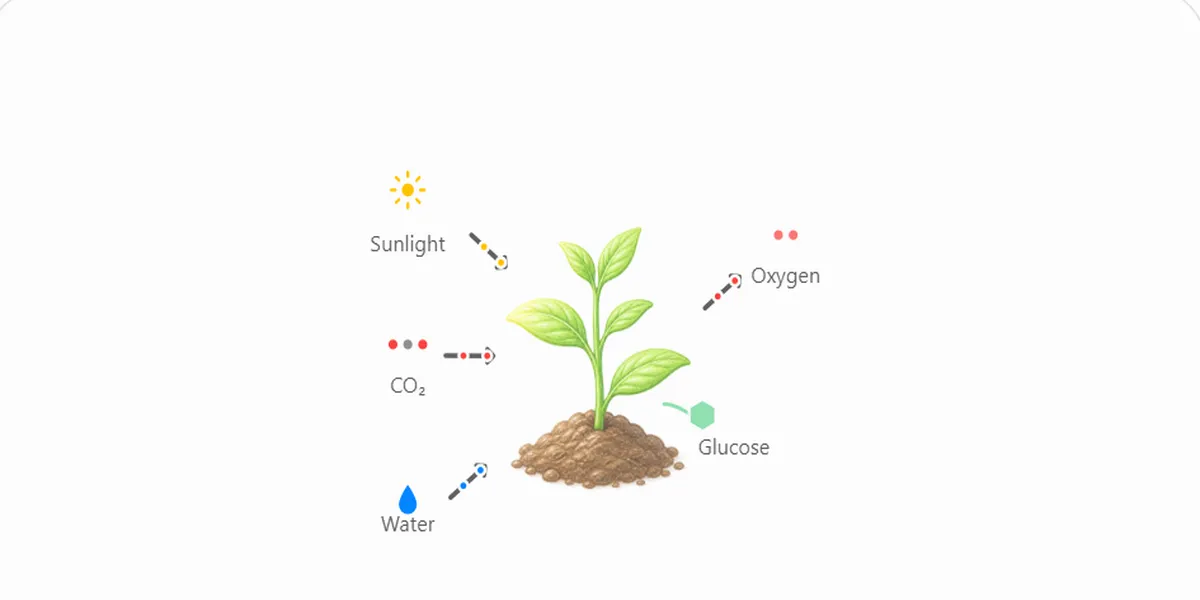
What Are the Main Sources Needed for Photosynthesis?
Photosynthesis requires several important inputs:
1. Sunlight
Sunlight is the main source of energy for photosynthesis. Chlorophyll absorbs light energy, which provides the energy needed to drive the chemical reactions.
2. Carbon Dioxide
Plants obtain carbon dioxide (CO₂) from the atmosphere. It enters the leaves mainly through tiny openings called stomata.
Carbon dioxide provides the carbon that plants use to build glucose and other organic molecules.
3. Water
Plants absorb water (H₂O) from the soil through their roots. Water is transported through the plant to the leaves.
Water provides hydrogen and electrons needed during photosynthesis. Oxygen is released as a by-product of the light-dependent reactions, with the oxygen atoms coming from water.
4. Chlorophyll
Chlorophyll is the green pigment found in chloroplasts. It absorbs light energy and helps start the reactions involved in photosynthesis.
Chlorophyll is not a raw material that gets used up like water or carbon dioxide. Instead, it helps capture the light energy required for the process.
Where Does Photosynthesis Take Place?
Photosynthesis mainly occurs in the chloroplasts of plant cells. Chloroplasts contain chlorophyll and specialized internal membranes where different stages of photosynthesis take place.
Photosynthesis also occurs in algae and certain bacteria, not just in land plants.
What Is the Photosynthesis Equation?
A simplified chemical equation for photosynthesis is:
6CO₂ + 6H₂O + light energy → C₆H₁₂O₆ + 6O₂
This means that plants use carbon dioxide, water, and light energy to produce glucose and oxygen.
The glucose can be used as an energy source or converted into other substances that help the plant grow and function.
Why Is Photosynthesis Important?
Photosynthesis is essential for life on Earth because it converts light energy into chemical energy stored in organic molecules. Plants, algae, and some microorganisms use this process to make their own food.
Photosynthesis also contributes a large amount of the oxygen in Earth's atmosphere and forms the foundation of many food chains. Animals and other organisms ultimately depend on photosynthetic organisms for food and, directly or indirectly, oxygen.
Photosynthesis: Sources and Products
Photosynthesis | Role |
|---|---|
Sunlight | Provides energy |
Carbon dioxide | Supplies carbon |
Water | Provides hydrogen and electrons |
Chlorophyll | Absorbs light energy |
Glucose | Main food product |
Oxygen | Released during photosynthesis |
Conclusion
The main sources needed for photosynthesis are sunlight, carbon dioxide, and water. Chlorophyll captures the light energy needed to power the process. Using these inputs, plants produce glucose and release oxygen. Photosynthesis is therefore an essential process that supports plants, food chains, and life on Earth.
Also Read: What is Mitochondrion?