
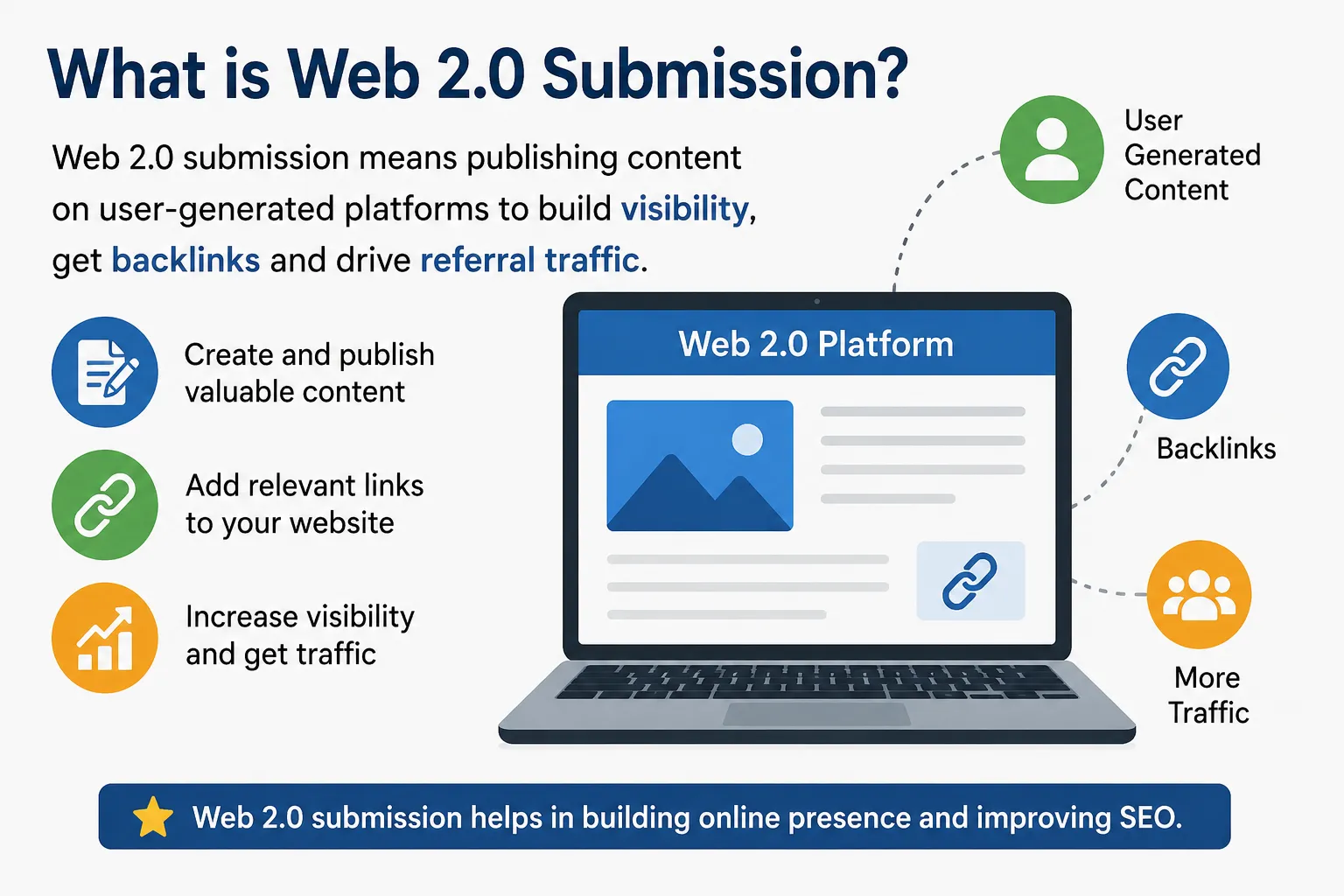
Web 2.0 submission is an off-page SEO technique in which you publish content on user-generated or content-sharing platforms that allow users to create pages, posts, blogs, or profiles. The published content can include a relevant link to your website, helping increase online visibility and create referral traffic. Common Web 2.0 platforms historically included blogging and publishing services where users could create their own content. When done properly, Web 2.0 can support a broader link-building and content distribution strategy, but simply creating many low-quality pages with links is not an effective modern SEO practice. The main focus should be on useful, original content, relevant platforms, and natural linking.
How Does Web 2.0 Submission Work?
Web 2.0 submission generally involves creating a profile or publishing account on a platform that permits user-generated content. You then create a useful article, blog post, guide, or informational page related to your website's topic.
A contextual link may be included when it genuinely helps readers find additional information. For example, a digital marketing website could publish an informative article about SEO strategies and naturally reference a detailed resource on its own website.
The process usually involves:
Selecting relevant and legitimate publishing platforms.
Creating a complete and trustworthy profile.
Publishing original, useful content.
Adding relevant links naturally within the content.
Maintaining and updating valuable pages when appropriate.
Monitoring referral traffic and overall SEO performance.
Web 2.0 Submission vs. Traditional Link Building
Aspect | Web 2.0 Submission | Traditional Link Building |
|---|---|---|
Content | User-created articles or pages | Links obtained from external websites |
Control | Usually high control over published content | Often depends on the publisher |
Main purpose | Content distribution, visibility, and supporting links | Authority, relevance, and referral traffic |
Quality requirement | Original and useful content is important | Quality and relevance of referring site are important |
SEO value | Can vary significantly by platform and link attributes | Depends on authority, relevance, editorial quality, and link type |
Benefits of Web 2.0 Submission
A well-planned Web 2.0 strategy can provide several potential benefits:
1. Additional Online Visibility
Publishing useful content on established platforms can help your brand appear in more places across the web.
2. Referral Traffic
If readers find the content useful, contextual links can generate visitors who are genuinely interested in your topic.
3. Content Distribution
Web 2.0 platforms can provide another channel for distributing educational articles, guides, and industry information.
4. Brand Presence
Maintaining relevant profiles and publishing valuable content can strengthen your brand's overall digital footprint.
5. Supporting Off-Page SEO
Web 2.0 content can be one component of a broader off-page SEO strategy, alongside digital PR, editorial backlinks, guest contributions, citations, and other legitimate methods.
Best Practices for Web 2.0 SEO
The biggest mistake is treating Web 2.0 submission as a way to generate hundreds of backlinks quickly. Search engines increasingly evaluate the quality, usefulness, relevance, and overall context of content.
For better results, create unique, reader-focused content instead of copying the same article across multiple platforms. Use links naturally and only where they provide additional value. Choose platforms that are relevant and reputable rather than publishing on every available website.
It is also important to avoid excessive exact-match anchor text, automated content, spun articles, link networks, and large-scale low-quality submissions. These approaches can make a backlink profile appear unnatural and provide little long-term SEO value.
Is Web 2.0 Submission Still Useful for SEO?
Web 2.0 submission should not be considered a primary SEO strategy by itself. Its value depends heavily on the quality and relevance of the platform, content, and link.
Modern SEO places greater emphasis on helpful content, topical authority, genuine backlinks, user experience, digital PR, and brand credibility. Therefore, Web 2.0 should be treated as a supporting activity rather than a shortcut to higher rankings.
For websites such as letsdiskuss.com, a stronger approach would be to combine useful content publishing with high-quality editorial links, relevant Q&A participation, digital PR, internal linking, and content designed for both traditional search and AI search systems.
Frequently Asked Questions
1. What is Web 2.0 submission in SEO?
Web 2.0 submission is an off-page SEO practice where users publish content on platforms that allow user-generated pages or posts and may include relevant links to their websites.
2. Is Web 2.0 submission good for backlinks?
It can contribute to a broader backlink and content-distribution strategy, but the value depends on the platform, content quality, relevance, and link characteristics. Low-quality mass submissions generally provide little SEO benefit.
3. How many Web 2.0 backlinks should I create?
There is no fixed number that guarantees SEO improvement. Quality and relevance are more important than creating a specific number of backlinks.
4. Is Web 2.0 submission considered white-hat SEO?
Publishing genuinely useful, original content and linking naturally can be a legitimate marketing practice. However, creating large numbers of low-quality pages primarily to manipulate rankings is not a sustainable SEO approach.
Also read : What is Web 2.O Backlinks?