The bicycle was not invented by one single person. Instead, it developed over many years through several inventions and improvements. However, one person is usually credited with creating the first practical ancestor of the modern bicycle: Karl von Drais, a German inventor.
Karl von Drais and the First Bicycle
In 1817, Karl von Drais introduced a two-wheeled machine called the “Laufmaschine,” meaning “running machine.” It was also known as the Draisine or Dandy Horse.
Drais's machine looked quite different from today's bicycle. It had two wheels arranged one behind the other, a seat, handlebars, and a frame, but it had no pedals. The rider sat on the seat and pushed against the ground with their feet to move forward.
This was an important breakthrough because the rider could steer the front wheel while balancing on two wheels. That basic arrangement—two wheels in a line—became fundamental to later bicycles.
Why Did Drais Invent It?
One reason was a shortage of horses in Europe following the 1815 eruption of Mount Tambora in Indonesia. The eruption caused major climate effects and contributed to poor harvests and food shortages in parts of Europe. Horses became more expensive to keep, so Drais looked for a way for people to travel without relying on a horse.
His invention offered a human-powered alternative for short-distance transportation.
From the Dandy Horse to the Bicycle
Drais's invention was only the beginning. Over the following decades, inventors experimented with ways to make two-wheeled machines faster and easier to use.
One major improvement was the addition of pedals. During the 1860s, French inventors and mechanics developed machines with pedals attached to the front wheel. These became known as velocipedes.
Pierre Michaux and his son Ernest Michaux are often associated with popularizing this type of pedal-driven bicycle in France. Because the pedals were connected directly to the front wheel, riders had to pedal the wheel itself.
These early bicycles were sometimes called “boneshakers” because their solid wheels and rigid frames made rides on rough roads extremely uncomfortable.
The High-Wheeler
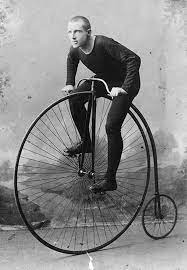
In the 1870s, bicycles developed another distinctive form: the high-wheeler, sometimes called the penny-farthing.
The front wheel became extremely large while the rear wheel remained much smaller. A larger front wheel allowed the bicycle to travel farther with each turn of the pedals, making it faster.
However, high-wheelers were difficult to mount and could be dangerous if the rider lost balance. They were eventually replaced by safer bicycle designs.
The Modern Bicycle
The bicycle began to look much more like today's bicycles during the 1880s. The important design was called the “safety bicycle.”
It had two similarly sized wheels, pedals connected to a chain, and a lower seat. The rider could sit between the wheels rather than high above a huge front wheel.
One particularly important inventor was John Kemp Starley, an English inventor and bicycle manufacturer. In 1885, he introduced the Rover Safety Bicycle, which became highly influential.
The Rover used many features that we recognize today:
Two wheels of similar size
A diamond-shaped frame
Pedals
A chain driving the rear wheel
A relatively low riding position
Steering through the front wheel
This design was much safer and more practical than the high-wheeler.
So, Who Gets the Credit?
It depends on what we mean by “invented the bicycle.”
Person | Contribution |
|---|---|
Karl von Drais | Created the two-wheeled, steerable precursor in 1817 |
Pierre and Ernest Michaux | Helped develop and popularize pedal-powered velocipedes |
Various 19th-century inventors | Improved wheels, frames, steering, and drive systems |
John Kemp Starley | Created the influential Rover safety bicycle in 1885 |
Therefore, Karl von Drais is generally credited with inventing the earliest bicycle-like machine, while the modern bicycle was the result of improvements made by many inventors.