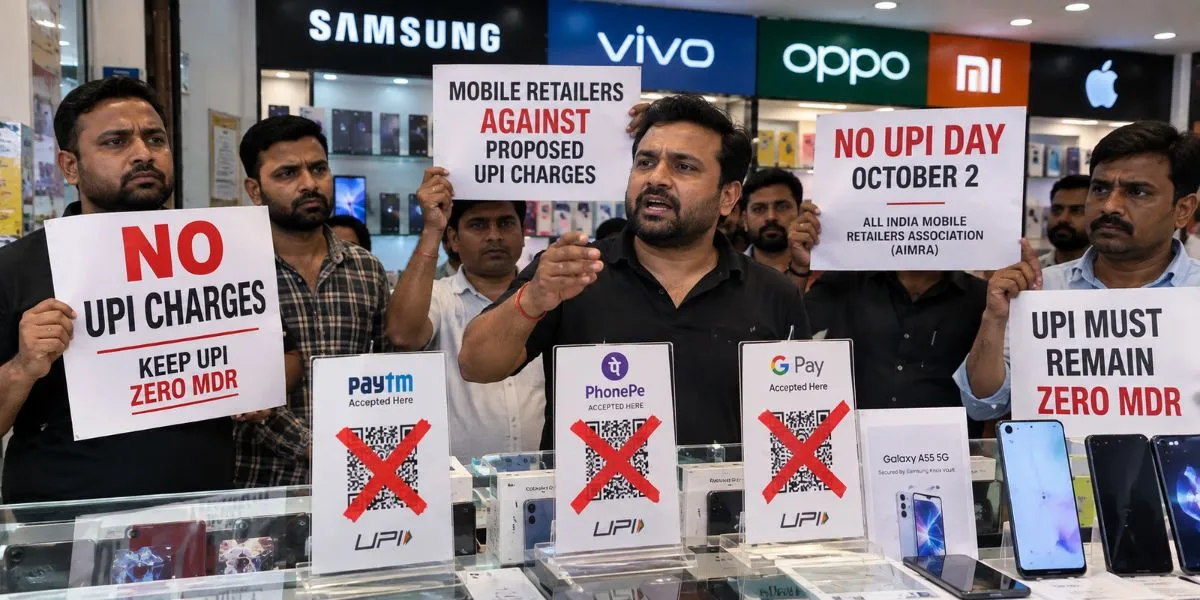
Mobile retailers in India are protesting against a proposed Merchant Discount Rate (MDR) on certain UPI payments because they say the charge could increase their payment costs, particularly on higher-value purchases such as smartphones. The protest is mainly about the potential effect of the new MDR on retailers' margins.
What Is the Proposed UPI Charge?
Under the new framework, a 0.4% MDR is scheduled to apply from October 15, 2026, to specified person-to-merchant (P2M) UPI transactions above ₹2,000. The framework includes exemptions and caps, and person-to-person payments are not covered by this MDR.
The Supreme Court on September 28, 2026, declined to stay the implementation while considering a legal challenge to the framework. The court has sought responses from the Centre and other parties.
Why Are Mobile Retailers Concerned?
1. Higher Transaction Costs
Mobile phones can cost well above ₹2,000. Retailers are concerned that a percentage-based MDR on eligible UPI payments could increase the cost of accepting digital payments.
2. Concern About Profit Margins
Industry representatives have argued that mobile retail can involve relatively tight margins. They therefore say that an additional payment-related cost could put further pressure on their earnings. These are concerns expressed by retailer groups and should not be treated as a universal measure of every retailer's margin.
3. Large Number of UPI Payments
UPI is widely used for retail transactions in India. Retailers argue that when a large number of eligible payments are processed, even a relatively small percentage-based charge can add up over time. Trade groups have therefore called for the continuation of the zero-MDR structure for merchant UPI payments.
4. Concern About the Impact on Digital Payments
Retailer groups have also expressed concern that additional merchant costs could affect how businesses accept digital payments, particularly for higher-value purchases.
What Are Mobile Retailers Doing?
The All India Mobile Retailers Association (AIMRA) has called for a “No UPI Day” on October 2, 2026. Participating retailers plan to temporarily stop accepting UPI payments as a way of protesting the proposed MDR.
Simple Example
Suppose a customer buys a smartphone for ₹50,000 and the transaction falls within the applicable 0.4% MDR category.
0.4% of ₹50,000 = ₹200
This is a simple calculation of the percentage. The actual MDR payable can depend on the applicable cap, exemptions, and the final framework. For example, current reporting says the MDR is capped at ₹300 for transactions of ₹75,000 or more.
What Does the Government Say?
The government has said that the MDR is a charge within the payment ecosystem rather than a direct consumer fee. It has also indicated that the framework includes exemptions and that the charge is not intended to be passed directly to customers.
Therefore, the main dispute is about how the cost of processing eligible UPI merchant payments will be handled, rather than a direct UPI charge being imposed on every customer.
Conclusion
Mobile retailers are protesting because they say the proposed UPI MDR could increase their payment expenses, especially when customers make higher-value purchases such as smartphones. Retailer groups are seeking continuation of the zero-MDR structure, while the government has defended the new framework as a charge within the payment ecosystem.
As of September 29, 2026, the framework is scheduled to take effect on October 15, while the legal challenge remains under consideration by the Supreme Court.