Quick Answer
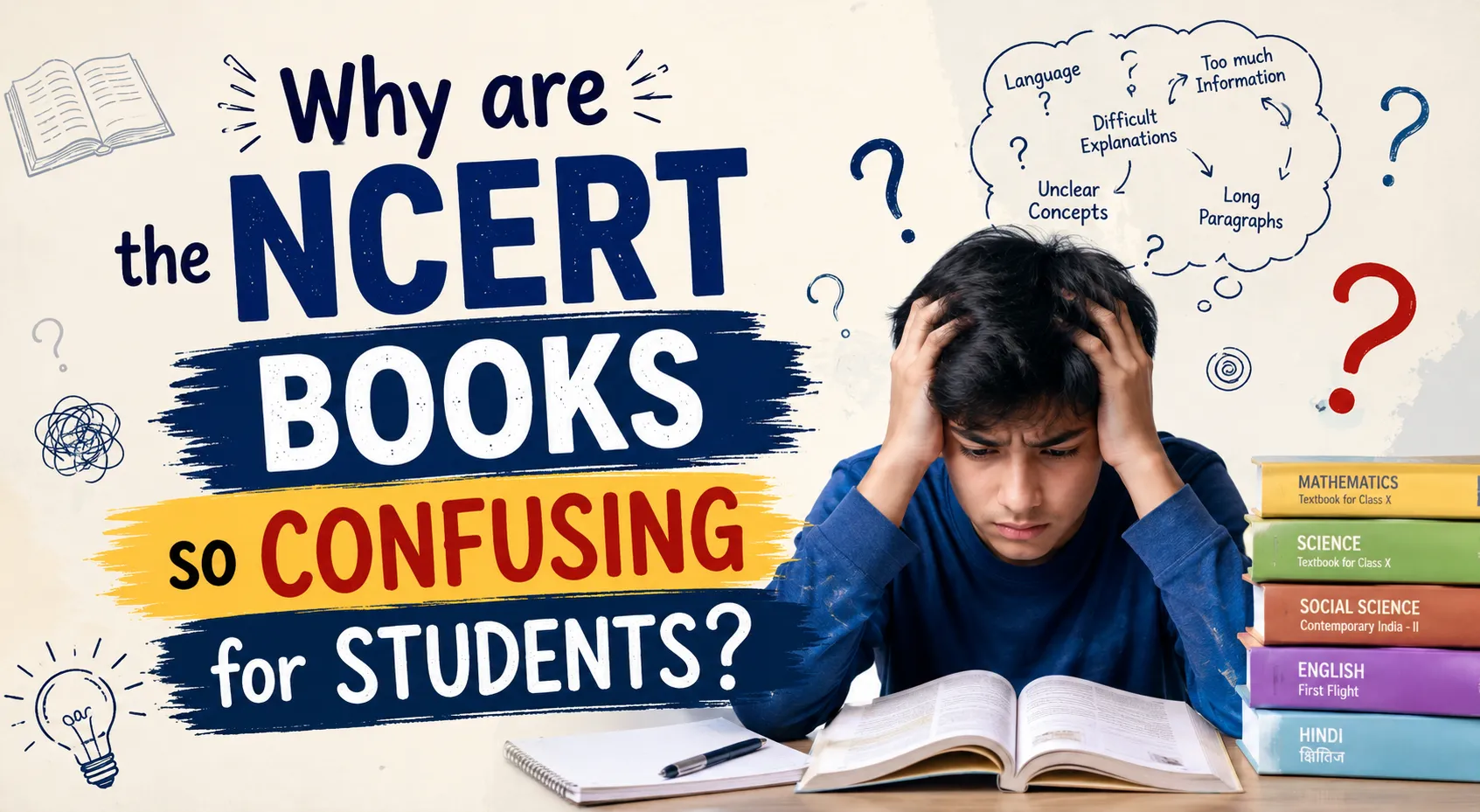
For generations, the National Council of Educational Research and Training (NCERT) textbooks have been the absolute foundation of the Indian education system. Whether you are a high schooler preparing for CBSE board exams or an aspirant tackling NEET, JEE, or UPSC, the standard advice is always the same: "Master the NCERTs." Yet, upon opening these seemingly thin books, a universal frustration arises, leading many to ask: Why are the NCERT books so confusing for students? The answer lies in their pedagogical design. NCERT books are not meant to be read as standalone self-study guides; they are designed as classroom accompaniments. They pack immense information into dense paragraphs, often skip intermediate mathematical steps, and use a narrative style that requires active decoding.
The "Classroom Accompaniment" Dilemma
To understand the complexity of these books, you must first understand their intended purpose. The NCERT editorial board designs these textbooks with the assumption that a qualified teacher will be present to facilitate the learning process.
When a student tries to read the textbook alone, they often hit a wall. In subjects like Physics and Mathematics, the authors frequently skip intermediate steps during derivations, assuming the teacher will fill in the blanks on the chalkboard. When a student studies independently without a mentor, this sudden leap from step A to step D creates massive confusion and a feeling of inadequacy.
Narrative Style vs. Structured Notes
Another major reason students struggle is the formatting of the content. Modern students are accustomed to "digest" or reference books that break concepts down into neat, bulleted lists and tabular comparisons.
NCERT books, particularly in subjects like History, Geography, and Biology, take a vastly different approach. They read like a narrative or a prose story. The books attempt to take the student on an intellectual journey, exploring the "why" and "how" behind concepts. Consequently, crucial facts, definitions, and exam-oriented points are often hidden deep within long, descriptive paragraphs. For a student trying to memorize facts quickly for an upcoming exam, this lack of organized structure feels chaotic and highly frustrating.
NCERT Subject Challenges at a Glance
To better understand how this complexity varies across different subjects, here is a breakdown of the common hurdles students face while reading NCERT textbooks:
Subject Area | Primary Cause of Confusion | How to Overcome It |
|---|---|---|
History & Civics | Dense paragraphs; reads like a story without bulleted timelines. | Create your own timeline notes and highlight key dates manually. |
Biology | Massive amounts of factual data hidden in continuous prose. | Extract definitions and create personal mind-maps for each chapter. |
Physics | Skips intermediate mathematical steps in complex derivations. | Use a reference book alongside NCERT to understand the missing math. |
Mathematics | Sudden jumps in exercise difficulty; limited practice questions. | Practice the "Miscellaneous" exercises thoroughly and seek external problem sets. |
Top Tips to Decode and Master NCERT Books
Understanding Why are the NCERT books so confusing for students? is only the first step. To truly conquer your exams, you must adapt your study strategy. Here are the most effective steps to extract value from these powerful textbooks:
Read Actively, Not Passively: Never read an NCERT book like a novel. Sit with a pencil and actively underline key terms, hidden facts, and definitions as you read through the dense paragraphs.
Create Your Own Notes: Because the books lack bullet points, it is your job to create them. After finishing a chapter, compress the narrative prose into structured, easy-to-revise bullet points.
Do Not Skip the Margins: NCERT books often hide incredibly important information, exceptions, and tricky concepts in the side margins, colored boxes, and the "Points to Ponder" sections.
Pair with Reference Books: Use NCERT to understand the core concept and the syllabus boundaries, but do not hesitate to use a supplementary reference book for step-by-step mathematical derivations or extra practice questions.
Frequently Asked Questions (FAQs)
Are NCERT books enough to score 90+ in board exams?
Yes, absolutely. The CBSE board strictly follows the NCERT syllabus, and board exam question papers are directly mapped to the concepts covered in these books. If you master every line, diagram, and exercise in the NCERT, scoring above 90% is highly achievable.
Why do toppers always recommend NCERT if it is so confusing?
Toppers recommend it because it is the official source of truth for national exams. While reference books are easier to read, they often contain extra, out-of-syllabus information that wastes time. Toppers know how to decode the NCERT and extract exactly what the examiners are looking for.
Should I stop using reference books entirely?
No. Reference books are fantastic tools for practice. The best strategy is to use NCERT as your primary textbook to learn the boundaries of the syllabus, and then use reference books to practice more numerical problems or view step-by-step explanations that NCERT skips.
Conclusion
Whenever a frustrated learner throws their hands up and asks, "Why are the NCERT books so confusing for students?", the key takeaway is that these books demand active participation. They are not spoon-feeding you the answers; they are challenging you to think critically, connect the dots, and build your own structured understanding of the world. By changing your approach—reading actively, making your own notes, and using the textbook as a classroom guide rather than a cheat sheet—you can unlock the immense value hidden within its pages and build an unbreakable academic foundation for your future.
Sources & References: CBSE
Also Read: Is NCERT Books are enough for class 12 board exam?