Quick Answer
The business world has undergone a massive digital transformation, permanently shifting how brands connect with consumers. If you are standing at a professional crossroads, you might find yourself asking: Why Choose A Career In Digital Advertising? The answer lies in the industry's explosive growth, dynamic work environment, and the sheer volume of opportunities it presents. Unlike traditional marketing, digital advertising perfectly blends creative storytelling with hard, analytical data. For ambitious professionals navigating major corporate and tech hubs like Gurugram and Noida, the industry offers a fast-tracked trajectory from executive-level execution to senior strategic management across diverse sectors, including technology, e-commerce, and logistics.
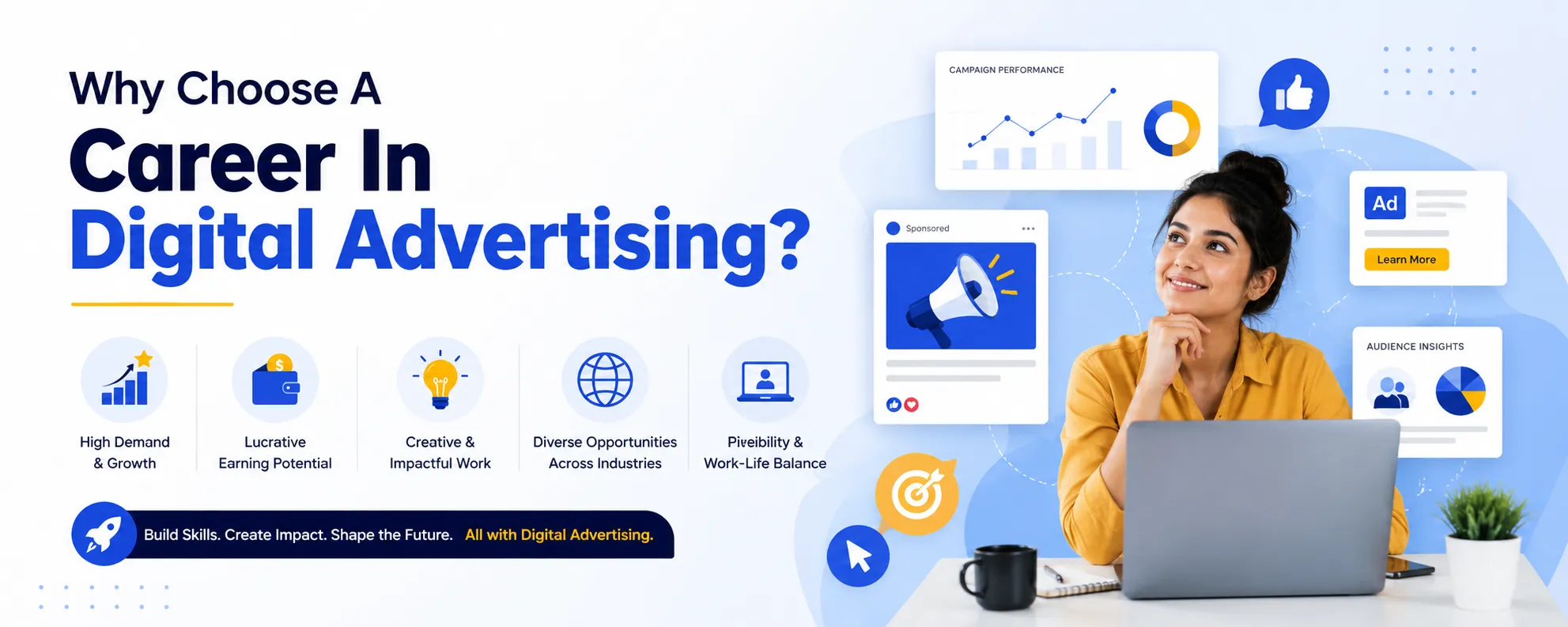
The Perfect Blend of Creativity and Data
Historically, advertising was an industry dominated entirely by creative directors and copywriters trying to guess what the audience wanted. Today, the landscape is radically different. Digital advertising removes the guesswork. It empowers professionals to launch a campaign, track its performance in real-time, and pivot strategies based on hard data.
When you work in this field, you get to flex both sides of your brain. One day you might be brainstorming a highly creative, viral social media campaign, and the next day you are analyzing click-through rates, optimizing cost-per-acquisition (CPA), and tweaking the backend targeting of a Google Ads account. This dual nature ensures that the work never becomes monotonous.
Career Trajectories at a Glance
The digital advertising ecosystem is vast, meaning you are never boxed into a single type of job. Whether you are a generalist overseeing overall brand health or a specialist driving immediate sales, there is a distinct path for you. Here is a breakdown of common roles and how they function:
Career Role | Primary Focus Area | Essential Skills Required |
|---|---|---|
Digital Marketing Executive | Day-to-day campaign execution, social media management, and basic reporting. | SEO, social media algorithms, basic analytics, adaptability. |
Performance Marketer | ROI-driven paid advertising (PPC) and maximizing lead generation budgets. | Google Ads, Meta Ads, A/B testing, deep data analysis. |
Content Strategist | Crafting the brand narrative and driving long-term organic reach. | Copywriting, video marketing strategy, consumer psychology. |
SEO Specialist | Ensuring the brand ranks highly on search engines for intent-driven keywords. | Keyword research, technical website audits, link building. |
Top Benefits of Entering the Industry
Understanding Why Choose A Career In Digital Advertising? requires looking beyond just the daily tasks. Here are the core professional and lifestyle benefits that make this field so incredibly attractive to modern talent:
Massive Industry Demand: Every modern business—from local brick-and-mortar shops to massive global logistics firms—requires an online presence to survive. This universal need creates incredible job security and high demand for skilled talent.
Rapid Career Mobility: The skills you learn in digital advertising are highly transferable. You can easily jump from an agency role into an in-house corporate position, or transition seamlessly between industries like software tech, retail, and supply chain logistics.
Constant Skill Evolution: The digital landscape changes daily. With constant updates to search algorithms and the introduction of artificial intelligence platforms, you are forced to continuously learn, ensuring your skills never become obsolete.
Measurable Impact: Unlike traditional billboards or print ads, digital advertising allows you to see the exact revenue your campaigns generate. This makes it incredibly easy to prove your value to employers and negotiate higher salaries or promotions.
Frequently Asked Questions (FAQs)
Do I need a specialized technical degree to succeed in this field?
No. While degrees in marketing, communications, or business are helpful, they are rarely mandatory. The industry values proven skills and certifications (like Google Analytics or Meta Blueprint) over traditional degrees. A strong portfolio demonstrating successful campaign execution will often outweigh formal education.
Will Artificial Intelligence (AI) replace digital advertising jobs?
AI is rapidly transforming the industry, but it acts as a tool rather than a replacement. AI tools like ChatGPT, Claude, and Gemini are incredible for drafting initial copy, analyzing massive datasets, and automating bids. However, the industry still fundamentally requires human strategy, emotional intelligence, and creative direction to connect with real consumers.
How do I advance from an executive role to a managerial position?
Advancement requires shifting your focus from daily task execution to high-level strategy and ROI. Executives who proactively seek out data analysis, take ownership of campaign budgets, and consistently prove how their digital efforts directly impact the company's bottom-line revenue are the ones who quickly move into strategic leadership roles.
Conclusion
Whenever a young professional or a recent graduate asks, "Why Choose A Career In Digital Advertising?", the answer ultimately boils down to relevance and growth. We are living in a digital-first economy. By choosing this career path, you are positioning yourself at the absolute forefront of modern business. It is a demanding, fast-paced career that requires constant adaptation, but for those willing to embrace the pace, it offers unparalleled creative satisfaction, immense upward mobility, and the opportunity to tangibly drive the success of the brands you work for.
Sources & References: HubSpot Academy