
Quick Answer
Have you ever watched a nature documentary and witnessed the lightning-fast standoff between a small furry mammal and a deadly cobra? The rivalry between these two animals is one of the most famous conflicts in nature. But exactly why mongoose and snakes are enemys?
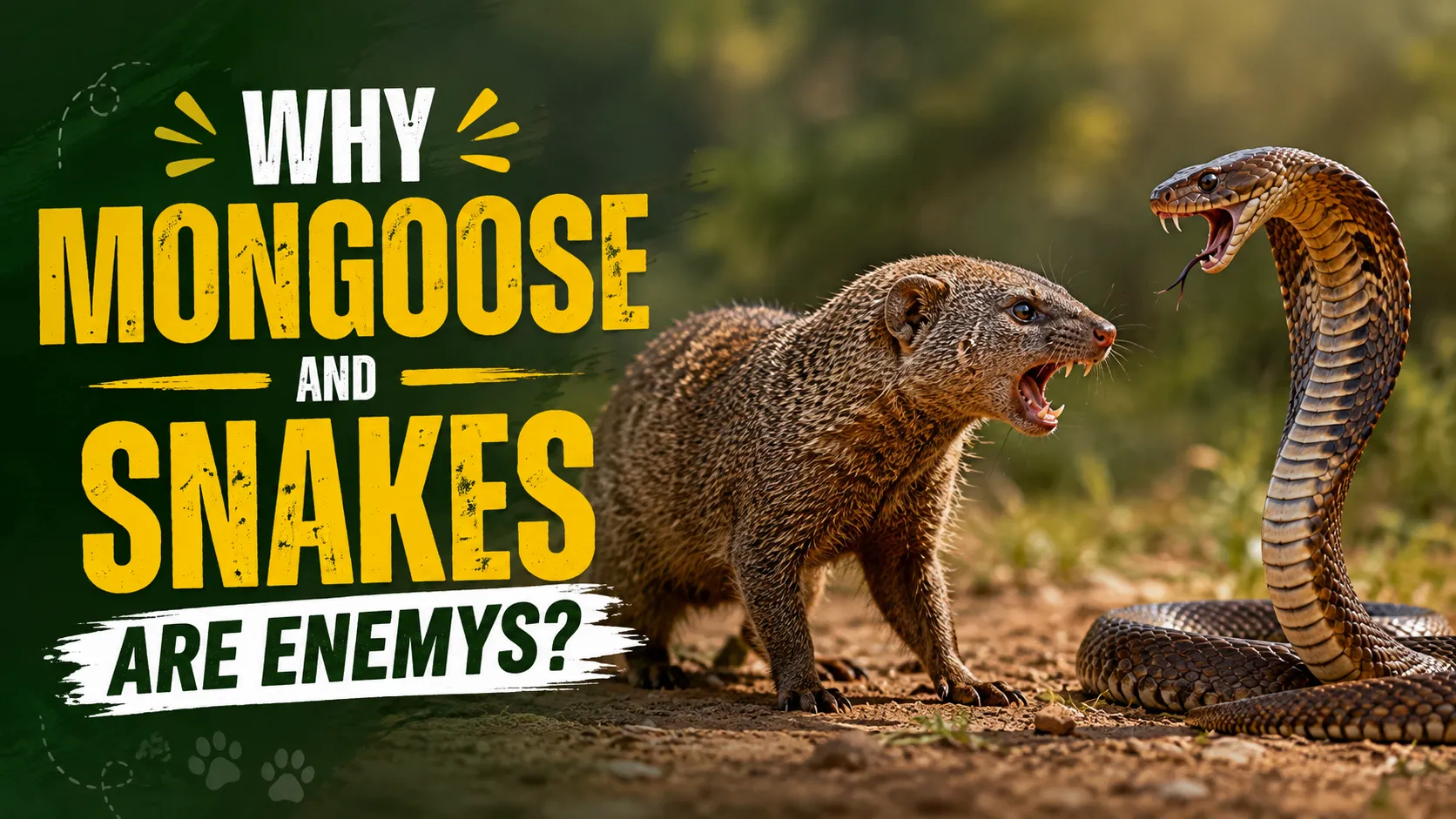
In the diverse forests and savannas of Africa and Asia, survival is a constant battle. For the mongoose, highly venomous snakes are not just a threat; they are a regular item on the dinner menu. This dynamic is not born out of sheer malice, but rather millions of years of a biological arms race.
In this guide, you will learn:
The exact biological mutation that allows the mongoose to survive venom.
The tactical strategies they use to win against deadly reptiles.
Why this rivalry is deeply tied to their dietary needs.
Mongoose vs. Snake at a Glance
Feature | The Mongoose | The Venomous Snake (e.g., Cobra) |
|---|---|---|
Primary Weapon | Agility, sharp teeth, crushing jaw strength | Venom-injecting fangs, striking speed |
Defensive Trait | Venom resistance (mutated receptors), thick fur | Intimidation (hooding, hissing), camouflage |
Combat Strategy | Evasion and exhaustion (rope-a-dope) | Ambush and immediate chemical immobilization |
Role in the Fight | Usually the predator / aggressor | Usually on the defensive |
Habitat | Dense forests, scrublands, savannas | Almost all terrestrial habitats |
The Biological Armor: Why Venom Fails
The primary reason behind the success of the mongoose in this rivalry comes down to a miraculous quirk of evolution.
Normally, when a venomous snake like a cobra strikes its victim, the neurotoxic venom binds to the victim's acetylcholine receptors in their muscle cells. This blocks vital nerve signals, causing rapid paralysis, respiratory failure, and death.
However, the mongoose has evolved specialized, mutated acetylcholine receptors. Their cell receptors are shaped slightly differently than those of most other animals. Because of this structural change, the snake's venom molecules literally bounce off the receptors without binding. While a mongoose is not entirely immune to massive doses of venom, it is highly resistant. A bite that would easily kill a human or a large dog will often just cause a mongoose to feel temporarily drowsy, allowing it to recover and survive.
Speed, Agility, and a Thick Coat
Beyond their incredible chemical resistance, a mongoose relies heavily on its physical attributes to survive and hunt in dense forests and grasslands.
When dealing with a lethal predator, defense is just as important as offense. Mongooses possess a dense, stiff coat of hair. When threatened by a snake, the mongoose will puff up this coat—a biological reaction known as piloerection. This makes the mongoose look much larger and provides a thick layer of armor that the relatively short fangs of a cobra struggle to pierce. Combined with reaction times that can outpace the strike of a snake, the mongoose is a formidable opponent.
How the Mongoose Wins the Fight
When a mongoose encounters a venomous snake, the battle is rarely a chaotic brawl. It usually follows a highly calculated sequence:
1.The Provocation:Measuring the opponent.
The mongoose dances around the snake, deliberately provoking it to strike in order to measure its reach and speed.
2.The Evasion:Lightning-fast reflexes.
As the snake lunges, the mongoose leaps backward or sideways, relying on its superior reflexes to dodge the fangs entirely.
3.The Exhaustion:The rope-a-dope strategy.
This evasive dance continues for several minutes. Snakes are ambush predators, not endurance fighters, and they quickly become exhausted by missing multiple strikes.
4.The Fatal Strike:The final blow.
Once the snake is visibly tired and its strikes become sluggish, the mongoose darts in and delivers a crushing bite to the back of the snake's skull, ending the fight instantly.
Frequently Asked Questions (FAQs)
Are all mongoose species immune to snake venom?
Not all species possess the exact same level of immunity. However, most species of mongoose that share their natural habitats with venomous snakes possess a high degree of neurotoxic resistance that protects them during a hunt.
Can a snake ever win a fight against a mongoose?
Yes. While the mongoose wins the vast majority of encounters, a snake can occasionally win. If a snake manages to wrap around the mongoose and constrict it, or if a very large venomous snake lands a direct, deep bite injecting a massive amount of venom into a vulnerable area like the face, the mongoose can succumb.
Do mongooses eat the venom glands of the snake?
Yes. Because venom is a protein-based substance, it is completely harmless when ingested and broken down by stomach acids. The mongoose will often eat the entire snake, including the venom glands, without any ill effects.
Conclusion
So, the next time someone asks, "Why mongoose and snakes are enemys?", you will know that the answer lies in a masterpiece of evolutionary engineering. The mongoose has developed the perfect combination of agility, thick armor, and chemical venom resistance to turn one of the world's most feared predators into a standard meal. Their encounters remain one of the most spectacular displays of survival and adaptation in the world's forests and grasslands, showcasing the endless, fascinating complexities of wildlife.
Sources & References
Also Read: