
In the Hindu scriptures, there is not only one but many stories about how Lord Vishnu got the Sudarshana Chakra. Different stories are found in different Puranas and traditions. Two of the most popular versions are that Lord Shiva gifted the Sudarshana Chakra to Lord Vishnu after being pleased with his devotion and that the divine architect Vishwakarma created the Chakra from a portion of Surya’s radiance. Both stories are respected in their respective traditions. They bring out different spiritual teachings; they are not contradictory.
When I was growing up, I remember my grandparents telling me the story where Lord Vishnu worshipped Lord Shiva with a thousand lotus flowers. It was the first version I heard, and it taught me that true devotion, humility, and sacrifice are valued even among the gods themselves.
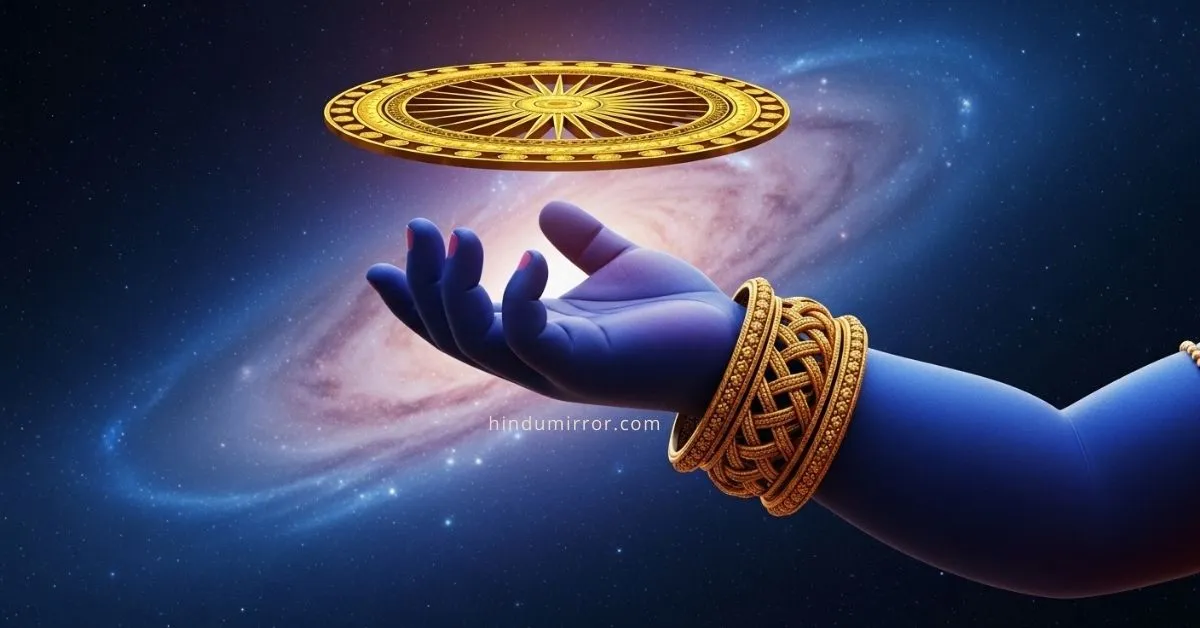
Popular Legend
The most popular legend is in the Shiva Purana.
This narrative is about powerful demons that were upsetting the gods and disturbing the cosmic order. Lord Vishnu decided to worship Lord Shiva with a thousand lotus flowers and recite the thousand names of Shiva.
Lord Shiva took away single lotus flowers one by one to test the devotion of Vishnu. Vishnu noticed that one blossom was missing, and he remembered that he was often nicknamed “Kamal Nayan” (the lotus-eyed one). He promptly volunteered one of his own eyes to take the place of the missing lotus.
Lord Shiva was extremely pleased with this devotion of Vishnu and appeared before him and gave him the divine Sudarshana Chakra. Vishnu later used this divine weapon to protect righteousness and defeat evil.
Other Scriptural Versions
Another well-known tradition is mentioned in the Vishnu Purana.
In this version, the divine architect Vishwakarma cut down the intense brilliance of Surya. From that holy energy, he fashioned various heavenly weapons, including the Sudarshana Chakra, which became the divine weapon of Lord Vishnu.
Hindu scriptures were written at different times, in different traditions, and therefore, it is common to have multiple narratives for the same divine object or event. Rather than picking one as the true story, many scholars interpret these myths as representing distinct theological and symbolic perspectives.
Implications
Sudarshana Chakra: Much More Than A Powerful Weapon.
The name signifies ‘auspicious vision’ or ‘right perception’. It represents:
Justice divine
Protection of dharma
Order for all
Wisdom and clarity
Destruction of evil and ignorance
Spiritually, the Chakra is a reminder to the devotees that it is the divine power which is constantly guided by righteousness and not by anger or personal gain.
Mythological Role
Sudarshana Chakra is the primary weapon of Lord Vishnu and is witnessed throughout Hindu mythology.
It is used to eliminate powerful demons, restore cosmic balance and safeguard adherents. In various tales of the Mahabharata and Bhagavata traditions, Lord Krishna, considered an incarnation of Vishnu, also uses the Sudarshana Chakra.
The Sudarshana Chakra, unlike ordinary weapons, is said to return to Lord Vishnu after its duty is accomplished, symbolizing divine control and perfect justice.
Symbolic Meaning
The spiritual significance of the Sudarshana Chakra is manifold.
It’s round to reflect the never-ending cycle of time and the universe. The constant turning is a reminder for followers that time is never-ending and that righteousness always wins over evil.
I personally feel this to be the most meaningful component. Whether you go by the Shiva Purana account or the Vishnu Purana version, both stress that divine might is linked with wisdom, responsibility, and altruistic purpose, not merely physical strength.
Frequently Asked Questions
1. Who presented Sudarshana Chakra to Lord Vishnu?
According to the Shiva Purana, Lord Shiva, pleased with Lord Vishnu's devotion, gave him the Sudarshana Chakra.
2. Who was the maker of Sudarshana Chakra?
According to the Vishnu Purana, it was born of a part of Surya’s brightness, generated by Vishwakarma.
3. What is the meaning of Sudarshan Chakra?
It is a sign of divine protection, justice, cosmic order, wisdom and victory of dharma over evil.
Must Read: How did Lord Yama become the king of hell?
 Answered by