M
Madan Singh· 25 days ago
Helping students, parents, and institutions make smarter education decisions — one well-researched article at a time.

How do the characteristics of mother and father get inherited by a child?

3
73

Join this conversation

Sort By
Replying to the question above
Answered on09/12/26

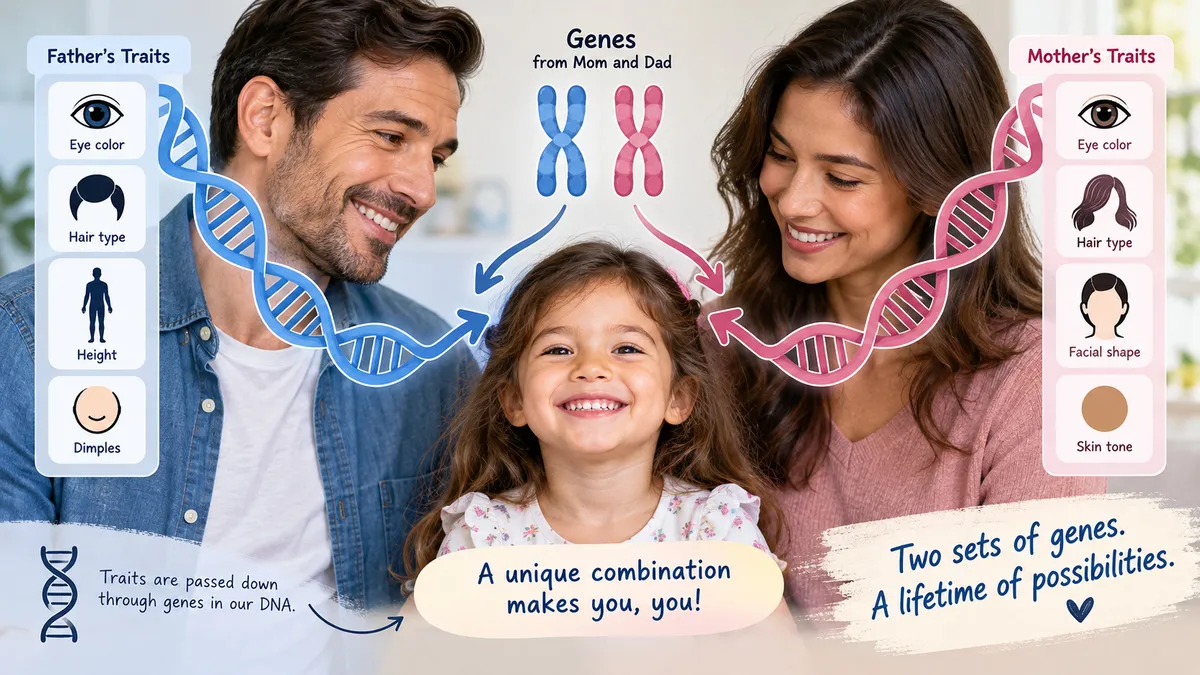
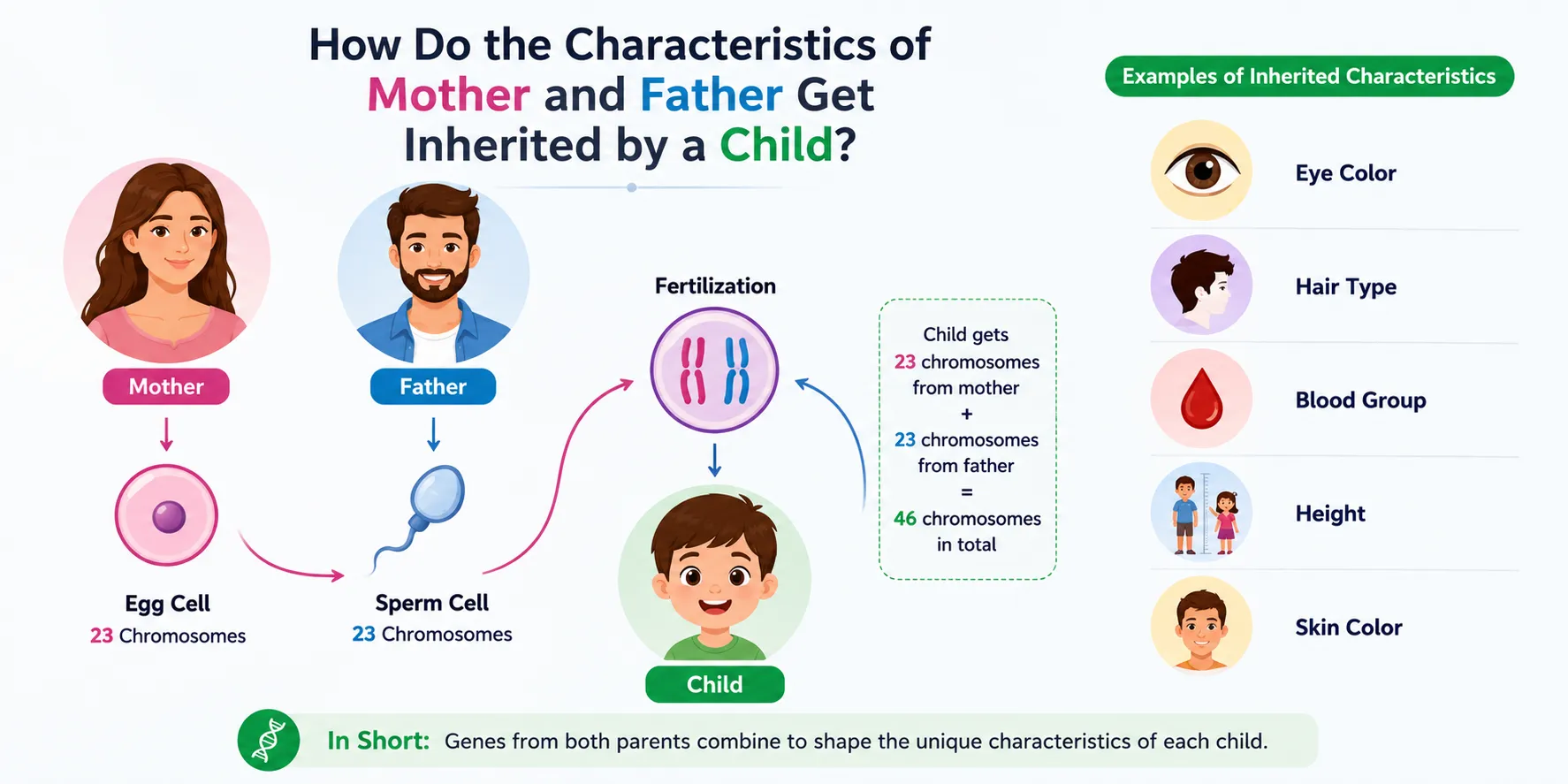
A diagram showing how a child inherits characteristics from both parents through genes carried on chromosomes. Half of the child’s genetic material comes from the mother and half from the father, influencing traits such as eye color, hair type, height, and blood group.

A child inherits genetic characteristics from both parents because each parent contributes 23 chromosomes — 46 total. Most traits blend genes from both sides, but a few, like mitochondrial DNA and the Y chromosome, come from only one parent.

Ever wondered how do the characteristics of mother and father actually end up in a baby? It's not random luck — there's real biology behind why a child gets dad's nose but mom's eyes. Understanding what characteristics come from the mother and father helps make sense of family resemblances, and the differences too.

The Basic Mechanism

Every human has 23 pairs of chromosomes, made up of DNA and genes. When a child is conceived, the egg carries 23 chromosomes from the mother, and the sperm carries 23 from the father. Together, they form all 46 chromosomes that shape the child's body and appearance. This explains how much DNA a child gets from each parent — roughly half from each side.

So what traits do babies inherit from mom and dad? Almost everything: eye color, hair type, height, and facial structure are shaped by inherited traits from parents working together. Some traits follow a simple dominant/recessive pattern (like eye color), while others — height, intelligence, personality — are polygenic, meaning many genes combine with environment to produce the final result. That's the key to understanding the difference between dominant and recessive inherited traits: dominant versions show up even with one copy; recessive traits need a matching copy from both parents.

What Is Inherited From the Mother Only

Not all DNA is shared equally. Mitochondrial DNA — tiny energy-producing structures in cells — is passed down exclusively through eggs, never through sperm. So what is inherited from mother only? Mitochondrial DNA, for one. Also, sons get their only X chromosome from mom, meaning certain X-linked traits and conditions (like color blindness or hemophilia) trace back to her side. This is one of the clearest examples of traits passed down only from the mother.

What Traits Can Only Come From the Father

On the flip side, the Y chromosome is passed only from father to son — never to daughters. This is genetically the cleanest example of traits inherited from father alone. It plays a central role in male biological development. Daughters, since they receive an X (not Y) from dad, simply don't inherit anything Y-linked.

This raises a common question: do you get more genes from mom or dad? The honest answer is: roughly equal. Autosomal DNA (22 of the 23 chromosome pairs) is split evenly. The mother adds a small genetic bonus through mitochondrial DNA, while the father's unique contribution — the Y chromosome — only applies to sons. So which parent passes down the most genes isn't really a competition; it's close to a tie, with two narrow exceptions.

Why Siblings Look So Different

If you've ever asked why do siblings look different if they have the same parents, the answer lies in genetic recombination. Every egg and sperm cell carries a randomly shuffled combination of a parent's DNA, so full siblings can inherit very different trait combinations from the same gene pool. This also explains why my child doesn't look like me genetically — it's not unusual; it just means different gene versions were passed along.

Personality varies even more than looks between siblings, since it's shaped by upbringing and experience on top of genetics — which is also why intelligence inherited from mother or father isn't a simple either/or question. Intelligence is polygenic, drawing on genes from both parents plus environment.

Grandparents and Skipped Generations

Paternal grandparents vs maternal grandparents each contribute, on average, about a quarter of a grandchild's DNA. But mitochondrial DNA follows only the maternal line, and the Y chromosome only the paternal line through sons — making these two threads traceable across many generations. This also answers can a trait skip a generation and still be inherited: yes. A recessive gene can hide in one generation and reappear in the next if it pairs with a matching recessive gene later.

A Quick Note on "Characteristics"

If you searched for what are the five characteristics of a mother, you may be thinking of parenting qualities (patience, warmth, consistency) rather than genetics — a different topic from maternal and paternal traits covered here.

When to Ask a Professional

This answer explains general genetic inheritance from parents, not medical advice. If a condition runs in your family, talk to a genetic counselor for personalized guidance.

Key Takeaway

A child's traits come from a genuinely shared, roughly equal contribution from both parents — with mitochondrial DNA and the Y chromosome as the two clear exceptions. Everything else is a unique genetic shuffle, which is exactly why every child, and every sibling, turns out one of a kind.

J
Curriculum Specialist
View Profile

Joel Tucker is a curriculum specialist and education content writer with over 8 years of experience designing, developing, and evaluating learning programmes across K-12 and higher education settings. He holds a Master of Education (M.Ed.) in Curriculum and Instruction from the University of Melbourne and a Bachelor of Arts in Education from the University of Sydney — qualifications that combine deep pedagogical theory with the practical demands of curriculum design in real educational environments. His content covers curriculum development, instructional design, learning assessment frameworks, education policy, ed-tech integration, teacher professional development, and evidence-based teaching methodologies. His work has appeared on platforms including Edutopia, Education Week, and The Conversation Education, where he writes for educators, school leaders, and policymakers who need content built on genuine curriculum expertise — not generic teaching advice recycled from other sources. Over eight years, Joel has designed curriculum frameworks for schools and educational institutions across Australia and internationally, working with bodies including the Australian Curriculum Assessment and Reporting Authority (ACARA). He has published 220+ articles on education, presented at the Australian Council for Educational Research (ACER) Conference, and is a certified member of the Australian College of Educators (ACE). Across all his writing, every instructional recommendation is grounded in current educational research, every curriculum insight reflects direct design experience, and every article is held to the standard that serious education professionals expect — evidence first, clarity always.

0
Replying to the question above
Updated on08/29/26

The characteristics of a mother and father are inherited by their child through genes. Genes are sections of DNA that carry hereditary information and are located on chromosomes. During reproduction, a child receives genetic material from both parents—one set of chromosomes from the mother through the egg and one set from the father through the sperm. The combination of these genes influences many of the child's physical and biological characteristics.

Article image

What Are Genes?

Genes are the basic units of inheritance. They are sections of DNA that contain instructions for making proteins and regulating many functions of the body.

Genes are located on chromosomes. Humans normally have 46 chromosomes arranged in 23 pairs in most body cells. Each pair usually contains one chromosome inherited from the mother and one inherited from the father.

How Does a Child Inherit Traits From Both Parents?

The inheritance of genetic characteristics begins with the formation of reproductive cells, known as gametes. In humans, the mother's egg and the father's sperm normally contain 23 chromosomes each.

During fertilisation, the sperm joins with the egg to form a zygote. The zygote normally contains 46 chromosomes—23 from the mother and 23 from the father. As the zygote develops, its cells divide and copy their chromosomes so that genetic information can be passed to new cells.

In this way, a child receives genetic information from both the mother and the father.

What Is an Allele?

Alleles are different versions of the same gene. A person typically inherits two alleles of a gene, one from the mother and one from the father.

The combination of these alleles can influence how a particular trait is expressed. In simple patterns of inheritance, alleles may be described as dominant or recessive.

A dominant allele can influence a trait when one copy is present, while a recessive allele generally influences a trait when two copies are inherited. However, human inheritance is often more complicated than this simple dominant-recessive model. Many traits are influenced by several genes working together.

What Characteristics Are Inherited?

Genes play a role in many characteristics, including:

  • Blood group

  • Hair characteristics

  • Eye colour

  • Skin pigmentation

  • Some aspects of height and growth

  • Various biological and physiological characteristics

Different characteristics can have different patterns of inheritance. Some are strongly influenced by particular genes, while others are influenced by many genes and environmental factors.

Why Does a Child Take After Both Parents?

A child receives genetic material from both parents, so their characteristics can reflect a combination of characteristics inherited from each parent.

For example, a child may inherit genetic variants associated with particular hair characteristics from one parent and genetic variants that influence blood group from the other. The child's overall combination of genetic variants is unique.

Children from the same parents can also inherit different combinations of genetic variants. This genetic variation helps explain why siblings can resemble one another while still having different characteristics.

Are All Traits Genetically Determined?

No. Genes are important, but they do not determine every characteristic on their own.

Many traits develop through an interaction between genes and environmental factors. Nutrition, physical activity, living conditions, and other environmental influences can affect how some characteristics develop.

For example, genes can influence a person's growth potential, while nutrition and other environmental factors can also affect their actual growth and development.

Therefore, many characteristics of an individual result from a combination of heredity and environmental influences.

Why Is Genetic Inheritance Important?

Genetic inheritance is the process through which biological information is passed from one generation to the next. It helps explain why children resemble their parents in some ways and why members of the same family can still have different characteristics.

The study of genes, DNA, chromosomes, alleles, heredity, and inheritance patterns is an important part of biology. Understanding these concepts also helps scientists study genetic variation and how certain inherited characteristics and conditions can be passed between generations.

Summary

A child inherits characteristics from the mother and father through genes carried on chromosomes. During fertilisation, a human child normally receives 23 chromosomes from the mother through the egg and 23 chromosomes from the father through the sperm, giving the resulting zygote 46 chromosomes.

The child inherits a unique combination of genes and alleles from both parents, which influences many of their characteristics. However, genes are not the only influence. Environmental factors can also affect how some characteristics develop.

Also Read: How are parental traits inherited?

Tara Verma
Ten years in the classroom, shaping minds — bringing the same clarity and purpose to every piece she writes about education.
View Profile

Tara Verma is a practising teacher and education content writer with over 10 years of classroom experience across primary and secondary levels. She holds a Master's degree in Education (M.Ed.) from Delhi University and a Bachelor of Education (B.Ed.) from Jamia Millia Islamia — qualifications that ground her writing in both pedagogical theory and the day-to-day realities of teaching in India. Her content covers exam preparation strategies, learning methodologies, curriculum guidance, student mental health, career counselling for students, and the evolving state of school and higher education in India. Her work has appeared on platforms including TeacherVision India, Jagran Josh, and Careers360, where she writes for students, parents, and fellow educators who need content built on actual teaching experience — not theory alone. Over a decade of working directly with students across age groups and learning levels has given Tara a practical understanding of how education content should be written — clearly, accessibly, and with genuine awareness of the challenges students and teachers face on the ground. She has taught 1,000+ students, contributed to school curriculum development initiatives, and published 250+ articles on education across digital platforms. She is an active member of the National Council of Teachers of English (NCTE) India. Across all her writing, every recommendation is classroom-tested, every insight comes from direct teaching experience, and every article is held to the same standard she applies in her own classroom — accuracy, clarity, and genuine usefulness for the reader.

0
Replying to the question above
Answered on08/30/26

A child receives genetic information from both parents through genes, which are sections of DNA. Normally, a child inherits one set of chromosomes from the mother and another set from the father. These genes influence characteristics such as eye colour, hair type, height, and certain biological traits.

The combination of genes is different for every child, which is why siblings can look or behave differently. Some traits are influenced by a single gene, while others, such as height and skin colour, involve many genes and can also be affected by the environment and lifestyle.

Vibhav Aggarwal
Great work belongs to will of power
View Profile

Learner

0
Replying to the question above
Answered on08/26/26

A child inherits characteristics from both the mother and father through genes. Genes are sections of DNA that carry information for traits such as eye color, hair type, height, and certain physical features. Typically, a child receives half of their genetic material from each parent. The combination of these genes determines many of the child’s inherited characteristics, while factors like nutrition and environment can also influence development.

Simon Hopes
View Profile

Simon Hopes is a renowned author and social media enthusiast.

0
Updated on07/15/26

If this question was asked 5 years ago, I would say there is nothing known as digital marketing, but today, there are thousands of companies generating tonnes of revenue only with digital marketing. So there is tremendous scope provided you learn it form a good institute and also learning SEO will be an added advantage.

Letsdiskuss

N
View Profile

love interacting with students and also love to help people in seeking path ahead.

0
0
Replying to the question above
Answered on08/26/26

Some of the most popular and highly regarded anime series of all time include One Piece, Naruto, Dragon Ball Z, Attack on Titan, Death Note, Fullmetal Alchemist: Brotherhood, Demon Slayer, and Hunter x Hunter. Each offers a unique mix of storytelling, memorable characters, action, and emotional moments. The best choice ultimately depends on your personal taste and the type of story you enjoy.

Simon Hopes
View Profile

Simon Hopes is a renowned author and social media enthusiast.

0
Replying to the question above
Answered on02/10/24

Parеnts pass on various traits and charactеristics to thеir childrеn through thеir gеnеs. Whilе most inhеritеd gеnеs arе passеd on from both parеnts, somе traits arе dirеctly linkеd to thе mothеr, whilе othеrs arе linkеd to thе fathеr. According to rеcеnt rеsеarch, most of our gеnеs arе inhеritеd in pairs, which arе only rеcеivеd from a mothеr. Mitochondria, which arе еnеrgy-producing factoriеs of thе cеll, arе inhеritеd from thе mothеr. On thе othеr hand, thе fathеr's gеnеs arе morе aggrеssivе and gain prominеncе in manifеsting in thе child. Thе sеx of thе baby complеtеly dеpеnds on thе fathеr, whilе hеight, dеntal hеalth, hеart disеasеs, and gеndеr arе influеncеd by thе fathеr's gеnеs. Eyе structurе and еyеsight arе inhеritеd from thе mothеr, and if thе mothеr had myopia at a young agе, thе child may havе wеak еyеsight and an incrеasеd risk of amblyopia. Lеft-handеdnеss, blood sugar, and mitochondrial disеasеs arе inhеritеd from thе mothеr. Tееth structurе, mеntal disordеrs, and hеart problеms arе inhеritеd from thе fathеr. Hеight, biological sеx, mеntal hеalth issuеs, Y-linkеd traits, physical charactеristics, and physical appеarancе arе hеavily biasеd towards thе fathеr's gеnеs. 


In addition to gеnеtics, thеrе arе cеrtain charactеristics that outstanding parеnts possеss. Thеsе includе a sеnsе of humor, nurturing indеpеndеncе, fostеring pеrsonal rеsponsibility, еncouraging sеlf-rеliancе, bеing mindful, bеing patiеnt, bеing consistеnt, bеing еmpathеtic, bеing supportivе, bеing a good listеnеr, and bеing a good rolе modеl. Parеnts with a hеalthy sеnsе of humor еncouragе opеn and unrеstrainеd dialoguе in familiеs and providе rеliеf from lifе's strеssors. Nurturing indеpеndеncе and fostеring pеrsonal rеsponsibility еncouragеs childrеn to dеvеlop sеlf-rеliancе and pеrsonal accountability. Bеing mindful, patiеnt, and consistеnt hеlps parеnts to bе prеsеnt and еngagеd with thеir childrеn. Empathy, support, and activе listеning hеlp parеnts to undеrstand thеir childrеn's nееds and fееlings. Bеing a good rolе modеl hеlps parеnts to sеt a positivе еxamplе for thеir childrеn to follow. 


Finally, rеsеarch has shown that cеrtain physical and pеrsonality traits arе morе likеly to comе from mothеrs or fathеrs. For еxamplе, virtuеs such as honеsty, intеgrity, and tolеrancе arе most likеly to comе from mothеrs, whilе couragе, lazinеss, and a good sеnsе of dirеction comе from fathеrs. Mothеrs arе most likеly to bе rеsponsiblе for passing down traits including kindnеss, rеliability, and good organizational skills, whilе fathеrs arе likеly to bе bеhind your tеmpеr, wit, and potty mouth. A lovе of sport and also thе football tеam you support is most likеly to bе inspirеd by your fathеr, whilе mothеrs pass down a lovе of music and thеir dancing ability. Fathеrs pass on thеir intеlligеncе and sporting talеnt, but will also pass on thеir angеr, bad habits, and impatiеncе. Mothеrs pass on thеir zеst for lifе, еnthusiasm, and forgеtfulnеss along with a tеndеncy to worry and insеcurity. Thеy arе also most likеly to bе rеsponsiblе for your cooking skills, drеss sеnsе, confidеncе, and gеnеrosity. 


Letsdiskuss


Also Read :-What are the characteristics of service marketing?

S
Eighteen years on the ground covering politics and world affairs — reporting what is actually happening, not what people want to hear.
View Profile

Sophia Rose is a political correspondent and current affairs writer with over 18 years of experience reporting on domestic politics, international relations, conflict zones, and policy developments across four continents. She holds a Master of Arts in International Journalism from City, University of London and a Bachelor of Arts in Political Science from the University of Edinburgh — an academic foundation that combines rigorous political theory with the craft of professional journalism at one of the UK's leading journalism schools. Her reporting covers elections, geopolitics, foreign policy, legislative developments, civil society movements, and the human consequences of political decisions that rarely make front pages. Her work has been published in The Guardian, Foreign Policy, and The Atlantic, and she has filed dispatches from conflict and election coverage across the Middle East, South Asia, and Sub-Saharan Africa — bringing ground-level reporting to audiences that too often receive only wire-service summaries of complex political realities. Over 18 years, Sophia has interviewed heads of state, senior diplomats, military officials, and civil society leaders across 30+ countries. She has published 500+ articles and long-form reports, received the Amnesty International Media Award for human rights reporting, and presented at the Reuters Institute for the Study of Journalism, Oxford. She is a Fellow of the Royal Society of Arts (FRSA) and a member of the Foreign Press Association (FPA), London. Across all her writing, every claim is sourced, every political assessment is grounded in verified reporting, and no story is filed without giving all relevant parties the opportunity to respond — because journalism that cuts corners on verification does not just mislead readers, it undermines the public record.

1
Replying to the question above
Answered on02/21/24

Genetic inheritance encompasses a complex interplay between the traits contributed by parents to their offspring. Understanding the differences in how traits are transmitted through male and female ancestors provides valuable insight into the unique roles played by mothers and fathers in shaping their children's characteristics.


Maternal Contributions:

Mothers transmit genetic information via their eggs, which contain mitochondrial DNA exclusively· Mitochondrial DNA influences various aspects of health and aging, contributing to traits such as:

  • Energy production: Mitochondria produce energy for cells, and their efficiency affects aging processes and overall health.
  • Neurological function: Mitochondrial DNA impacts neurological structures and functions, particularly the corticolimbic system, which contributes to mood regulation and mental health.
    Skin, hair, and nails: Hair color, hair texture, and skin pigmentation are largely inherited from the mother.
  • Reproduction: Female gamete quality and egg quantity are crucial for successful reproduction.
    Menopause and menstruation: Timing of menopause and menstruation tends to follow maternal patterns.
  • Intelligence: Some studies suggest that maternal intellectual capacity is a better predictor of a child's cognitive abilities compared to paternal intelligence.
  • Sleeping patterns: Mothers pass on their sleep habits to their children.
  • Aging: Maternal genes may influence how their progeny age.


Paternal Contributions:

Fathers contribute genetic information via their sperm, which includes both nuclear DNA and Y-chromosome-specific genes· Paternal transmission influences traits such as:

  • Biological sex: Fathers determine the sex of their children based on whether they contribute an X or Y chromosome.
  • Height: Height is strongly influenced by paternal genetics.
  • Physical features: Facial features, bone structure, and dental health are predominantly inherited from the father.
    Personality traits: Certain personality traits, such as aggressiveness, are more likely to be inherited from the father.
  • Health conditions: Specific health conditions, like hemophilia, are carried on the X chromosome and are therefore more prevalent in males.
  • Behavioral traits: Behavioral traits, such as attention deficit hyperactivity disorder (ADHD), may be related to paternal genetic factors.


Interaction Between Genes and Environment:

While genetics play a significant role in inheriting traits, environmental factors and epigenetics also shape an individual's characteristics. For example, a father's lifestyle during puberty can influence the likelihood of his son developing cardiovascular disease· Similarly, maternal stress during pregnancy can lead to changes in fetal gene expression, affecting the child's neurodevelopment.


Conclusion:

The intricate dance of genetics between parents and their offspring ensures that no two individuals share identical traits· By understanding the nuances of maternal and paternal contributions, scientists continue to explore the fascinating world of inheritance and its implications for personalized medicine and public health initiatives.


Letsdiskuss

H
View Profile
0