
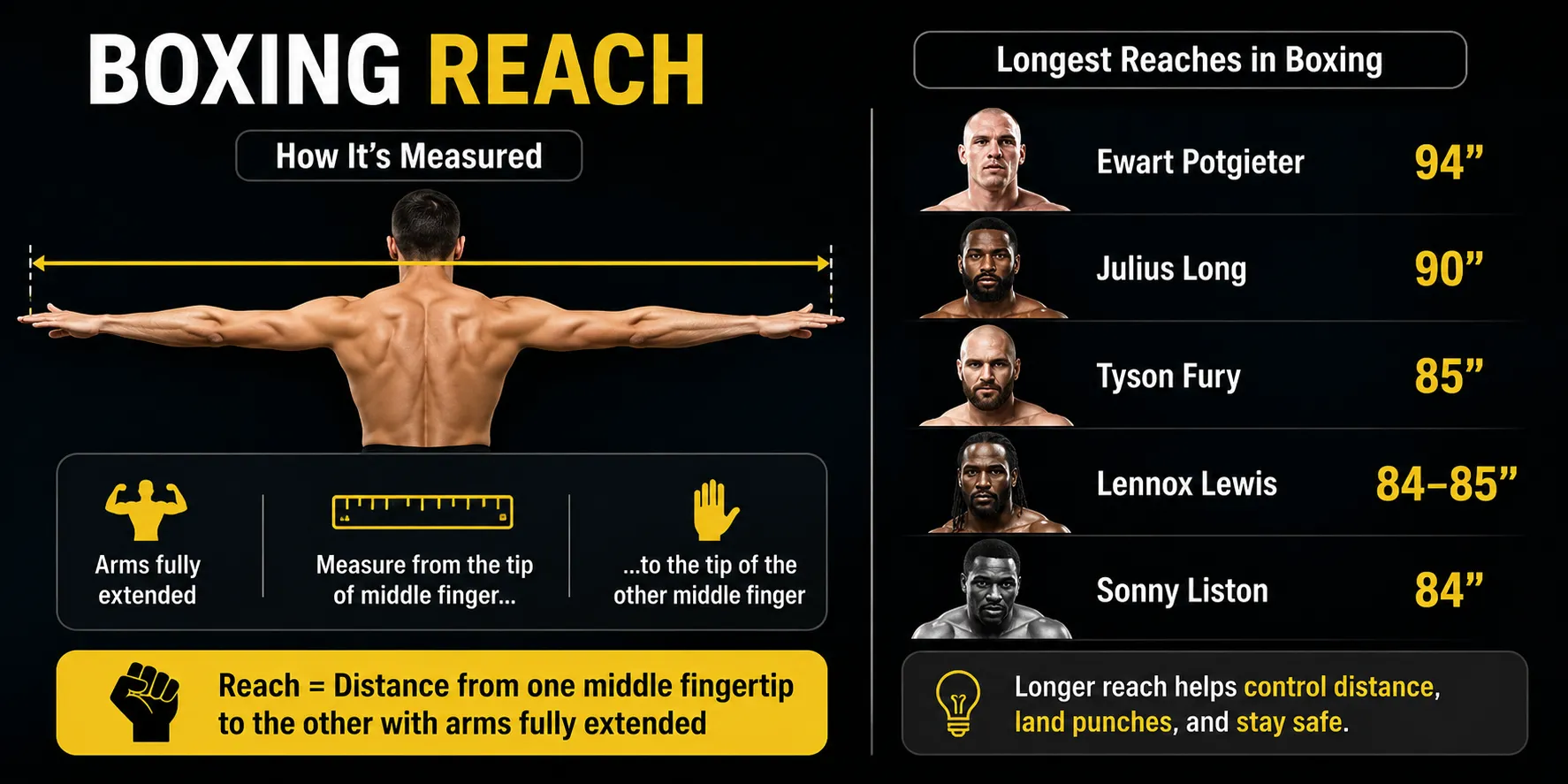
A boxer's reach is the distance measured from the tip of the middle finger on one hand to the tip of the middle finger on the other hand when both arms are fully extended horizontally. This measurement is also called a person's wingspan or arm span and is usually recorded in inches (or centimeters). It helps indicate how far a boxer can throw punches without stepping forward.
Ewart Potgieter, a former South African heavyweight standing about 7 ft 2 in (218 cm), is widely reported to have had one of the longest reaches ever recorded in boxing at approximately 94 inches (239 cm). However, because records from different eras are not always standardized, some sources describe this figure as reported rather than officially verified. Among more widely recognized professional heavyweights, Julius Long (90 inches), Tyson Fury (85 inches), Lennox Lewis (84–85 inches), and Sonny Liston (84 inches) are famous for their extraordinary reach.
One thing I've always found fascinating is that fans often focus only on height. In reality, height and reach aren't the same thing. Two boxers can be exactly the same height yet have very different wingspans, which can completely change how they fight.
How Is a Boxer's Reach Measured?
The measurement process is surprisingly simple.
Professional organizations generally measure reach by following these steps:
-
The boxer stands upright.
-
Both arms are stretched straight out to the sides, parallel to the floor.
-
The distance from the tip of one middle finger to the tip of the other middle finger is measured.
-
The final measurement is recorded in inches or centimeters.
This is almost identical to measuring a person's wingspan.
Interestingly, for many people, their reach is very close to their height, but elite athletes often break this pattern.
Why Does Reach Matter in Boxing?
Reach is one of the most valuable physical advantages a boxer can have, but it isn't everything.
A longer reach helps a boxer:
-
Land punches from farther away.
-
Control distance.
-
Keep opponents outside their striking range.
-
Use the jab more effectively.
-
Score points while taking fewer risks.
However, I've watched plenty of fights where the boxer with the shorter reach won comfortably. That's because footwork, timing, defense, and ring IQ often matter just as much as physical measurements.
A long reach creates opportunities, it doesn't guarantee victory.
Boxers with Some of the Longest Reaches
Here are some of the best-known examples.
| Boxer | Height | Reach |
|---|---|---|
| Ewart Potgieter | 7'2" | 94 in (reported) |
| Julius Long | 7'1" | 90 in |
| Tyson Fury | 6'9" | 85 in |
| Nikolai Valuev | 7'0" | 85 in |
| Lennox Lewis | 6'5" | 84–85 in |
| Sonny Liston | 6'1" | 84 in |
One detail many people don't realize is how remarkable Sonny Liston's measurements were. At 6 ft 1 in, he had an 84-inch reach, giving him a wingspan comparable to much taller heavyweights. Even today, his reach is considered extraordinary for his height.
Reach vs Other Boxing Measurements
Reach is important, but it's only one part of a boxer's physical profile.
| Measurement | What It Measures | Why It Matters |
|---|---|---|
| Reach | Fingertip to fingertip | Punching distance |
| Height | Standing height | Overall size |
| Weight | Body weight | Determines weight class |
| Stance | Orthodox or Southpaw | Fighting style |
| Hand Size | Fist dimensions | Can influence punching surface |
Many beginners assume taller automatically means longer reach.
That's often true, but not always.
Some shorter fighters have unusually long arms, while some very tall fighters have relatively average reach.
Common Misconceptions
"The tallest boxer always has the longest reach."
Not necessarily.
Although height and reach are often related, there are many exceptions.
"Reach alone wins fights."
No.
History has shown countless shorter-reach champions defeating longer opponents through:
-
Better movement.
-
Faster combinations.
-
Superior defense.
-
Smarter tactics.
Joe Frazier, for example, often overcame significant reach disadvantages through relentless pressure and exceptional timing.
"Reach is measured from shoulder to fist."
Incorrect.
Official boxing reach is measured from middle fingertip to middle fingertip, not arm length.
Boxing Reach at a Glance
| Feature | Details |
|---|---|
| Definition | Distance from one middle fingertip to the other with arms fully extended |
| Also Called | Wingspan or arm span |
| Measured In | Inches or centimeters |
| Why It Matters | Determines punching range and distance control |
| Longest Reported Reach | Ewart Potgieter – approximately 94 inches (reported) |
A boxer's reach is one of the most discussed physical measurements in combat sports because it directly affects how fighters control distance and land punches. It's measured from fingertip to fingertip with the arms fully extended and is often, though not always, close to a person's height. While legendary fighters such as Ewart Potgieter, Julius Long, Tyson Fury, Lennox Lewis, and Sonny Liston are known for exceptional reach, boxing history repeatedly proves that championships are won by skill, strategy, conditioning, and determination, not by arm length alone.
Frequently Asked Questions (FAQs)
1. How is a boxer's reach officially measured?
A boxer's reach is measured from the tip of one middle finger to the tip of the other middle finger with both arms extended horizontally.
2. Is a boxer's reach the same as height?
No. While many people have a reach similar to their height, some boxers have significantly longer or shorter wingspans.
3. Who had the longest reach in boxing history?
Ewart Potgieter is widely reported to have had a 94-inch reach, although this figure is not universally recognized as an official record. Among well-known professionals, Julius Long (90 inches) is also one of the longest recorded.
4. Why is reach important in boxing?
A longer reach allows a boxer to hit opponents from greater distance, maintain range with the jab, and potentially reduce the opponent's opportunities to counter.
5. Can a boxer with a shorter reach still become champion?
Absolutely. Many legendary fighters have overcome reach disadvantages through superior footwork, speed, defense, and ring intelligence.
Must Read: What is a Boxing Kidney Punch and Why Boxing Kidney Punch illegal?