
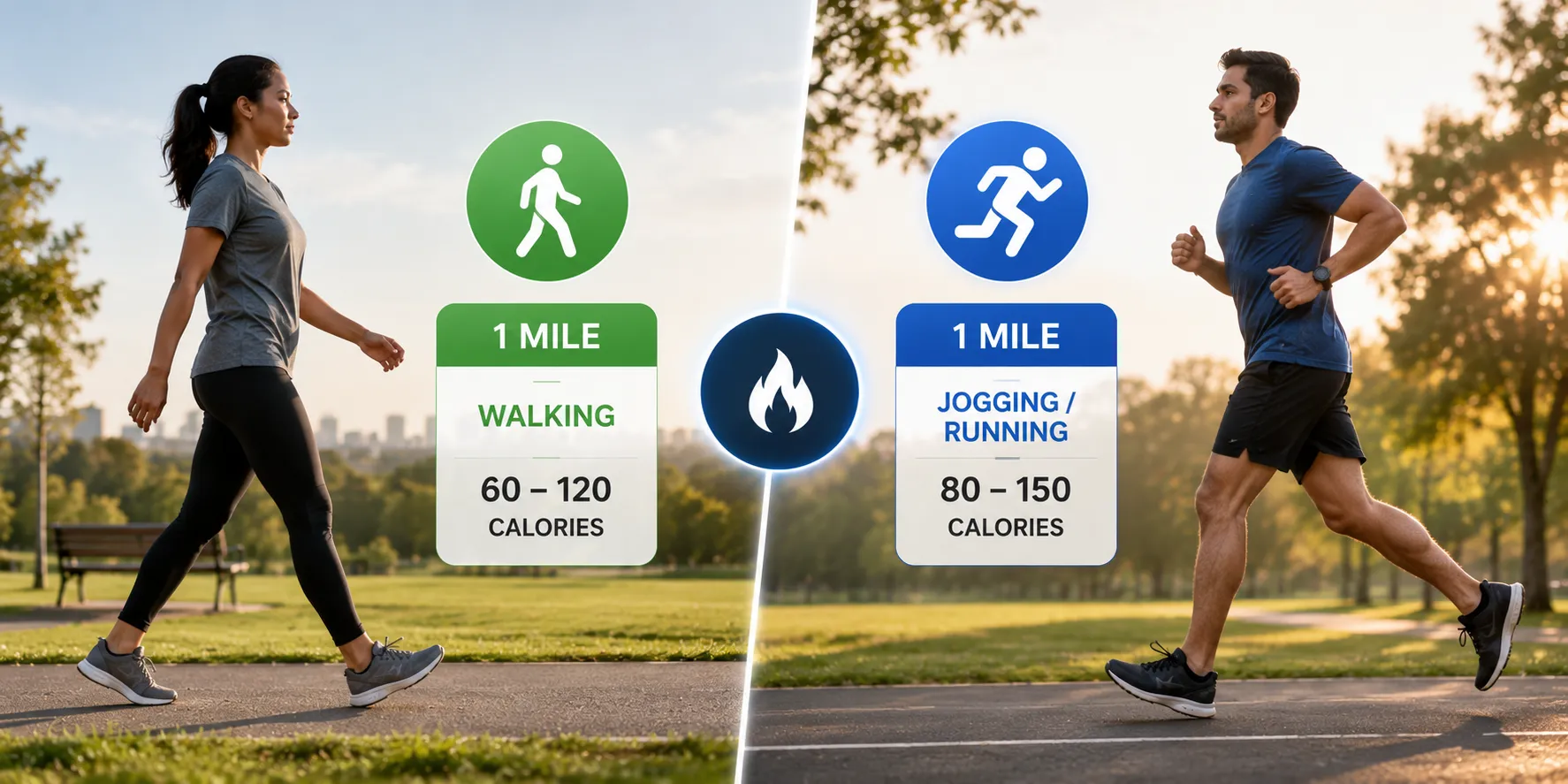
On average, walking one mile burns about 60–120 calories, while jogging or running one mile burns roughly 80–150 calories. The exact number, however, isn't determined by the mile alone.
If there's one factor that influences calorie burn the most after distance, it's your body weight.
Here's a simple way to think about it. Imagine two people run exactly one mile at a similar pace. One weighs 55 kg, while the other weighs 85 kg. The heavier person usually burns more calories because their body has to move more mass over the same distance. That's why two people following the exact same workout rarely see the same calorie burn. Research consistently shows that body weight is one of the strongest predictors of calories burned during walking and running.
I've actually seen this in real life as well. My sister is a nutritionist with a lean, athletic physique. When both of us cover the same one-mile distance, my fitness tracker almost always shows a higher calorie burn than hers. The reason isn't that I'm working harder. It's simply because my body requires more energy to move a heavier weight over that distance. That's exactly how energy expenditure works.
Calories Burned by Body Weight
Since the distance is fixed at one mile, body weight becomes the biggest variable.
| Body Weight | Walking (1 Mile) | Jogging/Running (1 Mile) |
|---|---|---|
| 50 kg (110 lb) | 55–70 kcal | 75–90 kcal |
| 60 kg (132 lb) | 65–80 kcal | 85–100 kcal |
| 70 kg (154 lb) | 75–90 kcal | 95–110 kcal |
| 80 kg (176 lb) | 85–105 kcal | 105–125 kcal |
| 90 kg (198 lb) | 95–120 kcal | 115–140 kcal |
| 100 kg (220 lb) | 105–130 kcal | 125–150 kcal |
These are practical estimates based on body weight and average walking or jogging intensity.
What Actually Affects Calorie Burn?
Most people think speed is the biggest factor.
It's important, but it isn't always the most important one.
1. Body Weight
This is the biggest contributor.
More body weight means:
- More muscle force required.
- Greater oxygen demand.
- Higher energy expenditure.
That's why a heavier individual usually burns more calories than a lighter person covering the same distance.
2. Walking vs Jogging
Running generally burns more calories because:
- Both feet leave the ground during each stride.
- More muscles are recruited.
- Heart rate increases more rapidly.
- Oxygen consumption is higher.
Interestingly, exercise physiology research has found that for the same distance, running doesn't burn dramatically more calories than many people assume. Running is far more demanding per minute, but when you compare one mile versus one mile, the gap is smaller than expected because distance itself is a major driver of energy expenditure.
3. Fitness Level
This surprises many people.
As your body becomes fitter, it becomes more efficient.
That means experienced runners often burn slightly fewer calories per mile than beginners because their movement economy improves.
Being efficient is actually a sign of better fitness, not lower effort.
4. Terrain
Walking uphill burns more calories than walking on flat ground.
Similarly:
- Trails
- Sand
- Stairs
- Inclines
all increase energy expenditure because your muscles work against greater resistance.
5. Pace
Pace influences calories burned, but for a fixed distance, its effect is smaller than many people think.
Running faster burns more calories per minute.
Running one mile slowly versus quickly usually results in fairly similar total calorie expenditure because the distance remains unchanged.
Walking vs Jogging: Which Burns More?
| Activity | Calories per Mile* | Joint Impact | Beginner-Friendly |
|---|---|---|---|
| Walking | 60–120 kcal | Low | ✅ Yes |
| Jogging | 80–150 kcal | Moderate | Yes |
| Running | 90–160+ kcal | High | Best for trained individuals |
*Approximate values vary with body weight and intensity.
If your goal is overall health and consistency, walking is an excellent choice.
If your goal is burning more calories in less time, jogging or running is usually more efficient.
The best exercise is the one you can continue doing consistently.
Tips to Increase Calorie Burn
You don't always need to run faster.
Small changes often make a bigger difference.
Add Inclines
Walking uphill recruits more muscles and increases calorie expenditure.
Include Strength Training
More muscle mass slightly increases daily energy expenditure and improves running or walking efficiency.
Walk Briskly
Increasing your pace from a casual stroll to a brisk walk raises your heart rate and burns more calories.
Stay Consistent
One mile every day for a year usually produces better long-term results than running several miles once a week.
Consistency almost always beats intensity when it comes to long-term health.
Improve Your NEAT
One of the most overlooked factors in weight management is NEAT (Non-Exercise Activity Thermogenesis).
Simple habits such as taking the stairs, standing more often, walking during phone calls, or parking farther away can collectively burn hundreds of extra calories over a week.
Common Misconceptions
"Everyone burns 100 calories per mile."
No.
Body weight, pace, terrain, and fitness level all influence calorie burn.
"Running burns twice as many calories as walking."
Not necessarily.
Running burns far more calories per minute, but when the distance is the same, the difference is much smaller than many people expect.
"The fitter you become, the more calories you'll burn."
Actually, well-trained athletes often burn slightly fewer calories performing the same activity because their bodies become more efficient.
Calories Burned Per Mile at a Glance
| Factor | Biggest Influence? |
|---|---|
| Body Weight | ⭐⭐⭐⭐⭐ |
| Distance | ⭐⭐⭐⭐⭐ |
| Terrain | ⭐⭐⭐⭐ |
| Pace | ⭐⭐⭐ |
| Fitness Level | ⭐⭐ |
If you're trying to estimate how many calories you burn while walking or jogging one mile, body weight and distance are the two variables that matter most. Once the distance is fixed at one mile, a heavier person will almost always burn more calories because moving more body mass requires more energy. Pace, terrain, and fitness level still influence the final number, but not nearly as much as many people believe. Rather than chasing a perfect calorie estimate, focus on building a routine you can stick with. Over months and years, consistency has a much greater impact on health, fitness, and weight management than the calorie burn from any single workout.
Frequently Asked Questions (FAQs)
1. Does a heavier person burn more calories walking one mile?
Yes. In most cases, heavier individuals burn more calories because their bodies require more energy to move greater body mass over the same distance.
2. Is jogging one mile always better than walking one mile for weight loss?
Not always. Jogging burns more calories in less time, but brisk walking is easier to sustain consistently and places less stress on the joints. Long-term adherence is often more important than intensity.
3. Does running faster burn more calories for the same one-mile distance?
Only slightly. Running faster increases calories burned per minute, but for a fixed one-mile distance, total calorie expenditure doesn't increase as dramatically as many people expect.
4. Why does my smartwatch show different calories than my friend's even though we walked together?
Fitness trackers estimate calorie burn using your body weight, age, sex, heart rate, and movement data. Two people covering the same distance can legitimately receive different calorie estimates.
5. If my goal is fat loss, should I focus more on burning calories during exercise or being active throughout the day?
For most people, the biggest long-term results come from combining regular exercise with higher daily movement (NEAT), strength training, and a sustainable nutrition plan rather than relying on workout calories alone.
Must Read:Does walking help you lose weight?