Answered on09/29/26
A quarter pound is equal to 113.4 grams. For everyday cooking or measuring, you can simply round it to about 113 grams.

Learning, exploring, and connecting with others.
0

Join this conversation
A quarter pound is equal to 113.4 grams. For everyday cooking or measuring, you can simply round it to about 113 grams.
A quarter pound = 113.4 grams (approximately).
1 pound = 453.6 g
¼ pound = 113.4 g
A quarter pound is equal to 113.4 grams. This common 1/4 lb to g conversion is useful for measuring food, following recipes, or converting a burger’s listed weight into metric units. Because one pound contains 453.59 grams, dividing it by four gives the precise quarter-pound equivalent. This measurement is especially helpful when comparing package sizes, adjusting ingredient quantities, or checking nutritional information listed in grams on food labels.
One pound is officially defined as 453.59237 grams under the international avoirdupois system, the standard used across the US, UK, and most English-speaking countries.
Dividing 453.59237 by 4 gives 113.398 grams, which rounds cleanly to 113.4 grams for everyday use.
Working out 1/4 lb to g on a calculator or converter tool produces this same rounded figure, since it's the accepted standard conversion.
For cooking or shopping purposes, rounding to 113 or 113.4 grams is precise enough, and the extra decimal places rarely matter outside a lab setting.
Quarter-pound measurements show up constantly, most famously in fast food, where the well-known "quarter pounder" burger gets its name directly from this weight. Home cooks converting American recipes into grams, gym-goers tracking protein or meat portions, and online shoppers comparing product weights listed in different units all end up needing the same 1/4 lb to g figure at some point.
|
Fraction of a Pound |
Grams |
|---|---|
|
1/4 lb |
113.4 g |
|
1/2 lb |
226.8 g |
|
3/4 lb |
340.2 g |
|
1 lb |
453.6 g |
Having these figures on hand makes it easier to estimate related weights without pulling out a calculator every time.
If exact precision doesn't matter, rounding 113.4 grams to a plain 113 grams is close enough for most kitchen scales. Digital kitchen scales that switch between ounces, pounds, and grams make this conversion unnecessary in practice, since they display the metric figure automatically. Still, knowing the number by memory helps when a scale isn't handy or a nutrition label lists weight only in grams.
The next time a recipe or product label requires a metric measurement, knowing that a quarter pound equals approximately 113.4 grams can save you the need to use a converter.
There are exactly 113.398 grams in a quarter pound. However, for almost all practical real-world applications—whether you are measuring out ingredients for a cake or calculating nutritional macros—you should simply round this number to 113.4 grams.
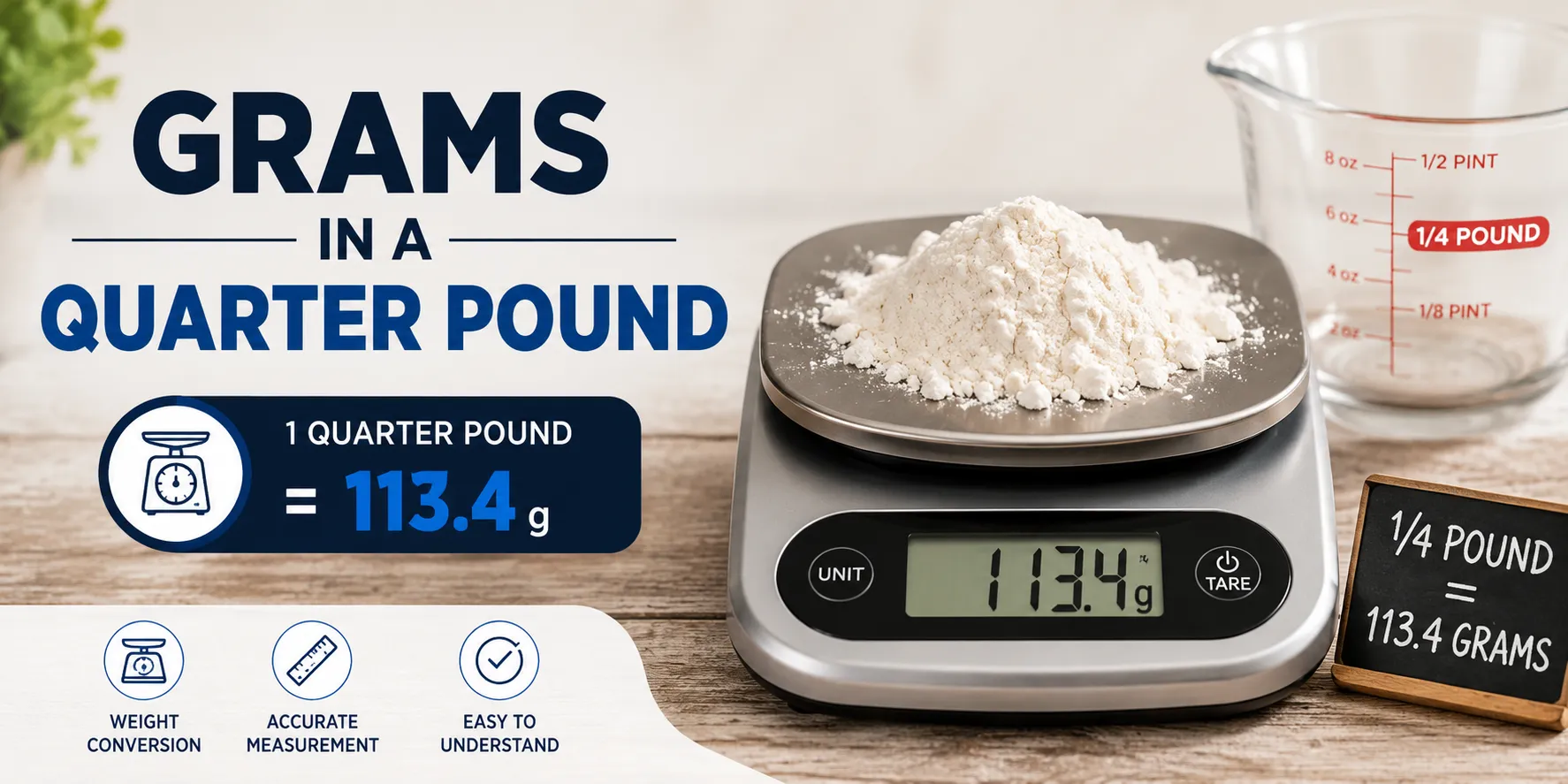
If you are staring at a digital kitchen scale trying to translate a recipe, knowing this specific conversion is incredibly helpful. The metric system is universally recognized as being far superior when it comes to precision cooking and baking. This is precisely why so many professional chefs and home cooks prefer to convert imperial ounces and pounds straight into metric grams before they begin working.
To understand exactly how we arrive at this specific figure, you only need to memorize the basic, baseline conversion between pounds and grams:
One full pound (1 lb) is equivalent to exactly 453.592 grams.
Because a quarter pound is exactly 25 percent of a full pound, you simply divide 453.592 by 4.
The resulting mathematical equation gives you 113.398 grams.
Alternatively, you can always convert the weight through ounces. There are 16 ounces in a standard pound, which means a quarter pound equals exactly 4 ounces. Since a single ounce is equal to 28.3495 grams, multiplying that figure by four gives you the exact same scientific result.
The most famous cultural reference to this specific measurement is, of course, the fast-food "Quarter Pounder" hamburger. When a restaurant advertises a quarter-pound burger, they are specifically referring to the pre-cooked weight of the raw beef patty, which sits right at that 113.4-gram mark. By the time the meat is fully seared on a grill and the internal fat renders out, the actual patty on your plate will weigh significantly less.
This measurement is also incredibly common in international baking. For example, if you are utilizing a European recipe that calls for 115 grams of butter, a standard American quarter-pound stick of butter (which equals 113.4 grams) is close enough to the requirement. You can safely drop the entire stick directly into your mixing bowl without compromising the structural integrity of your final baked product.
While the exact scientific number stretches to three decimal places, you realistically do not need that extreme level of absolute perfection unless you are working in a highly controlled chemical laboratory or compounding medications. Standard consumer-grade digital kitchen scales generally do not measure fractions of a gram; they automatically round to the nearest whole number. Therefore, if your scale reads 113 grams or 114 grams, your measurement is perfectly accurate for whatever you happen to be cooking, baking, or portioning out for your daily meal prep.
These are the following common tools.
1 Google Adwords.
A quarter pound is equal to approximately 113.4 grams. The thing is, a quarter pound means one-fourth (¼) of a pound, and when converted to the metric system, it equals 113.398 grams, which is usually rounded to 113.4 grams.
Here's how the conversion works:
1 pound = 453.592 grams
¼ pound = 453.592 ÷ 4
= 113.398 grams
Final Answer: ¼ pound ≈ 113.4 grams
You can use this simple formula:
Grams = Pounds × 453.592
For a quarter pound:
0.25 × 453.592 = 113.398 grams
So, ¼ pound = approximately 113.4 grams.
Here are a few quick conversions for reference:
| Pounds | Grams |
|---|---|
| ¼ lb | 113.4 g |
| ½ lb | 226.8 g |
| 1 lb | 453.6 g |
| 2 lb | 907.2 g |
| 5 lb | 2,268 g |
I remember seeing recipes and food labels from the US that mentioned ¼ pound, while most of the products around me were measured in grams. The thing is, once I learned that a quarter pound is about 113.4 grams, switching between the two measurement systems became much easier.
Knowing this conversion is useful in many everyday situations, such as:
Following international recipes.
Measuring meat, cheese, butter, and other food items.
Grocery shopping in countries that use different measurement systems.
Cooking and baking.
Understanding product packaging and nutrition labels.
So, if you ask me how many grams are in a quarter pound, the answer is approximately 113.4 grams. While the exact conversion is 113.398 grams, it is usually rounded to 113.4 grams for everyday cooking, shopping, and food measurements.
Must Read: How many grams are in one pound?
A quarter pound is a unit of weight that is equal to one-fourth of a pound. It is commonly used in the United States to measure food, such as meat, cheese, and produce. A quarter pound is also equal to 4 ounces.
To convert a quarter pound to grams, you can use the following conversion factor:
1 quarter pound = 113.398 grams
Therefore, there are 113.398 grams in a quarter pound.

Step-by-Step Process
To convert a quarter pound to grams, follow these steps:
weight in quarter pounds * 113.398 grams/quarter pound = weight in grams
For example, to convert 1 quarter pound to grams, you would multiply 1 quarter pound by 113.398 grams/quarter pound:
1 quarter pound * 113.398 grams/quarter pound = 113.398 grams
In most cases, it is sufficient to round the result to two decimal places.
For example, 113.398 grams rounded to two decimal places is 113.40 grams.
Examples
Here are some examples of how to convert quarter pounds to grams:
Example 1:
Convert 2-quarter pounds to grams.
2 quarter pounds * 113.398 grams/quarter pound = 226.796 grams
Round the result to two decimal places:
226.796 grams rounded to two decimal places is 226.80 grams.
Example 2:
Convert 3-quarter pounds to grams.
3 quarter pounds * 113.398 grams/quarter pound = 340.194 grams
Round the result to two decimal places:
340.194 grams rounded to two decimal places is 340.20 grams.
Conclusion
To convert a quarter pound to grams, multiply the weight in quarter pounds by the conversion factor of 113.398 grams/quarter pound. Round the result to the desired number of decimal places.
Here is a table of common quarter pound-to-gram conversions:
| Quarter Pounds | Grams | |---|---|---|
| 1 | 113.398 |
| 2 | 226.796 |
| 3 | 340.194 |
| 4 | 453.592 |
| 5 | 566.99 |
| 6 | 680.388 |
| 7 | 793.786 |
| 8 | 907.184 |
| 9 | 1020.582 |
| 10 | 1133.98 |
A pound is a mass unit commonly used in the USA and some other countries, but not part of the metric system. In the metric system, the standard unit is a gram (G). To convert between pounds and Grams, we use the following conversion factor:
1 pound (pound) = 453,59237 G (G)
Now, if you want to find out how many grams are in a pound room (1/4 pound), just divide the number of grams into 4 pounds (because a room is a room).
.png&w=384&q=75)
Therefore, the calculation goes like this:
453.59237 G 4 = 113.3980925 G
A round for sufficient accuracy, a pound of room is about 113.4 grams. This conversion is useful when it is necessary to work with measurements in different systems, such as the conversion of a pound recipe into grams or understanding the weight of an item in a country that uses a metric system.