
The short answer is:
Scientists don't know the exact number, but they estimate there are at least hundreds of billions to sextillions of planetary systems (solar systems) in the observable universe.
Here's why.
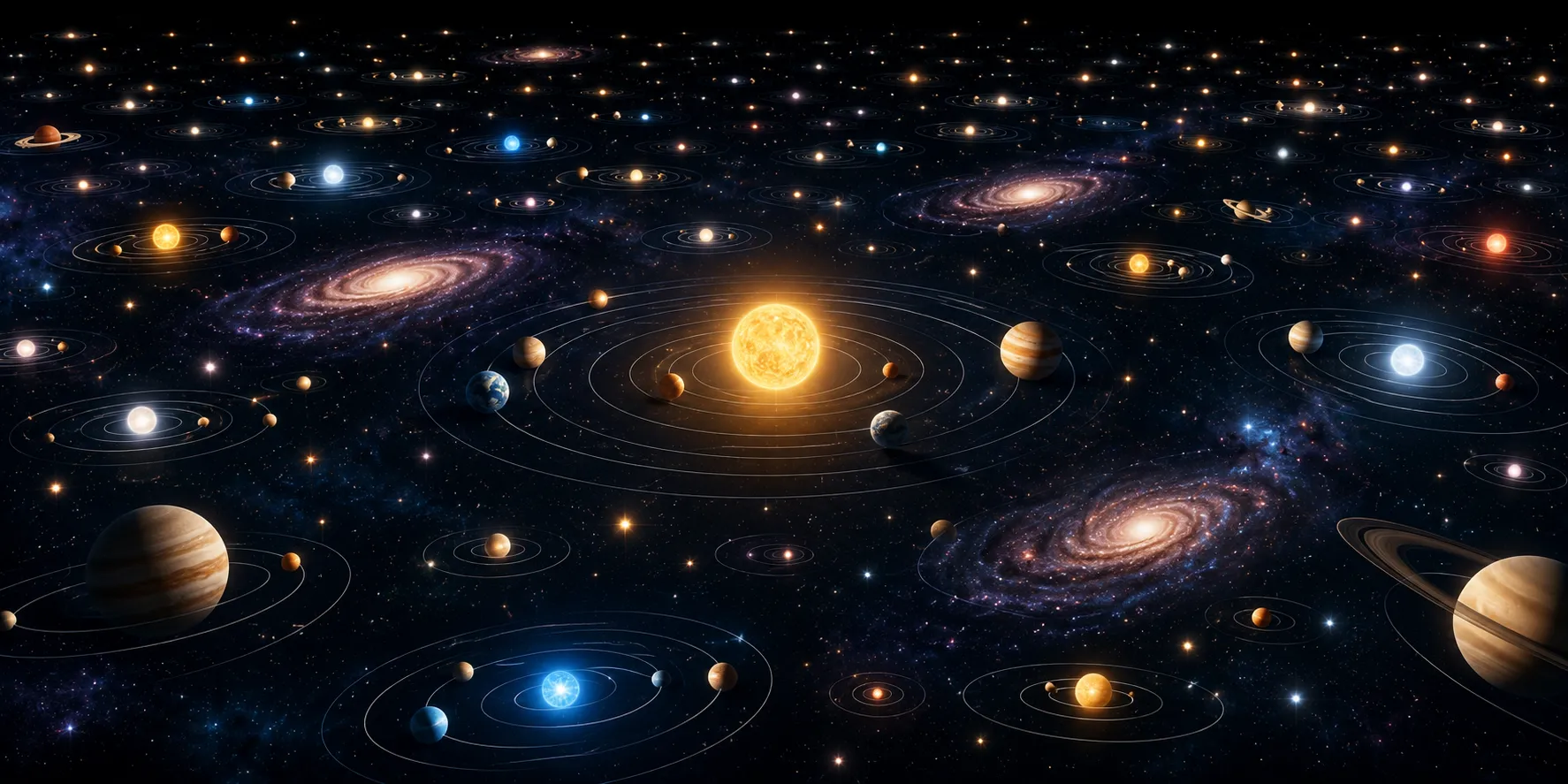
Astronomers now know that most stars have at least one planet orbiting them, and many stars have entire planetary systems. Since the observable universe contains at least 100 billion galaxies, and each galaxy contains billions or even hundreds of billions of stars, the total number of solar systems is almost unimaginably large.
One of the biggest misconceptions starts with the word "solar system."
Technically:
- The Solar System (capital "S") refers only to our planetary system, centered around the Sun.
- A planetary system refers to any star with planets orbiting it.
In everyday conversation, people often say "solar system" even when they mean planetary system.
So when someone asks:
"How many solar systems are there in the universe?"
they're usually asking:
"How many planetary systems exist?"
Based on what astronomers know today, the answer is an enormous number—likely at least as many as there are stars, because planets appear to be extremely common.
Estimated Quantity
| Region | Estimated Number of Planetary Systems |
|---|---|
| Our Solar System | 1 |
| Milky Way Galaxy | Hundreds of billions (estimated) |
| Observable Universe | Likely sextillions (10²²–10²⁴+) of planetary systems |
NASA's Kepler mission fundamentally changed our understanding of the universe by showing that planets are the rule, not the exception. Statistical studies indicate that there are more planets than stars in the Milky Way, meaning planetary systems are incredibly common.
How Do Scientists Estimate It?
Since astronomers obviously can't count every planetary system one by one, they use statistical methods.
Step 1: Observe Thousands of Stars
Space telescopes like:
- Kepler
- TESS
- James Webb Space Telescope
observe stars and look for planets passing in front of them.
Step 2: Calculate Planet Frequency
From those observations, scientists estimate:
- How many stars have planets.
- How many planets each star typically hosts.
Kepler data suggests that planetary systems are incredibly common, and many stars likely have multiple planets orbiting them.
Step 3: Scale Up
Astronomers then multiply those averages by:
- The estimated number of stars in a galaxy.
- The estimated number of galaxies in the observable universe.
The result isn't an exact count, but it tells us that the universe almost certainly contains an astonishing number of planetary systems.
Interesting Facts
Learning about planetary systems completely changed how I looked at space.
For the longest time, I genuinely believed there was just one Solar System and that it somehow represented everything inside the Milky Way Galaxy. Once I started reading more about astronomy, I realized our Solar System is just one tiny neighborhood among an unimaginable number of others. That realization made me dive much deeper into exoplanets, galaxies, and how planets actually form.
I also remember watching Doraemon as a child. There were episodes that mentioned galaxies and traveling through space. Back then, those scenes felt like pure science fiction. Looking back now, it's fascinating to realize that modern astronomy has actually confirmed thousands of planets beyond our Solar System, and scientists believe billions more are waiting to be discovered.
Some fascinating facts:
- NASA has already confirmed more than 6,000 exoplanets, and the number continues to grow as new discoveries are made.
- The Milky Way alone contains at least 100 billion stars.
- Scientists estimate that most stars probably have planets.
- Some planetary systems contain multiple stars instead of just one, meaning planets can orbit two or even three suns.
- Our Solar System is only one small part of the Orion Arm of the Milky Way.
Common Misconceptions
"There is only one solar system."
Not exactly.
There is only one Solar System with a capital S—ours.
But there are countless planetary systems throughout the universe.
"Every star has exactly one planet."
No.
Some stars have:
- One planet.
- Several planets.
- More than eight planets.
Some may have none at all.
"Scientists know the exact number."
No.
The universe is far too vast to count every planetary system individually.
Instead, astronomers use observations and statistical models to produce the best available estimates.
Frequently Asked Questions (FAQs)
1. How many solar systems are there in the Milky Way?
Scientists estimate there are hundreds of billions of planetary systems, since most stars are believed to host planets.
2. Is our Solar System unique?
Yes and no.
It's unique because it's our planetary system, but astronomers have discovered thousands of other planetary systems with very different arrangements of planets.
3. How many exoplanets have scientists discovered?
NASA has confirmed more than 6,000 exoplanets, with thousands more candidates still awaiting confirmation.
4. Do all stars have planets?
Current evidence suggests that most stars likely have at least one planet, although not every star has been observed closely enough to confirm this.
5. Could another planetary system support life?
Possibly.
Scientists have already identified hundreds of potentially habitable worlds, but there is currently no confirmed evidence of extraterrestrial life.
Our Solar System is only one tiny planetary system in an unimaginably vast universe. While astronomers can't determine the exact number of planetary systems that exist, current evidence strongly suggests there are at least hundreds of billions in the Milky Way alone and likely sextillions across the observable universe. Thanks to missions like Kepler, TESS, and the James Webb Space Telescope, we've learned that planets are remarkably common, making our cosmic neighborhood far less unique than once believed. The more we explore space, the more it becomes clear that our Solar System is just one chapter in an incredibly large cosmic story.
 Answered by