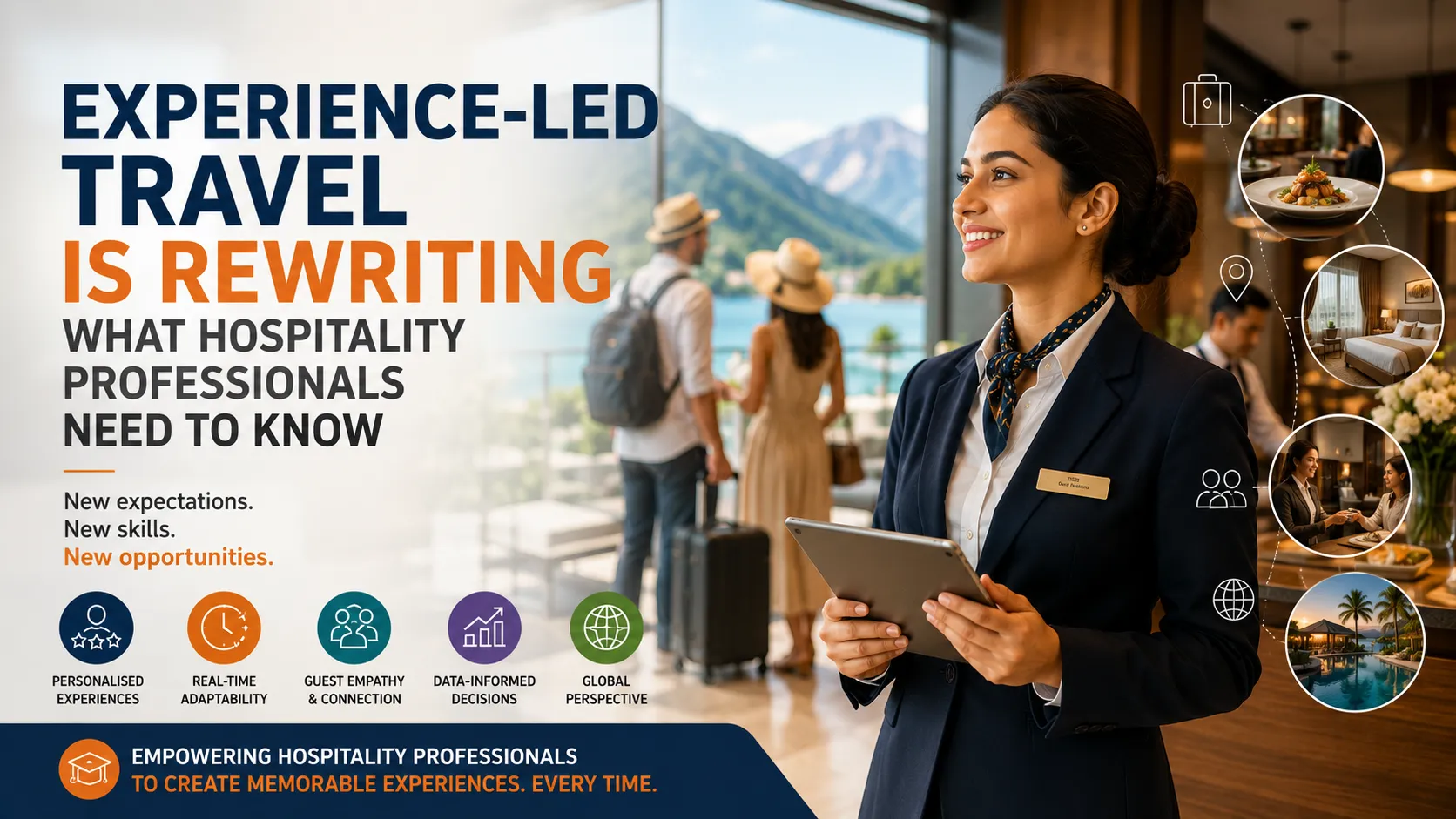
Travel is no longer defined by destinations. It is defined by experiences. Guests are increasingly choosing journeys that provide immersion, personal relevance and cultural depth. This marks a structural change in the way the hospitality industry creates value and its expectations of the workforce.
The data supports this shift. According to McKinsey, experiences have become a powerful driver of travel decisions, with 52% of Gen Z travellers willing to spend more on experiences, compared to 29% of Baby Boomers. Meanwhile, A global study of 4,300 travellers by Accor and Globetrender found that 25% would rather start their travel search with a mood rather than a destination. Collectively, these findings point to a clear transition from destination-led to experience-led travel.
This evolution is redefining capability. Many traditional hotel management courses were designed for standardised service environments. Today, however, that context no longer reflects industry reality. Today’s professionals must interpret guest intent, adapt in real time, and deliver outcomes that feel individual, not scripted.
The gap is also exposing a growing disconnect between education and workplace expectations. Many hospitality management training programs still emphasise theory over execution. As a result, students exploring hotel management courses after 12th are increasingly on a look out for learning models that build applied capability alongside foundational knowledge.
Experience Economy Demands a New Kind of Training
As travel becomes increasingly experience-led, hospitality roles are shifting from routine service delivery towards creating personalised, real-time guest experiences. Guests today expect personalised interactions shaped by context, emotion, and immediacy. This shift is exposing a capability gap that traditional hospitality management training programs have not been designed to address.
The problem is structural. Classroom-led models create graduates with theoretical understanding but limited exposure to live service environments. The solution lies in embedding learning within operational settings where decision-making, coordination, and service recovery are practiced as part of the daily workflow.
This is where Emversity is redefining the existing model for hospitality education delivery. As a skilling platform, it partners with universities to deliver industry integration to degree pathways that combine academic learning with continuous immersion inside active hospitality environments. Students gain structured exposure across food production, front office, and F&B operations through pathways such as SMART, EDGE, SPRINT, and Gateway, while earning stipends from early stages of training.
The model also extends to international markets including UAE, Singapore, Malaysia and Thailand with collaboration with global partners such as Prism Hotels. Unlike traditional hotel management courses, this approach reflects the growing demand for job oriented courses that focus on practical learning, adaptability and industry readiness alongside academic learning.
From Service Roles to Experience Architects
As travel becomes increasingly experience-led, hospitality roles are moving from structured service delivery to real-time experience creation. Today’s professionals are expected to shape guest journeys through context, responsiveness and personalisation. This change requires skills that go beyond operational procedures, thus redefining the outcome of traditional hotel management courses.
Hotels, resorts and travel platforms are hiring more and more for guest-centric execution and adaptability. Success is no longer measured solely on service accuracy, but the ability to anticipate intent and deliver consistently memorable experiences. As a result, hospitality management programs are being forced to rethink their structures, because traditional classroom-led models alone no longer align with industry realities. Learning needs to take place in real hotel environments, where decisions are of immediate effect. The difference is now definitive. Knowledge alone is not enough. The ability to perform in dynamic environments has become the primary measure of readiness.
Rethinking Career Pathways in Hospitality
Experience-led travel is changing both guest and employer expectations. For students, the ability to adapt to this change is paramount. Hotel management courses are no longer evaluated solely by the qualifications they offer, but by how effectively the program prepares the young talent for live environments where guest expectations are fluid and the results are judged on execution.
This is leading to a structural rethink in the delivery of hospitality education. Industry partners like Emversity are an example of this shift, by offering students real-time hotel experience as part of an academic curriculum enabling students to develop capability through direct engagement. This is helping satisfy the qualities employers increasingly look for: flexibility, coordination and the ability to provide a dependable service in a live setting.
As industry moves towards more personalised and experiential interactions and the need for professionals who are able to provide exceptional service delivery and with precision will only increase. Careers in hospitality will depend on professionals who can consistently deliver. As a result, hotel management courses will also evolve to place increased focus on applied competence as the key measure of industry readiness.