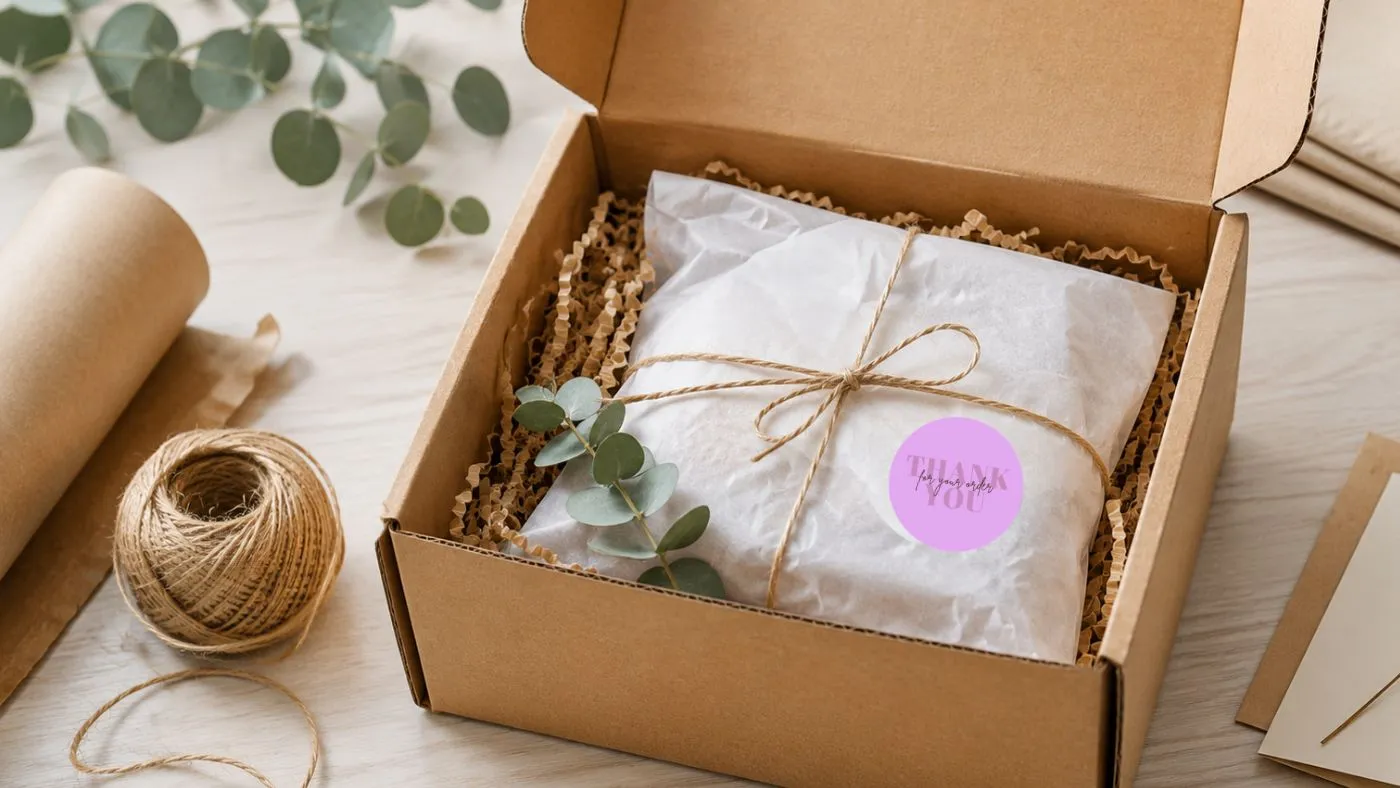
Opening an online order should feel satisfying. The customer has already spent time choosing the product, entering payment details, and waiting for delivery. The moment the package arrives is the first time that purchase becomes real.
That moment matters, but it does not require a custom-printed box, layers of decorative filler, or an elaborate ribbon arrangement. In many cases, expensive packaging adds cost without making the experience noticeably better.
A memorable unboxing experience comes from a few simpler things: the product arrives safely, the package looks organized, the branding feels consistent, and the customer finds something thoughtful inside. Small businesses can create that feeling with standard shipping materials and a few carefully chosen details.
The goal is not to make every shipment look like a luxury gift box. It is to make the customer feel that someone cared about how the order was prepared.
Start With Packaging That Protects the Product
Good presentation cannot make up for a damaged product.
Before thinking about tissue colors, stickers, inserts, or free gifts, make sure the outer packaging can survive normal shipping conditions. The box or mailer should protect the order from moisture, pressure, impacts, and movement.
Choose a package that fits the product closely. A box that is much larger than the item usually requires more filler and may increase shipping costs. It also gives the product more room to move around during transit.
A package that is too small creates a different problem. Products may become bent, compressed, scratched, or difficult to remove.
Consider the needs of the specific product:
Clothing and other soft items may only require a sturdy waterproof mailer.
Prints, photographs, and paper goods need protection from bending and moisture.
Jewelry may need a small inner box or padded sleeve.
Candles, ceramics, and glass products need cushioning around every side.
Bottles and containers should be checked for leaks before shipping.
Multiple items should be separated if they could scratch or damage each other.
Test your packaging before sending it to customers. Pack a sample order, shake it, turn it upside down, and open it again. Check whether the items moved, rubbed together, or became difficult to remove.
It is not the most exciting part of packaging design, but it prevents the kind of experience customers remember for the wrong reason.
Make the First View Feel Intentional
Think about what the customer sees immediately after opening the package.
The product should not look as though it was dropped into a box at the last minute. It should appear organized, even when the packaging materials are basic.
A clear first view can be created in several ways:
Place the main product near the top of the package.
Fold clothing so an important design or logo is visible.
Group small items inside a sleeve, pouch, or folded tissue paper.
Put the thank-you card where it will be seen immediately.
Keep invoices and shipping documents beneath the presentation layer.
Arrange multi-item orders in a logical order.
The customer should quickly understand what has arrived. They should not need to dig through loose filler or empty the entire package onto a table.
This does not mean appearance should override protection. Fragile items still need to be placed where they are safest. But within those limits, a thoughtful arrangement costs almost nothing and can improve the first impression.
Use Standard Boxes and Mailers With Confidence
Small businesses sometimes assume that memorable packaging requires custom boxes. It does not.
A plain kraft box, white mailer, or standard padded envelope can work well when it is clean, properly sized, and consistently presented. Customers care more about receiving the right product in good condition than whether the company logo is printed across every surface.
Standard packaging also has practical advantages. It is easier to purchase in small quantities, easier to store, and usually less expensive than custom packaging.
The key is consistency.
Choose a basic packaging system and repeat it across your orders. You might use:
One tissue paper color
One standard thank-you card
One sticker shape
One packing slip format
One consistent placement for inserts
One style of product label
Repeating a few recognizable details helps customers associate the package with your brand.
A plain mailer can feel intentional when it contains a neatly wrapped product, a branded seal, and a short thank-you note. The outer package does not need to do all the work.
Add One Recognizable Brand Detail
You do not need to cover the package in logos. One clear brand element is usually enough.
A branded detail could be:
A sticker sealing the tissue paper
A logo label on the product
A stamp on the outside of a kraft box
A card printed in your brand colors
A short message written in your usual tone
A patterned paper sleeve
A branded piece of packing tape
For many small businesses, custom stickers are a practical option because the same design can be used to seal packaging, label products, decorate plain boxes, or serve as a small customer freeb**ie.
Choose a detail that fits naturally into the packing process. It should be easy to apply and affordable to replace.
And keep the presentation restrained. Several competing logos, patterns, colors, and messages can make the package feel less polished rather than more memorable.
Use Tissue Paper Carefully
Tissue paper is one of the easiest ways to improve product presentation without ordering custom packaging.
A single sheet can:
Keep several items grouped together
Prevent light surface scratches
Hide the product until the customer opens the wrap
Add a consistent brand color
Make a basic box look more organized
You do not need custom-printed tissue paper. Solid white, kraft, black, or colored tissue can create a clean presentation at a much lower cost.
Use only as much as the package needs. Too many layers create waste and make the product harder to reach.
Tissue paper also should not be treated as protective cushioning for fragile items. It can improve appearance and prevent minor surface contact, but it will not protect glass, ceramic, or other breakable products from impact.
Write a Thank-You Message That Sounds Human
A short thank-you message can be more memorable than an expensive packaging upgrade.
Customers know that many online orders are processed through automated systems. A note reminds them that a person or small team prepared the package.
For businesses with a low order volume, handwritten notes may be practical. As the business grows, a printed card is easier to manage and can still feel personal.
The message does not need to be long. It should sound sincere and useful.
For example:
“Thank you for supporting our small business. We packed your order by hand and hope you enjoy it. If anything arrived damaged or incorrect, reply to your order confirmation email and we will help.”
That message does three things:
It thanks the customer.
It reinforces that the order came from a real team.
It explains what to do if there is a problem.
Avoid filling the card with promotional language. A thank-you note should not feel like another advertisement.
You can place a discount or referral offer on the back, but the main message should focus on the customer and their order.
Include Useful Information
Some of the best packaging inserts are not decorative. They help the customer use the product correctly.
Depending on what you sell, a useful insert might include:
Care instructions
Washing directions
Setup steps
Storage recommendations
Sizing information
Safety guidance
Ingredients or materials
Contact information
Warranty details
Tips for getting better results
Useful information improves the experience after the package has been opened. It may also reduce customer support questions, product misuse, and avoidable returns.
Keep the instructions short and easy to scan. A small card is not the place for several pages of dense text.
When longer instructions are necessary, include a QR code that leads to a detailed guide or video. Label the code clearly so customers know why they should scan it.
“Scan for assembly instructions” is more useful than “Scan me.”
Give Every Insert a Clear Purpose
It is easy for packaging to become cluttered.
A business may include a thank-you card, care card, discount flyer, referral card, social media request, packing slip, business card, and several product brochures. Individually, each piece may seem reasonable. Together, they create a pile of paper the customer is likely to throw away.
Each insert should earn its place.
Before adding something, ask:
Does the customer need this information?
Does it improve the use of the product?
Does it solve a common problem?
Does it make contacting support easier?
Is it likely to influence a future purchase?
Could this information be combined with another card?
A single double-sided insert is often better than three separate cards.
One side could contain a thank-you message and contact details. The other could include care instructions, a QR code, or a small reorder offer.
Simplifying the package makes it feel more organized and reduces printing costs.
Add a Small Freebie Only When It Makes Sense
A free item can create a pleasant surprise, but it should be relevant to the customer and inexpensive enough to include consistently.
Possible package freebies include:
A small sticker
A sample product
A bookmark
A mini art print
A recipe card
A spare part
A care accessory
A simple branded item
The freebie should connect naturally to the order.
A skincare company might include a sample of a related product. An artist might include a mini print. A stationery store might include a small sticker or bookmark. A craft business might provide a useful material sample.
Avoid random promotional objects that have little connection to the purchase. A customer may not see them as a gift. They may simply see more packaging waste.
Food and candy can also create problems related to allergies, dietary restrictions, heat, and cleanliness. Unless food is closely connected to the business, a non-food item is usually safer.
Most importantly, the free item should never replace good service. A customer who receives the wrong product will not be comforted by an extra sticker or sample.
Make the Package Easy to Open
An enjoyable unboxing experience should not feel like a test of patience.
Avoid excessive tape, hidden openings, sharp staples, and unnecessary layers. Customers should be able to open the package without damaging the product or searching for instructions.
Consider these questions:
Is the opening easy to find?
Does the customer need scissors or a knife?
Could a cutting tool damage the product?
Are small parts secured?
Can the main item be removed without turning the box upside down?
Is the packaging accessible to customers with limited hand strength?
Tamper-resistant packaging may be necessary for certain products, but it should still be designed with the customer in mind.
Test the opening process yourself. Better yet, ask someone unfamiliar with the packaging to open it while you watch. Problems that seem obvious to the person who designed the package may not be obvious to a customer.
Avoid Messy Decorative Filler
Decorative shredded paper can make a package look full and colorful, but it often creates a mess.
Small pieces stick to products, scatter across tables, and become another thing the customer needs to clean up. They also take up storage space and can slow down the packing process.
If filler is needed for protection, use the smallest amount that does the job.
Crumpled kraft paper, corrugated inserts, padded wraps, and fitted cardboard pieces are often easier for customers to handle. The right choice depends on the product, but protective performance should come before appearance.
Do not add filler only to make a box look more expensive. A smaller, better-fitting box is usually the cleaner solution.
Encourage Sharing Without Demanding It
A thoughtful unboxing experience can encourage customers to post photographs or videos. But the package should not make social sharing feel like an obligation.
A small card can include your social media handle or a short prompt, such as:
“Show us how you use it.”
“Tag us so our team can see what you created.”
“Share your finished setup.”
These messages feel more natural than demanding a post or offering several complicated steps in exchange for a discount.
Make the product easy to photograph. Use a clean arrangement, consistent colors, and limited loose filler. Place the most visually interesting part of the order where it appears early in the unboxing process.
Still, remember that the product is the main reason customers share. Packaging supports the moment, but it cannot manufacture enthusiasm for an item that does not meet expectations.
Keep the Packing Process Efficient
A packaging idea may seem inexpensive until labor is included.
Tying ribbon around every box may cost only a few cents in materials, but it can add a minute or more to each order. That becomes a significant cost when the business ships hundreds of packages.
Time each step of your packing process. Pay attention to tasks such as:
Folding tissue paper
Applying stickers
Writing names on cards
Assembling inner boxes
Tying string or ribbon
Measuring filler
Adding several inserts
Small details are worth keeping when customers notice and value them. But packaging should not become so complicated that orders ship late.
Create a simple packing checklist so employees can reproduce the same presentation:
Confirm the product and quantity.
Inspect the item.
Select the correct package size.
Add protective materials.
Arrange the product.
Include necessary instructions.
Add the thank-you card.
Apply the brand seal.
Close and label the package.
Check the address before shipping.
A repeatable process creates consistency without relying on expensive materials.
Track Your Packaging Cost Per Order
Packaging upgrades can quietly reduce profit margins.
Calculate the complete packaging cost for each order. Include:
Outer box or mailer
Protective material
Tissue paper
Stickers or labels
Printed inserts
Free items
Tape
Added shipping weight
Packing time
Then decide whether every order needs the same level of packaging.
A small, low-cost product may only need a mailer, branded sticker, and thank-you card. A high-value or gift-ready order may justify a rigid box, tissue wrap, protective insert, and free sample.
Matching the packaging to the product keeps costs under control.
It may also make sense to offer gift packaging as a paid option. Customers who value the extra presentation can choose it, while standard orders remain simple and efficient.
Watch for Common Unboxing Mistakes
A few packaging choices can make an otherwise good order feel careless.
Common mistakes include:
Shipping a small item in an oversized box
Prioritizing decoration over product protection
Including several repetitive sales inserts
Using too much tape
Hiding care instructions beneath the product
Adding loose filler that creates a mess
Using strong fragrances
Including food without considering allergies
Choosing materials that transfer ink or color
Making the package difficult to open
Adding details that slow fulfillment
Changing the packaging style too often
Consistency is useful. Repeat customers may enjoy recognizing the same tissue paper, card design, sticker, or short message.
A package does not have to surprise the customer every time. It should make the order feel familiar, dependable, and carefully prepared.
Conclusion
A memorable unboxing experience does not depend on expensive packaging.
Start with the basics. Use a package that fits the product, protects it during shipping, and opens without unnecessary frustration. Arrange the contents carefully so the first view feels organized.
Then add one or two details that support the brand. Tissue paper, a sticker, a useful insert, or a sincere thank-you card can make a standard box or mailer feel intentional.
Every element should have a purpose. It should protect the product, improve presentation, provide useful information, reinforce the brand, or make the customer feel appreciated.
The best packaging system is not the one with the most layers. It is the one your business can afford, your team can repeat, and your customers can enjoy without dealing with unnecessary waste or clutter.