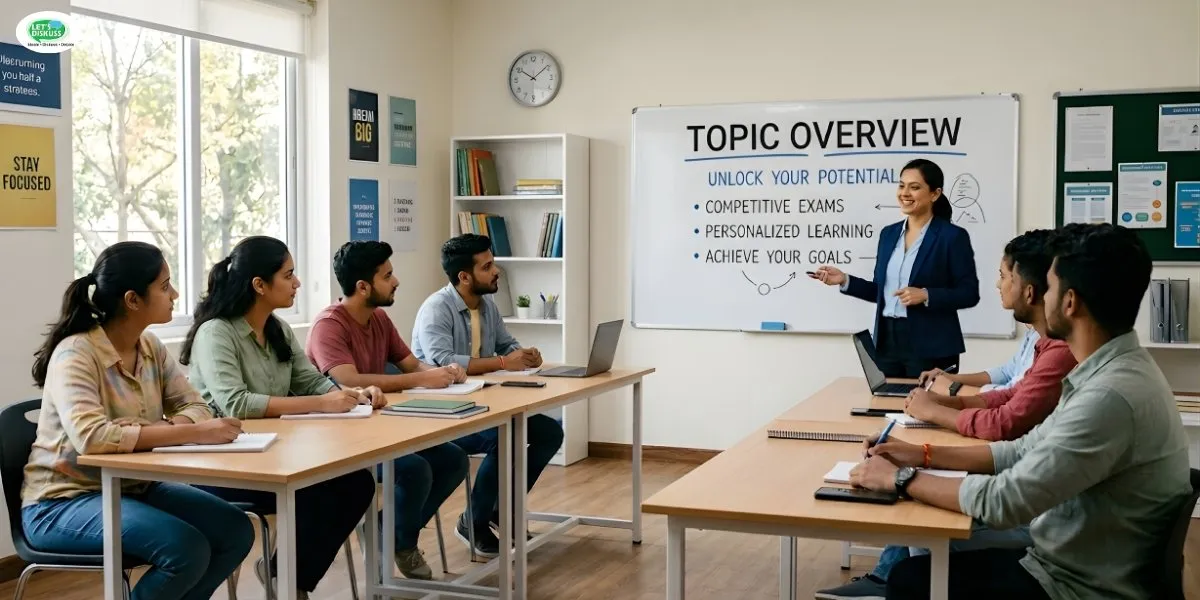
Every time a child comes home from coaching at 9 PM, someone in the family says it: Your child’s childhood is ruined. And honestly? I get it. That feeling is real.
You've seen the headlines. You've seen the memes. You've seen the viral posts about how Indian kids are losing their childhood to JEE prep and coaching institutes. And somewhere in your mind, you've probably agreed with it too.
Table of Contents
But here's what nobody is telling you. The real story is actually the opposite.
- See, the narrative that coaching institutes ruin childhood is not wrong to discuss. But it's dangerously incomplete.
- It focuses entirely on the extreme cases and the bad outcomes while ignoring the millions of students for whom coaching was literally the bridge between where they were and where they wanted to go.
- I've seen this up close. A first-generation college student from a small town in UP whose government school had no science lab, no qualified physics teacher, and no career counselor. Coaching didn't ruin his childhood. It gave him a direction when no one else could.
So before you decide that coaching institutes are the villains of Indian education, let's actually look at what's really happening. Because do coaching institutes really ruin childhood? Let’s figure out together in this comprehensive guide.
The Real Benefits of Coaching Institutes
Honestly, the benefits of coaching institutes are real, documented, and directly felt by lakhs of students across India every single year. The problem is that we've gotten so caught up in debating whether coaching is good or bad that we've stopped noticing what it's actually doing right.
Academic Support for Students:
Walk into any government school in a Tier-2 or Tier-3 city and count these three things:
- Number of qualified science teachers
- Students per classroom
- Doubt-clearing sessions available per week
The numbers will literally tell you everything.
This is where coaching institutes step in. Schools are supposed to be the primary learning space, yes. But the reality, especially outside metro cities, is brutal:
- One teacher handles 60+ students
- Syllabus completion takes priority over concept clarity
- Individual attention is basically a myth
Coaching institutes flip that equation:
- Smaller batches mean actual attention on each student
- Subject-specific teachers who know their topic inside out
- Regular doubt sessions, not once-in-a-blue-moon ones
- A pace that matches competitive exam patterns, not just board exams
That's not ruining childhood. That's filling a massive gap that the school system left wide open.
Here's what the academic support actually looks like in practice:
| What Schools Offer | What Coaching Institutes Add |
| 1 teacher for 50-60 students | Smaller batches with focused attention |
| Board exam syllabus only | Competitive exam concepts + applications |
| Limited doubt-clearing time | Dedicated doubt sessions, daily or weekly |
| Annual or half-yearly tests | Weekly tests with performance tracking |
| General career awareness | Specific goal-oriented academic planning |
This is not basically about replacing schools. It's about completing the picture that schools were never able to complete on their own.
Importance of Supplementary Education:
Here's the thing:
- Supplementary education is not a new concept invented by Kota or Aakash or Allen Institutes. It has existed in every society that has ever had competitive selection processes.
- The importance of supplementary education becomes obvious the moment you look at what students are actually competing for.
- IIT seats. NEET seats. Government jobs. Bank PO. These are not just exams. These are gateways that change family trajectories for generations. And the competition for them is genuinely brutal.
Ground Reality: In 2024, over 23 lakh students appeared for NEET for roughly 1.08 lakh MBBS seats. That's a competition ratio that no amount of self-study alone can fully prepare you for. You need structured preparation. You need someone who has seen these patterns year after year. You need coaching. Supplementary education in this context isn't extra. It's essential.
Advantages of Coaching Classes Over Self-Study
Self-study gets a lot of praise in motivational content. And look, it's important. But anyone who has actually sat alone with a JEE Advanced paper or a UPSC Mains question will tell you that self-study without direction is just organized confusion.
This is where the advantages of coaching classes over self-study become very real, very quickly:
Time Management for Students
One of the most underrated things coaching institutes do is build time management for students from a very early age. And no, not in the “wake up at 5 AM” productivity guru way. In the actual structured, sustainable way.
When a student joins a coaching institute, they get a fixed schedule. Classes at specific times, tests on specific days, revision cycles built into the timetable. This structure does something that most self-studying students struggle to create on their own. It removes the daily decision fatigue of figuring out what to study and when.
Students who manage their time well in coaching don't just perform better in exams. They carry that skill forward into college, into jobs, into their adult lives. That's not ruining childhood. That's building a fundamental life skill during the years when habits are easiest to form.
Goal Setting for Children
Coaching institutes are actually one of the best environments for goal setting for children in the Indian context.
Here's why I am weighing on this:
At home, the conversation around goals is usually vague. "Study hard so your future will be bright.” That's it. That's the whole career counseling session most Indian kids get.
Nobody is sitting a 14-year-old down and saying
- Here is your current percentile
- Here is where you need to be in three months
- Here are the specific chapters you need to crack to get there
Coaching institutes do exactly this. And it works.
Here's what that structured goal setting actually looks like in practice:
- Weekly tests with rankings: You know exactly where you stand, not just “I studied hard this week”
- Monthly progress reports: Data on what's improving, what's not, and what needs fixing
- Target-setting sessions before each phase of preparation so you're never just studying; you're working toward something specific
The students who go through this process don't come out broken. They come out knowing exactly how to chase a goal, break it down, track it, and adjust when things go off plan. Their peers who never had coaching? They spend years in college figuring out what these students already know.
How Coaching Institutes Help Students Succeed
When people ask, do coaching institutes really ruin childhood? They're usually picturing a factory. Rows of students, no interaction, no warmth, just pressure and marks. That picture exists. But it's not the whole picture.
The Role of Mentorship in a Child's Education:
The role of mentorship in a child's education is something that Indian families have historically relied on outside the home. The neighborhood tutor, the uncle who was an engineer and gave career advice, and the family friend who helped with college applications. That informal mentorship has always existed.
Good coaching institutes formalize and scale that. The best teachers at coaching institutes aren't just subject matter experts. They're the adults outside the family who actually know the student's academic situation, who see their potential even when the student can't, and who provide direction during the most confusing years of a young person's life.
I've heard this from enough students to know it's not a rare thing. The teacher who told them they could crack IIT when their own family had given up on the idea.
The faculty member who spotted that a student was struggling emotionally and addressed it before it became a crisis. This is mentorship. And it happens inside coaching institutes more than the critics acknowledge.
Student Mentorship Through Peer Learning
When you're sitting in a room with 40 other students all chasing the same goal, something happens. You learn from each other:
- The student who cracked the shortcut for a problem type shares it
- The one who found a better study schedule tells the group
- Study groups form naturally
- Healthy competition pushes everyone forward
This kind of peer-based learning is genuinely hard to replicate through self-study at home.
And here's what nobody talks about. This is exactly the kind of collaborative environment that workplaces require. Students who go through coaching institutes often arrive at college already knowing:
- How to learn in groups
- How to navigate competitive environments graciously
- How to seek help when they need it
That's not a ruined childhood but a prepared adulthood.
| What Good Coaching Institutes Actually Build | How It Helps Later in Life |
| Structured study habits | Better productivity in college and jobs |
| Goal setting and tracking | Project management in professional life |
| Peer learning and collaboration | Teamwork in corporate and startup environments |
| Handling failure through tests | Resilience when real-world setbacks happen |
| Access to experienced mentors | Career clarity before critical decision points |
Conclusion: The Positive Role of Coaching in Education
So let's come back to the original question. Do coaching institutes really ruin childhood? And let me give you my honest, unfiltered answer.
No. Not inherently. And definitely not in the way the narrative suggests.
What ruins childhood is lack of balance. What ruins childhood is when a 13-year-old is pulled out of every extracurricular activity, denied friendships, and subjected to 14-hour study days with no room to breathe. That's a parenting and boundary problem, not a coaching institute problem.
The role of coaching in education is to supplement, guide, and accelerate preparation for a genuinely competitive world. The benefits of coaching institutes, when they're implemented with any sense of balance, are very real. Academic support for students who need it. Time management skills. Goal-setting habits. Mentorship from teachers who genuinely care. Peer communities that push students forward. Coaching didn't ruin Indian childhood. The lack of balance around coaching sometimes does. That's a very different problem with a very different solution.
The conversation India needs to have is not “should coaching exist.” It's “how do we make coaching institutes better, more balanced, and accessible to the students who need them most?” That's the harder conversation. And the right one too.