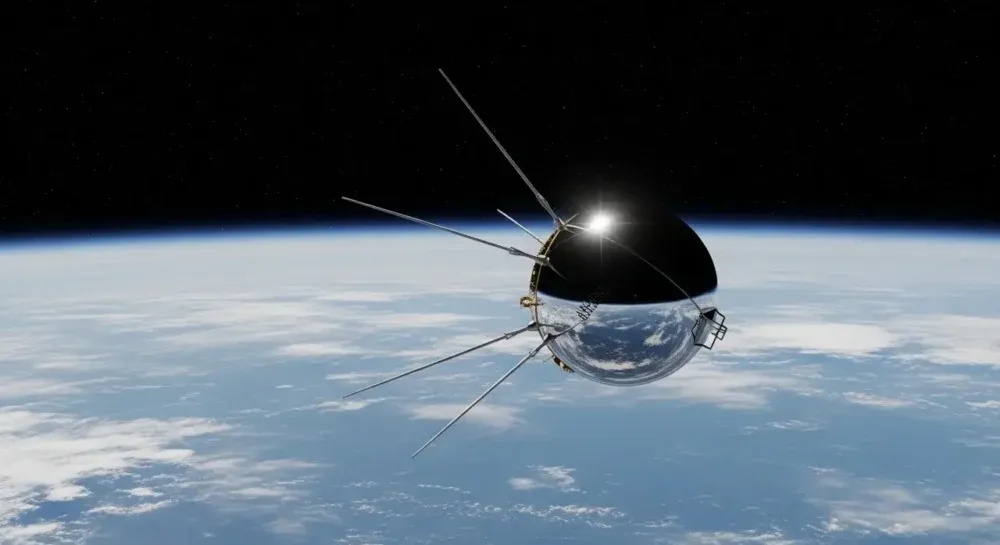
Space is not a silent void anymore. Then, two Russian satellite units conducted a precision move April 28, 2026, changing the orbital landscape and setting off alarm bells among industry specialists. Data from space situational awareness company COMSPOC show COSMOS 2581 and COSMOS 2583 came within just 10 feet (3 meters) of each other. At orbital velocities of almost 17,000 mph, this proximity is not only a technological feat, but a demonstration of extraordinary control.
KEY TAKEAWAYS
-
Precision Rendezvous: Russia successfully kept two high-speed satellites within 10 feet of one another.
-
Sophisticated Tech: "Highly sophisticated" are the moves that analysts from COMSPOC and LeoLabs describe.
-
Security Features: These “inspector” capabilities enable near-range surveillance of foreign assets.
A “Handshake” in Space
It wasn't a chance meeting by any means. LeoLabs radar tracking data analysed by LeoLabs shows COSMOS 2583 has made a series of “fine maneuvers” to preserve formation with its sibling craft. This degree of Rendezvous and Proximity Operations (RPO) is a master class in contemporary satellite guiding.
This mission is an elaborate cluster: COSMOS 2581, 2582 and 2583, all to be launched in early 2025. The latest operation also included “Object F,” a tiny subsatellite released to test independent proximity sensors. One satellite was left behind when the main couple completed the high risk “handshake”.
Understanding the Orbital Mechanics
In order to comprehend the gravitas of this occurrence, one needs think about the physics involved. You have to make tiny tweaks all the time to stay 3 meters apart at thousands of miles per hour. A little mistake in thrust might cause a catastrophic collision, forming a debris cloud that would endanger dozens of additional adjacent assets.
This was not a “coincidental pass,” the COMSPOC said in a May 1 report. The active steering shows that the Russian satellite program has incorporated extremely advanced autonomous navigation software capable of responding to orbital changes in real time.
The reason investors and defense analysts are paying attention
A Russian satellite with these capabilities is a strategic asset of immense worth. While these operations have theoretical value for commercial "space tug" services like refueling or repairing old satellites, they are commonly regarded as tests for "inspector" or "stalker" technologies.
If a satellite can touch another object at 10 ft it can:
-
Capture high-res imagery of classified gear.
-
Intercept local radio waves and data links.
-
Demonstrate the capability to physically disrupt the adversary’s communications hub.
The “Dual-Use” Dilemma
The holy grail of space sustainability for the commercial sector is RPO technology. Others like Astroscale and Northrop Grumman are developing similar technology to get rid of space trash or extend the life of multi-billion-dollar telecommunications satellites. But when a nation-state like Russia exhibits these skills with military-designated hardware (COSMOS series), the game changes from “maintenance” to “monitoring”.
Defense researchers say that if a satellite can get close enough to "inspect" a friendly craft, it can go close enough to disable it. So every precision step is a potential geo-political chess move.
History of Orbital Shadowing
This incident is another in a series of bolder behavior. In 2020, Russia’s COSMOS 2542 was criticized internationally for trailing a U.S. espionage satellite. But this is a major evolution in cooperation for the current mission.
Tracking these three objects conducting RPO since late 2025 shows that Russia has advanced its autonomous software to a level comparable to one of the major space powers. The presence of “Object F” - the subsatellite - demonstrates a multi-tiered approach to SSA where one primary ship can deploy smaller “eyes” to scan a region from numerous perspectives concurrently.
The Major Powers Compared
Russia is not alone in its efforts. Both the US and China have been detected performing similar "close-approach" operations.
-
The U.S.: Has been using its GSSAP (Geosynchronous Space Situational Awareness Program) satellites to track other craft for years.
-
China: Has shown the ability to “shuttle” satellites between orbits to investigate or assist other spacecraft.
Here the difference is total closeness. Even for the military, 10 feet is a very narrow separation that pushes the limits of what is deemed a "safe" distance because the vacuum of space is so unforgiving.
The Business Impact: Insurance and Risks
Such movements add fresh risks in the broader aircraft industry. Satellite operators now have to consider the potential of “uninvited guests”.
-
Insurance Expenses: “Stalking” in orbit is on the rise and insurers may increase premiums for high value assets in Low Earth Orbit (LEO).
-
Defensive Tech: Prepare for a rush in demand for self-defence sensors on satellites – cameras and radar to identify when another spacecraft is approaching.
-
Regulatory Concerns: International space law doesn’t have a precise concept of “trespassing” in orbit. This Russian move underscores the importance of a “rules of the road” regime to avoid inadvertent collisions or deliberate meddling.
Conclusion: A New Age of Orbital Supremacy
As space turns become an arena of competition, the accuracy displayed by these Russian satellite units demonstrates that the fight for supremacy in the orbital realm is approaching a very advanced new phase. Whether for maintenance or surveillance, the capacity to “tail” an object in orbit is a potent tool in the 21st-century geopolitical armory.
COSMOS 2581, 2582 and 2583 will continue their mission and industry leaders will be watching intently. If Moscow can keep that kind of coordination going with a cluster of satellites, then it means that space operations are going to be conducted differently -not as separate missions, but as synchronized, multi-asset maneuvers that may control a certain orbital plane.
The “10-foot handshake” is a warning to the world: There is no such thing as a private orbit in the age of the contemporary.
Also Read: Amazon LEO Rocket Launch the Future of Internet