
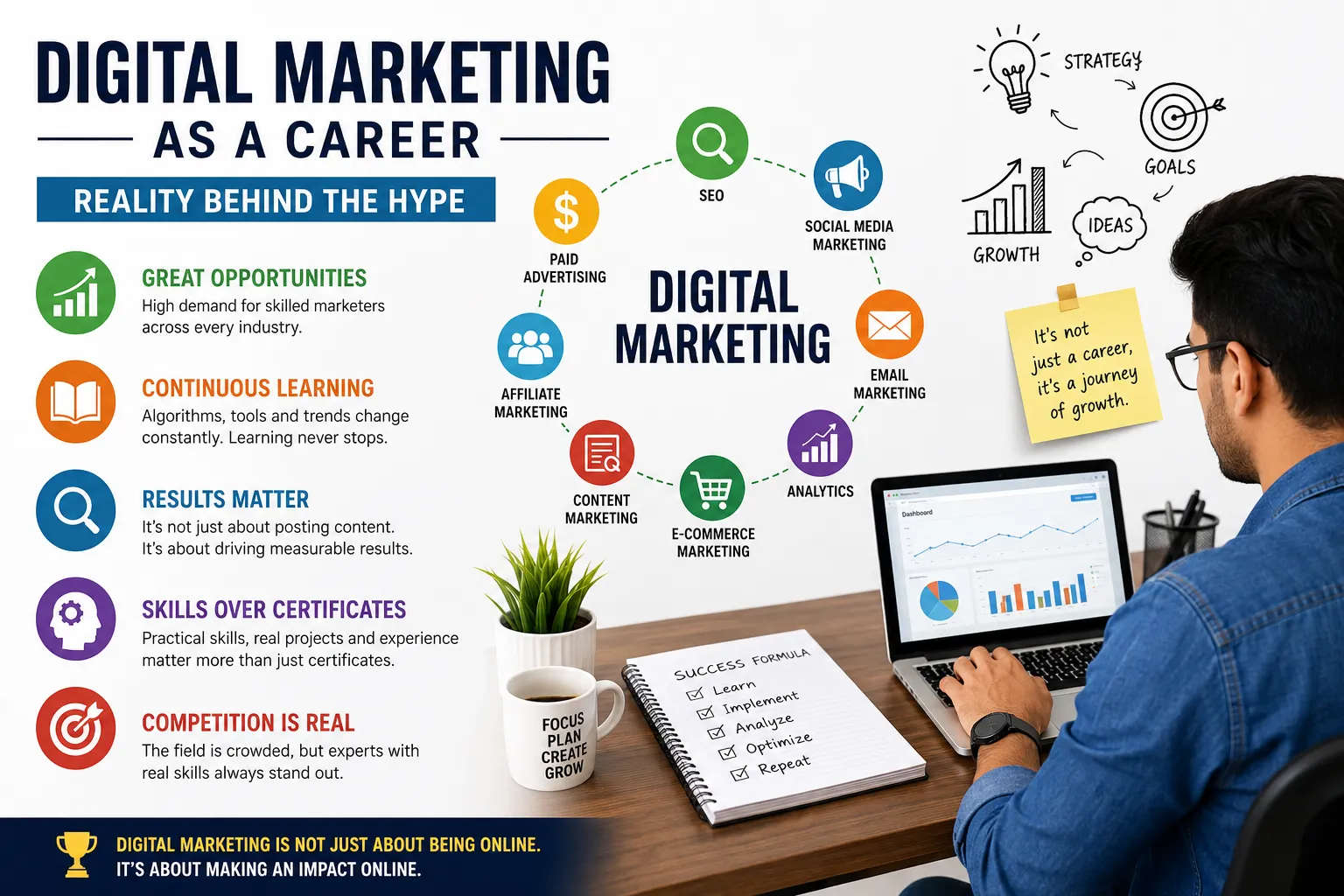
Digital marketing can be a strong career choice, but it is not the quick-money or easy-work opportunity that social media sometimes makes it appear to be. The field offers opportunities in SEO, content marketing, social media marketing, paid advertising, email marketing, analytics, affiliate marketing, and AI-powered marketing, but success requires practical skills and continuous learning. Entry-level roles are accessible compared with many specialized careers, yet competition for good positions is high. Digital marketers are expected to understand data, customers, content, platforms, and business objectives—not simply post on social media. The industry also changes quickly because of Google algorithm updates, AI tools, privacy changes, automation, and evolving consumer behavior. For someone willing to build real expertise and demonstrate measurable results, digital marketing can become a sustainable and rewarding career.
The Reality of a Digital Marketing Career
The biggest difference between the hype and reality of digital marketing is the amount of work behind successful campaigns. A campaign may look simple from the outside, but professionals often spend considerable time researching audiences, analyzing competitors, creating content, testing campaigns, monitoring performance, and improving results.
Digital marketing is also broader than social media. A professional may work with search engine optimization (SEO), Google Ads, social media, email campaigns, conversion rate optimization (CRO), content strategy, marketing analytics, and customer relationship management (CRM).
Employers increasingly value people who can connect marketing activities with business outcomes such as leads, sales, revenue, customer acquisition, and retention.
What Makes Digital Marketing Attractive?
Digital marketing has several advantages as a career. Businesses of almost every size need an online presence, creating demand for marketing skills across industries.
It is also possible to enter the profession through multiple routes. A person can start with an internship, freelance projects, an in-house marketing role, an agency position, or by building their own website and portfolio.
Another advantage is specialization. As experience grows, a marketer can move toward areas such as technical SEO, performance marketing, PPC, content strategy, marketing analytics, e-commerce marketing, or AI search optimization.
Reality | What It Means for Your Career |
|---|---|
Many entry-level opportunities | Getting started can be easier than in some highly regulated professions, but competition remains strong. |
Continuous learning is necessary | Search engines, advertising platforms, AI tools, and consumer behavior keep changing. |
Results matter | Employers and clients increasingly want measurable traffic, leads, conversions, and revenue. |
AI is changing marketing | AI can automate parts of research and content production, but strategy, judgment, creativity, and verification remain important. |
Freelancing is possible | Freelancing can provide flexibility, but finding clients and maintaining consistent income takes time. |
Specialization improves prospects | Developing expertise in SEO, PPC, analytics, content, or another niche can make you more valuable. |
The Skills You Actually Need
A common misconception is that digital marketing requires only creativity or social media knowledge. In reality, strong marketers combine communication, analytical thinking, research, technology, and business understanding.
Important skills include:
SEO and search intent
Content strategy and copywriting
Google Analytics and performance measurement
Paid advertising and campaign optimization
Social media strategy
Keyword and competitor research
Conversion rate optimization
Email marketing
Basic data analysis
AI-assisted research and content workflows
Understanding customer behavior and marketing funnels
You do not need to master everything immediately. A better approach is to develop strong fundamentals and then specialize in one or two areas.
Is Digital Marketing a High-Paying Career?
Digital marketing can become a well-paid career, but income varies significantly by experience, specialization, location, company, industry, and measurable performance.
An inexperienced beginner should not expect a high salary simply after completing a short digital marketing course. Certifications can demonstrate learning, but employers usually care more about whether you can apply your knowledge to real marketing problems.
Professionals with several years of experience and strong expertise in areas such as performance marketing, SEO, marketing analytics, e-commerce, or marketing automation can have stronger earning potential.
Freelancers and consultants may earn more than employees in some cases, but their income can also be less predictable.
The Impact of AI on Digital Marketing
Artificial intelligence is one of the biggest changes affecting the profession. AI can help marketers with research, brainstorming, data analysis, personalization, content workflows, and repetitive tasks.
However, AI does not eliminate the need for skilled marketers. Instead, it changes what valuable marketing skills look like. Marketers increasingly need to know how to use AI effectively, verify its output, understand search behavior, maintain brand quality, and make strategic decisions.
The strongest professionals are likely to be those who use AI to increase productivity while retaining human judgment, creativity, originality, and accountability.
What Beginners Often Get Wrong
One common mistake is collecting certificates without building practical experience. Another is trying to learn every marketing channel at once.
A better strategy is to choose a foundation such as SEO, content marketing, paid advertising, or social media marketing, learn the fundamentals, and then create practical projects.
For example, you could build a small website, conduct keyword research, create optimized content, track search performance, run a small advertising experiment, or analyze an existing marketing campaign. These projects can become portfolio evidence when applying for jobs.
Inshort
The reality behind the digital marketing hype is that it is neither an effortless career nor an industry without opportunities. It is a competitive, constantly changing profession where practical skills and measurable results matter more than simply knowing marketing terminology. Beginners who combine SEO, content, analytics, AI tools, communication, and business thinking can build valuable careers over time. The best reason to choose digital marketing is not the promise of quick money, but the opportunity to develop skills that businesses genuinely need.
FAQs
1. Is digital marketing a good career for beginners?
Yes. Digital marketing can be accessible to beginners because there are multiple entry points, including internships, junior marketing roles, agencies, freelancing, and personal projects. Building a portfolio and practical skills can make it easier to compete for opportunities.
2. Is digital marketing really as easy as social media suggests?
No. Learning basic concepts can be relatively easy, but becoming effective at digital marketing requires experience with research, strategy, analytics, content, advertising, and performance optimization. Consistently producing business results takes time.
3. Will AI replace digital marketing jobs?
AI is more likely to change many digital marketing tasks than eliminate the entire profession. Repetitive work can increasingly be automated, while strategic thinking, creativity, customer understanding, data interpretation, and decision-making remain important.
4. What is the best digital marketing skill to learn first?
Start with the fundamentals of SEO, content, audience research, analytics, and marketing funnels, then choose a specialization based on your interests and career goals. Practical projects are usually more valuable than learning theory alone.
Also read : Should I do an MBA or a course in digital marketing?