
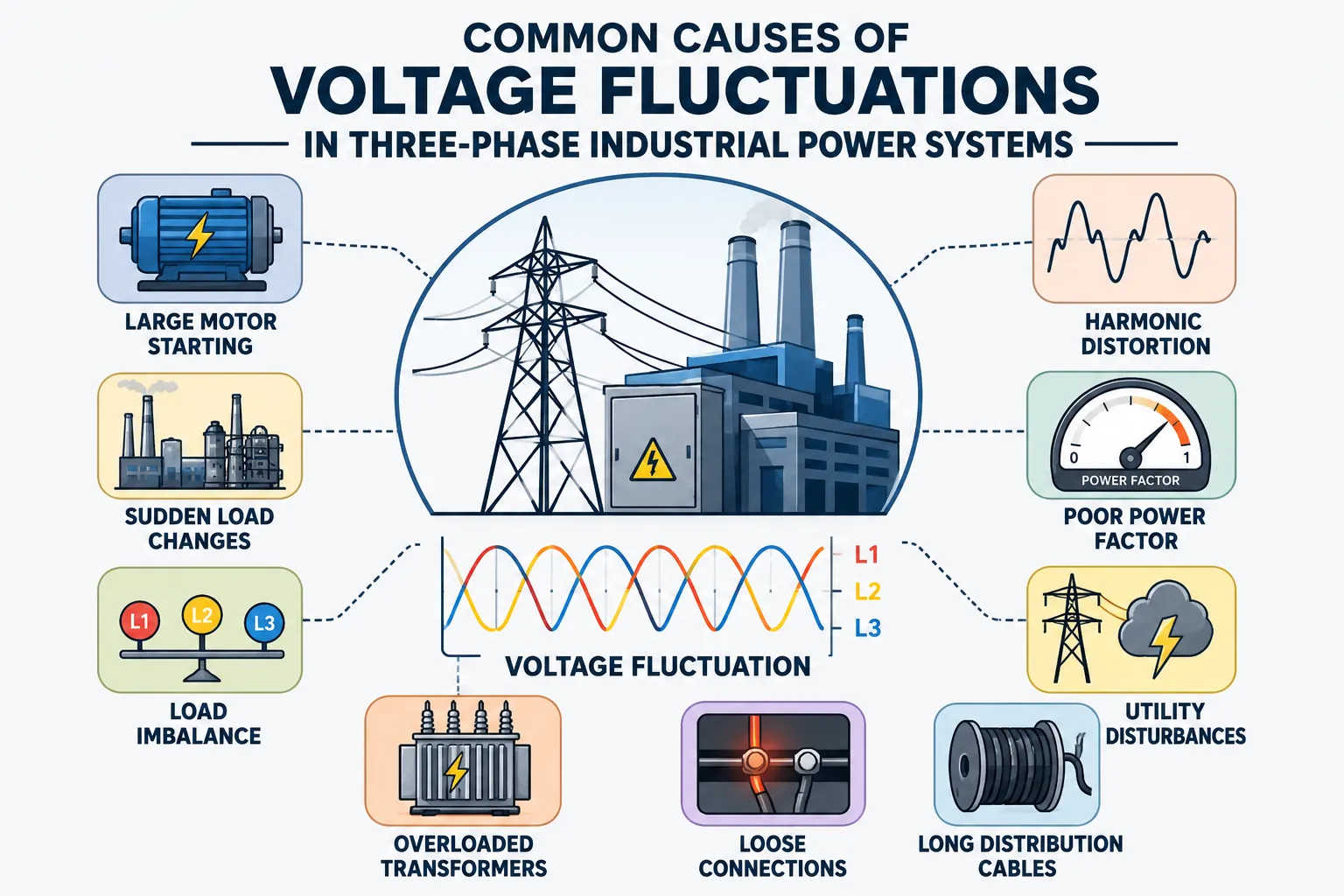
Voltage fluctuations in three-phase industrial power systems occur when the supply voltage repeatedly rises or falls from its normal level. Common causes include large motor starting, sudden load changes, unbalanced loads, loose connections, overloaded transformers, and utility-side disturbances. Harmonic distortion from variable frequency drives (VFDs), welders, and other nonlinear equipment can also affect voltage stability. Poor power factor and inadequate distribution capacity may further increase voltage variations. These fluctuations can cause motor overheating, equipment malfunction, production interruptions, and reduced electrical efficiency. Identifying the source early helps industries maintain stable voltage and protect sensitive electrical equipment.
Common Causes of Voltage Fluctuations
Cause | How It Affects Voltage |
|---|---|
Large motor starting | Creates a temporary voltage drop due to high starting current |
Sudden load changes | Rapidly changes voltage demand across the system |
Load imbalance | Causes unequal voltage across the three phases |
Overloaded transformers | Reduces the system's ability to maintain stable voltage |
Loose connections | Creates resistance, heating, and unstable voltage |
Long distribution cables | Produces voltage drops under heavy loads |
Harmonic distortion | Distorts the electrical waveform and affects power quality |
Poor power factor | Increases current demand and voltage losses |
Utility disturbances | External faults or switching can cause voltage variations |
1. Large Motor Starting
Industrial motors can draw several times their normal operating current when starting. When a large motor starts, this high inrush current can temporarily reduce the voltage available to other equipment. Frequent starting and stopping of large induction motors can therefore create noticeable voltage fluctuations.
2. Sudden Changes in Industrial Loads
Industrial facilities often operate heavy equipment such as compressors, pumps, furnaces, elevators, and conveyors. Switching these loads on or off suddenly changes the current demand. If the electrical system does not have enough capacity, the change can produce voltage dips or rises.
3. Three-Phase Load Imbalance
A three-phase system works most efficiently when loads are reasonably balanced across all three phases. Uneven distribution of single-phase equipment can create phase voltage imbalance. This can increase current in certain phases and cause motors to run inefficiently or overheat.
4. Transformer and Distribution Problems
An overloaded or incorrectly sized transformer may struggle to maintain the required voltage during periods of high demand. Problems with transformers, switchgear, busbars, or distribution cables can also contribute to voltage instability.
5. Harmonics and Nonlinear Loads
Equipment such as variable frequency drives, rectifiers, UPS systems, arc furnaces, and welding machines can introduce harmonic currents into an industrial electrical network. Excessive harmonics can contribute to poor power quality and additional heating and losses.
6. Poor Power Factor
A low power factor causes industrial equipment to draw more current for the same useful power output. Higher current increases voltage drop across cables, transformers, and other system components. Power factor correction equipment, when correctly designed, can help reduce these losses.
7. Utility-Side Disturbances
Not every voltage fluctuation originates inside the factory. Problems on the utility network, including switching operations, faults, lightning, nearby heavy industrial loads, and changes in grid demand, can produce voltage sags, swells, or short-duration disturbances.
Conclusion
The most common causes of voltage fluctuations in three-phase industrial power systems are motor starting, sudden load changes, phase imbalance, overloaded equipment, poor connections, harmonics, low power factor, and utility disturbances. Monitoring voltage on all three phases and conducting a power-quality assessment can help identify the actual source. Correct equipment sizing, load balancing, preventive maintenance, harmonic mitigation, and appropriate voltage regulation can improve overall system stability.
FAQs
1. What causes voltage dips in a three-phase system?
Large motor starting, sudden increases in industrial load, overloaded transformers, and high resistance in cables or connections are common causes of voltage dips.
2. Can an unbalanced load cause voltage fluctuations?
Yes. Unequal loading of the three phases can create voltage imbalance and increase current in individual phases, potentially affecting three-phase motors and other equipment.
3. Do VFDs cause voltage fluctuations?
VFDs can contribute to power-quality problems because their electronic switching can generate harmonics. Proper filtering and system design can reduce these effects.
4. How can industries reduce voltage fluctuations?
Industries can reduce fluctuations by balancing loads, properly sizing transformers and cables, improving power factor, controlling motor starting currents, addressing loose connections, and monitoring power quality.
Also read : Motional EMF: How Motion in a Magnetic Field Creates Voltage