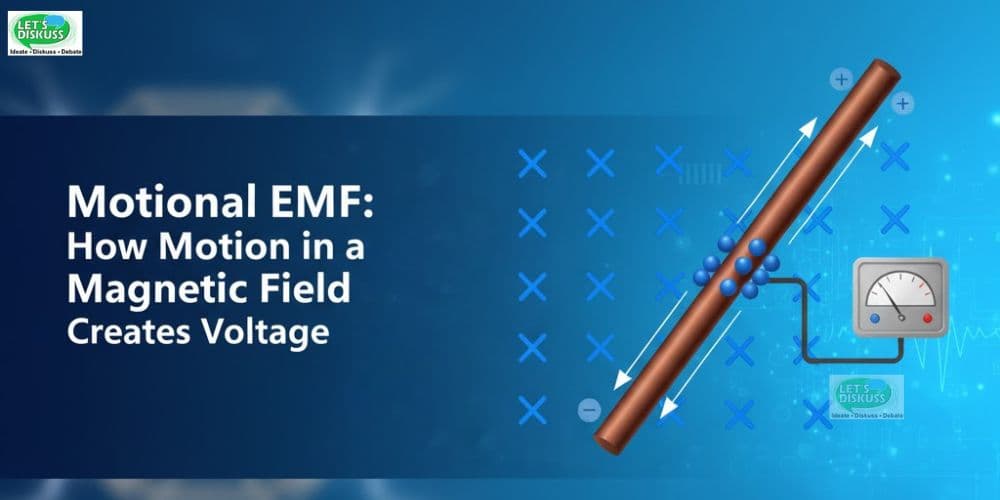
Electromagnetic induction is one of the most fascinating links between motion, magnetism, and electricity. When a conductor moves through a magnetic field, it experiences a potential difference between its ends — an effect known as Motional Electromotive Force (EMF). In this article, we’ll explore the concept in detail, derive the governing equations, and connect it with practical examples and physical intuition.
Introduction
When a conductor moves through a magnetic field, the charges within it experience a magnetic force. This force drives charges to accumulate at one end of the conductor, creating an electric potential difference or EMF.
This induced EMF is known as Motional EMF because it arises from motion in a magnetic field rather than from a changing magnetic field itself.
Motional EMF forms the foundation for electric generators, railguns, and many electromagnetic devices. To understand it, let’s start with a simple physical setup.
The Basic Setup — Rectangular Conductor in a Magnetic Field
Consider a rectangular conducting loop PQRS in a homogeneous magnetic field B which is oriented perpendicular to the plane of the loop (pointing into the page) as shown in Figure 1. The side segment, PQ, can move on the rails PS and QR but the other elements of the loop do not move.
In case the side PQ is moved continuously to the left at a constant velocity v, the area of the loop enclosed by the loop decreases with time, therefore, causing a time change in the magnetic flux that enters the loop.

Magnetic Flux and Induced EMF
The magnetic flux linked with the loop is given by
ΦB=B⋅A=Blx
where
- B = magnetic field (perpendicular to loop),
- l = length of the rod PQ,
- x = instantaneous distance between PQ and RS.
As the rod moves left, x decreases with velocity v=dx/dt.
According to Faraday’s law of electromagnetic induction, the induced EMF is
ε=−dΦB/dt
Substituting the expression for magnetic flux:
ε=−d/dt × (Blx)=−Bl × dx/dt
Since the rod moves toward the left, dx/dt=−v. Therefore,
ε=Blv
The magnitude of induced EMF is directly proportional to the magnetic field, the length of the conductor, and its velocity.
Direction of Induced Current (Lenz’s Law)
The cross-sectional area of the loop is decreased as the segment PQ is shifted to the left, a decrease in the magnetic flux passing through the loop. It is by the law of Lenz that the induction of an electromotive force in the loop will cause an electric current producing a magnetic field in opposition to this loss of flux.
As a result, a current I oppositely passes along the loop PQRS as shown in Figure 1, and this current opposes the movement of PQ. This phenomenon is consistent with the law of conservation of energy: the mechanical energy used in moving the conductor is changed to electrical energy in the circuit.
Lorentz Force Explanation
The identical outcome may be obtained through the study of the Lorentz force on moving charges in the conductor.
A charge, which is situated q inside the conductor PQ and travels in the conductor at a velocity of v in the presence of a magnetic field B, is subjected to a magnetic force.
F=q(v×B)
This force is orthogonal to both v and B hence pushing the positive charges towards one end of the rod and the negative charges towards the other end.
Given a length of the rod of length l, the potential difference or rather the work done in a unit charge across the extreme points is.
ε=W/q=Blv
So the Lorentz-force methodology gives an equation that is the same as that given by the law of Faraday.
Physical Meaning and Energy Conversion
In essence, when the conductor moves through a magnetic field, the external force applied to maintain its motion does mechanical work. This work is converted into electrical energy via induced EMF.
This shows how motion in a magnetic field produces electricity, forming the fundamental working principle behind electric generators.
EMF in a Rotating Conductor
So far, we discussed a straight rod moving linearly. Now, let’s consider a rotating conductor, such as a metallic rod pivoted at one end and rotating in a uniform magnetic field (see Figure 2).
1. Setup Description
A metallic rod of length l rotates with angular velocity ω in a uniform magnetic field B, which is perpendicular to the plane of rotation. The outer end of the rod is connected to a circular metallic ring.
As the rod rotates, free electrons experience a Lorentz force q(v×B) and move toward the outer end. This motion of charges produces a potential difference between the center and the rim — the motional EMF.
2. Derivation (Method I — Lorentz Force Approach)
For a small element of the rod at a distance r from the center, its linear velocity is v=ωr.
The induced EMF across this small element is
dε=Bv dr=Bωr dr
Integrating from r=0 to r=R:
ε=∫0R Bωr dr=1/2 × BωR2
Hence, the induced EMF between the center and the rim is
ε=1/2BωR2
3. Method II — Using Rate of Change of Flux
Alternatively, consider the rotating rod as one side of a closed loop OPQ.
As it rotates through an angle θ, the area of the loop changes by
A=1/2 × R2θ
The rate of change of magnetic flux is
dΦB/dt=B × dA/dt=1/2 × BR2 × dθ/dt
Since dθ/dt=ω,
ε=1/2 × BωR2
Both methods yield the same result, confirming the consistency of our derivation.

Example 1 — Rotating Rod
Given:
Length l=1.0 m
Frequency f=50 rev/s
Magnetic field B=1.0 T
To find: Induced EMF between the center and the metallic ring.
We know:
ε=1/2 × BωR2
Substitute ω=2πf=2π×50=100π rad/s.
ε=1/2 × (1.0)(100π)(1.0)2=157 V
Result:
ε=157 V
Thus, the EMF induced between the center and rim of the rotating rod is 157 volts.
Example 2 — Rotating Wheel with Spokes
Given:
- Number of spokes: 10 (each 0.5 m long)
- Speed = 120 rev/min = 2 rev/s
- Magnetic field HE=0.4 G=0.4×10⁻⁴ T
To find: EMF between the axle and rim.
Using the same formula,
ε=1/2 × ωBR2
Here, ω=2πf=2π×2=4π rad/s.
ε=1/2×4π×0.4×10−4×(0.5)2
ε=6.28×10⁻⁵ V
Note:
The number of spokes is immaterial because all EMFs across the spokes are in parallel, and the potential difference between the axle and rim remains the same.
Comparison of Linear and Rotational Motion
| Type of Motion | Setup | Expression for EMF | Nature of EMF |
|---|---|---|---|
| Linear motion | Straight rod moving in uniform B | ε=Blv | Uniform along rod |
| Rotational motion | Rod rotating in uniform B | ε=1/2 × BωR2 | Varies with radius |
This comparison shows that the general principle remains the same — motion in a magnetic field produces EMF — but the expression changes with geometry.
Energy Perspective and Power Transfer
When the conductor moves through the magnetic field, a force acts on it due to the magnetic interaction with the induced current. The external agent doing work to keep the rod moving at constant velocity supplies energy that is converted into electrical energy in the circuit.
If I=ε/R is the current in the circuit, the magnetic force on the rod is F=BIl, and the rate of mechanical work done is
P=Fv=BIlv=(Blv)2/R
This equals the rate of heat generation in the resistor, confirming energy conservation.
Broader Significance — Electricity and Magnetism Are One
In a stationary conductor, a time-varying magnetic field induces an EMF. In a moving conductor, even a steady magnetic field does the same. Both cases are unified under Faraday’s Law, which states:
ε=−dΦB/dt
Therefore, the basic process of electromagnetic induction is the change in the magnetic flux, either as a result of a spatial movement or that of a time-varying flux. This deep interaction of motion, magnetism, and electric fields is a fundamental concept of electromagnetism.
Applications of Motional EMF
- Electric Generators: Rotating coils in magnetic fields produce current by motional EMF.
- Railguns and Linear Accelerators: Use motion of conductors in magnetic fields to produce high-speed projectiles.
- Electromagnetic Brakes: Induced currents oppose motion, converting kinetic energy to heat.
- Induction Sensors: Detect motion or magnetic field variations.
- Physics Demonstrations: Sliding rods on conducting rails illustrate Faraday’s law in motion.
Conclusion
Motional Electromotive Force illustrates a simple yet profound idea — motion in a magnetic field can generate electricity.
Whether a rod slides on rails or spins around an axis, the changing magnetic flux through its motion induces an EMF that can drive a current. Both Faraday’s flux rule and Lorentz-force reasoning lead to the same result, showing the unity of electromagnetic phenomena.
In short, Motional EMF isn’t just a topic in physics — it’s the principle behind the very generation of electrical energy that powers our world.