Cell culture is a laboratory technique in which cells are grown under controlled conditions outside their natural environment. It is one of the most important tools in modern biology, medicine, biotechnology, and pharmaceutical research because it allows scientists to study how cells grow, function, communicate, and respond to different conditions without experimenting directly on humans.
Today, cell culture is used in everything from cancer research and vaccine development to drug discovery, regenerative medicine, and personalized healthcare. Many medical breakthroughs that we rely on today would not have been possible without cell culture technology.
Major Applications
1. Medical Research
One of the biggest uses of cell culture is understanding how diseases develop at the cellular level.
Researchers use cultured cells to study:
-
Cancer
-
Alzheimer's disease
-
Parkinson's disease
-
Diabetes
-
Heart disease
-
Genetic disorders
Instead of studying an entire organism, scientists can observe individual cells under carefully controlled laboratory conditions, making experiments more precise and reproducible.
2. Drug Discovery & Development
Before a new medicine reaches human clinical trials, it is usually tested on cultured cells.
Cell culture helps researchers:
-
Evaluate drug effectiveness.
-
Identify potential side effects.
-
Measure toxicity.
-
Compare different drug candidates.
-
Reduce unnecessary animal testing.
This saves both time and development costs while improving the safety of new medicines.
3. Vaccine Production
Cell culture has become an essential part of vaccine manufacturing.
Scientists grow viruses or specific cell lines under controlled conditions to produce vaccines for diseases such as:
-
Polio
-
Rabies
-
Influenza
-
COVID-19
-
Hepatitis
Modern vaccine production depends heavily on reliable cell culture systems.
4. Cancer Research
Cancer cells grow differently from healthy cells.
Using cell culture, researchers can study:
-
Tumor growth
-
Cell division
-
Gene mutations
-
Drug resistance
-
New cancer therapies
This has significantly improved our understanding of how cancer develops and how targeted treatments can be designed.
5. Regenerative Medicine & Stem Cell Research
Cell culture plays a central role in regenerative medicine.
Scientists culture stem cells to explore:
-
Tissue repair
-
Organ regeneration
-
Skin grafts
-
Bone regeneration
-
Future organ engineering
Although many of these technologies are still evolving, they represent one of the most promising areas of modern medicine.
6. Biotechnology & Biopharmaceutical Manufacturing
Many life-saving medicines are produced using cultured cells.
These include:
-
Monoclonal antibodies
-
Recombinant proteins
-
Hormones
-
Enzymes
-
Therapeutic proteins
Cell culture has become the backbone of the modern biopharmaceutical industry.
7. Toxicity & Safety Testing
Before chemicals, cosmetics, or pharmaceuticals reach the market, they often undergo cell-based safety testing.
Researchers evaluate:
-
Toxicity
-
Cell damage
-
Irritation potential
-
Biological response
This approach provides valuable safety data while reducing dependence on animal experiments.
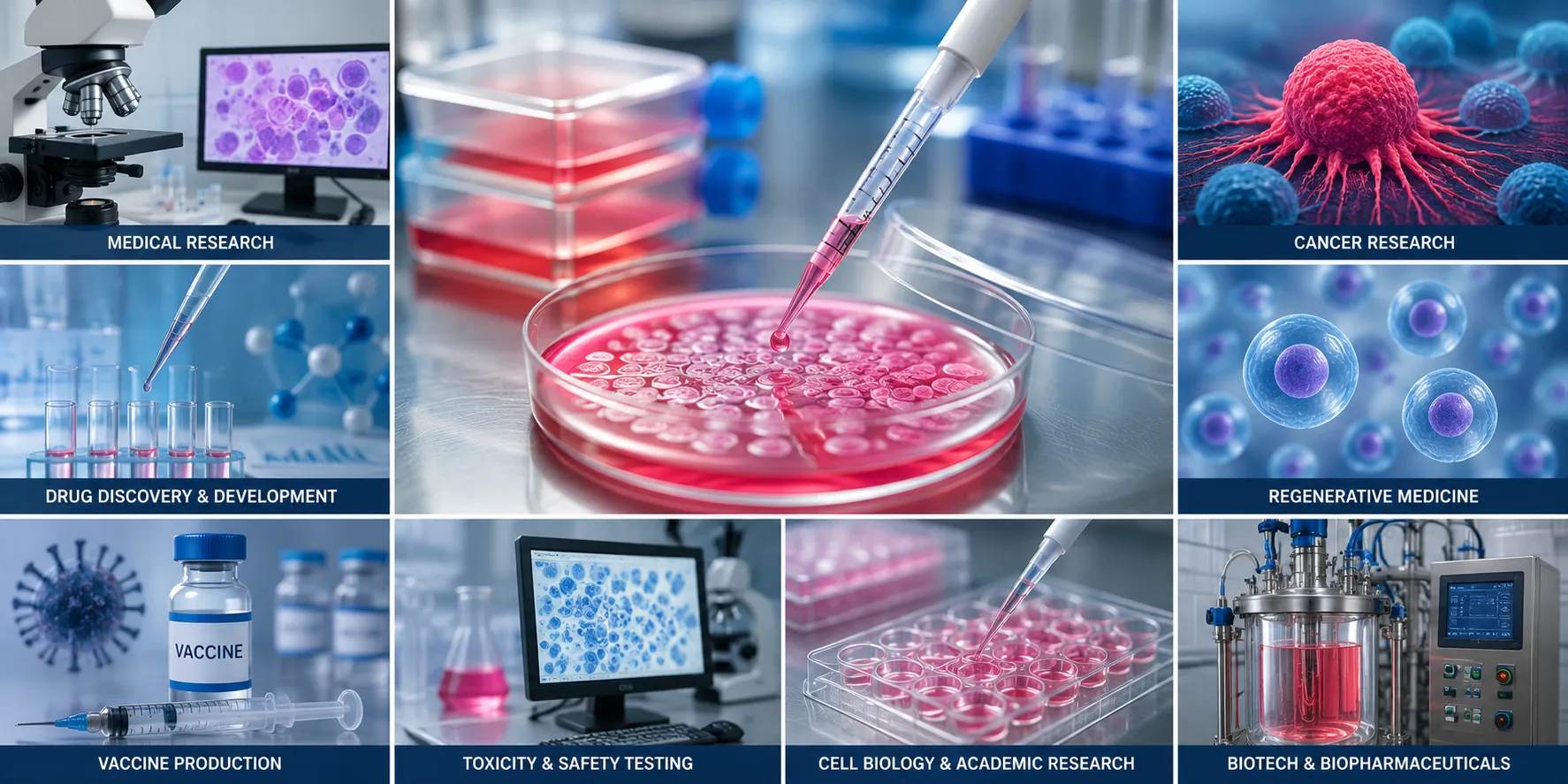
Industries That Use Cell Culture
Cell culture isn't limited to research laboratories.
It is widely used across multiple industries.
| Industry | Major Applications |
|---|---|
| Healthcare | Disease research, diagnostics |
| Pharmaceuticals | Drug discovery and testing |
| Biotechnology | Therapeutic protein production |
| Vaccine Manufacturing | Viral vaccine production |
| Cancer Research | Tumor biology and targeted therapies |
| Regenerative Medicine | Stem cells and tissue engineering |
| Cosmetics | Product safety testing |
| Academic Research | Cell biology, genetics, microbiology |
The growing adoption of cell culture reflects its importance across both scientific research and commercial biotechnology.
Benefits
Cell culture offers several important advantages.
Controlled Environment
Scientists can carefully regulate:
-
Temperature
-
Nutrient supply
-
pH
-
Oxygen levels
This improves experimental accuracy.
Reproducible Results
Because cultured cells grow under standardized conditions, experiments are easier to repeat and verify.
Faster Research
Studying cells directly is often much quicker than conducting experiments using whole organisms.
Reduced Animal Testing
Many early-stage experiments can now be performed using cultured cells, supporting more ethical research practices.
Supports Medical Innovation
From vaccines to cancer therapies, cell culture has accelerated countless medical breakthroughs over the past few decades.
One of the reasons cell culture has transformed biomedical science is that it allows researchers to observe biological processes at the cellular level under controlled conditions. That level of precision would be extremely difficult to achieve inside a living organism, where countless variables interact simultaneously.
Limitations
Despite its advantages, cell culture has certain limitations.
-
Cultured cells don't fully replicate the complexity of the human body.
-
Results obtained in the laboratory don't always translate directly to clinical outcomes.
-
Cell cultures can become contaminated if strict laboratory procedures aren't followed.
-
Maintaining healthy cell lines requires specialized equipment and expertise.
-
Long-term cultures may undergo genetic or behavioral changes over time.
For these reasons, promising laboratory findings are usually followed by animal studies and clinical trials before becoming approved medical treatments.
Common Misconceptions
"Cell culture means growing entire organs."
Not exactly.
Traditional cell culture involves growing individual cells. While organoids and tissue engineering are advancing rapidly, they are specialized applications beyond standard cell culture.
"Cell culture is only used for cancer research."
No.
Although cancer research is a major application, cell culture is equally important in virology, immunology, pharmacology, genetics, regenerative medicine, and biotechnology.
"Cell culture completely replaces animal studies."
Not yet.
Cell culture reduces the need for animal experiments in many situations, but whole-organism studies remain necessary for understanding how treatments affect complex biological systems.
Frequently Asked Questions (FAQs)
1. What is the primary use of cell culture?
Its primary use is to grow cells outside the body so researchers can study diseases, test drugs, develop vaccines, and understand cellular biology under controlled conditions.
2. Why is cell culture important in drug development?
It allows scientists to evaluate drug safety, effectiveness, and toxicity before moving to animal studies and human clinical trials.
3. Is cell culture used to make vaccines?
Yes. Many viral vaccines are produced using cultured cells, making cell culture a critical component of modern vaccine manufacturing.
4. Which industries rely on cell culture?
Healthcare, pharmaceuticals, biotechnology, vaccine manufacturing, regenerative medicine, cosmetics, and academic research all depend heavily on cell culture technology.
5. What is the biggest advantage of cell culture?
Its biggest advantage is the ability to study living cells in a highly controlled and reproducible environment, enabling more accurate scientific research.
Cell Culture at a Glance
| Aspect | Summary |
|---|---|
| Primary Purpose | Grow and study cells outside the body |
| Major Uses | Disease research, drug discovery, vaccine production, regenerative medicine |
| Main Industries | Healthcare, biotechnology, pharmaceuticals, cosmetics |
| Biggest Advantage | Controlled and reproducible experiments |
| Main Limitation | Cannot fully replicate the complexity of a living organism |
Cell culture has become one of the foundations of modern biomedical science. From understanding how diseases develop to producing vaccines and developing life-saving medicines, its applications continue to expand every year. As technologies such as 3D cell culture, organoids, gene editing, and personalized medicine advance, cell culture will remain an essential tool for scientific discovery and future healthcare innovations.
Must Read: who founded cells?