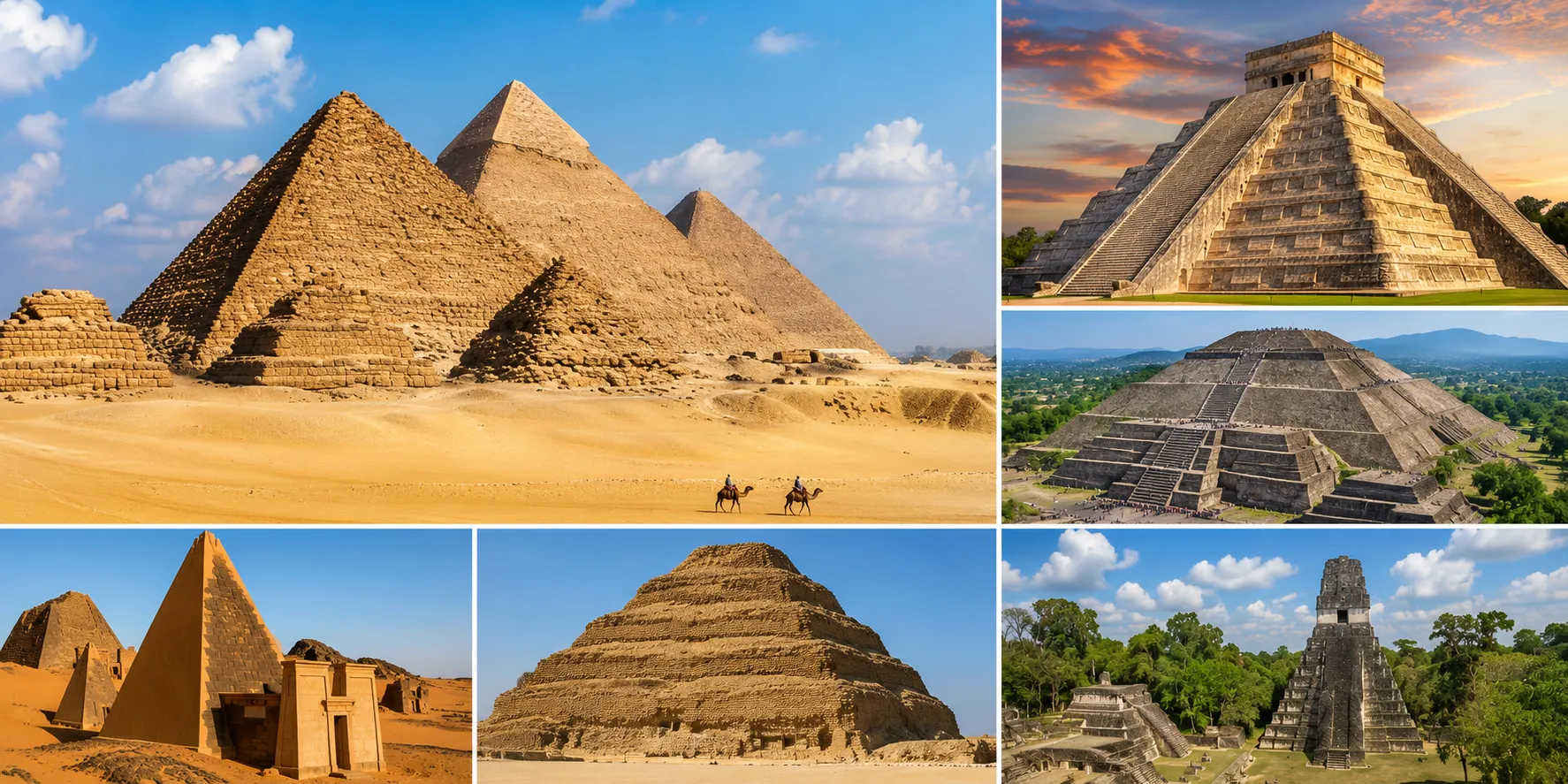
Pyramids are massive geometric structures with a broad base and sloping sides that meet at a point or, in some civilizations, a flat platform at the top. While the Egyptian pyramids are the most famous, pyramids were also built by ancient civilizations such as the Maya, Aztecs, and Nubians. Depending on the civilization, they served as royal tombs, religious temples, ceremonial centers, or monuments. Today, pyramids are considered some of the greatest engineering achievements in human history.
History
The earliest known monumental pyramid is the Step Pyramid of Djoser, built around 2780 BCE at Saqqara in ancient Egypt. Designed by the architect Imhotep, it marked the beginning of pyramid construction in Egypt. Over time, pyramid designs evolved into smooth-sided structures, leading to the construction of the famous Pyramids of Giza, including the Great Pyramid of Khufu.
Centuries later, civilizations in Mesoamerica, including the Maya and Aztecs, built their own pyramids. Unlike Egyptian pyramids, many of these featured staircases leading to temples at the top and were mainly used for religious ceremonies rather than burials.
Timeline of Pyramid Development
| Period | Major Development |
|---|---|
| Around 2780 BCE | Step Pyramid of Djoser built in Egypt |
| Around 2600–2500 BCE | Great Pyramids of Giza constructed |
| Around 1000 BCE onward | Pyramid construction expanded across Mesoamerica |
| Later Egyptian dynasties | Pyramid building gradually declined as burial practices changed |
Purpose
Different civilizations built pyramids for different reasons.
| Civilization | Main Purpose |
|---|---|
| Ancient Egypt | Royal tombs for pharaohs and queens |
| Maya | Religious temples and ceremonial centers |
| Aztecs | Worship, rituals, and public ceremonies |
| Nubians | Burial monuments for rulers |
Egyptian pyramids were designed to protect the bodies of rulers and the treasures buried with them for the afterlife. In contrast, many Mesoamerican pyramids were active places of worship where ceremonies, sacrifices, and astronomical observations took place.
Types
Pyramids vary in design depending on the civilization that built them.
| Type | Description |
|---|---|
| Step Pyramid | Built with stacked levels resembling stairs |
| True Pyramid | Smooth-sided pyramid with triangular faces |
| Bent Pyramid | Changes angle midway due to engineering adjustments |
| Temple Pyramid | Flat-topped pyramid supporting a temple or shrine |
The transition from step pyramids to smooth-sided pyramids reflects significant advancements in ancient engineering and architecture.
Construction
Building pyramids without modern machinery remains one of history's greatest engineering achievements.
Archaeological evidence suggests that ancient Egyptians used:
-
Large limestone and granite blocks
-
Wooden sledges to transport heavy stones
-
Earthen or stone ramps
-
Skilled workers and organized labor teams
-
Boats and Nile waterways to move construction materials
Recent research also indicates that waterways connected to the Nile played an important role in transporting massive stone blocks to construction sites. Although researchers continue to study the exact techniques, there is strong evidence that careful planning, engineering, and skilled labor, not supernatural forces, made pyramid construction possible.
Famous Examples
Some pyramids are recognized worldwide for their history, architecture, and cultural significance.
| Pyramid | Location | Famous For |
|---|---|---|
| Great Pyramid of Giza | Egypt | Only surviving Wonder of the Ancient World |
| Pyramid of Khafre | Egypt | Appears tallest because of higher ground |
| Pyramid of Menkaure | Egypt | Smallest of the three main Giza pyramids |
| Step Pyramid of Djoser | Egypt | World's oldest monumental stone pyramid |
| Pyramid of the Sun | Mexico | One of the largest pyramids in the Americas |
| El Castillo (Temple of Kukulcán) | Mexico | Famous for its astronomical alignment during equinoxes |
Interesting Facts
-
The Great Pyramid of Giza remained the tallest human-made structure in the world for nearly 3,800 years.
-
More than 130 Egyptian pyramids have been discovered so far.
-
The Great Pyramid is the only surviving Wonder of the Ancient World.
-
Egyptian pyramids were originally covered with polished white limestone, making them shine brightly in sunlight.
-
Pyramid-building traditions developed independently in Egypt and the Americas, despite their similar shapes.
Common Misconceptions
"All pyramids are in Egypt."
No.
Although Egypt is home to the world's most famous pyramids, pyramid structures are also found in countries such as Mexico, Sudan, and Guatemala.
"All pyramids were built as tombs."
Not true.
Egyptian pyramids mainly served as royal tombs, while many Mesoamerican pyramids functioned as temples and ceremonial centers.
"Aliens built the pyramids."
There is no credible archaeological evidence supporting this claim.
Research shows that pyramids were built by skilled workers using the engineering knowledge and construction techniques available at the time.
"Every pyramid has a pointed top."
No.
Many pyramids in Mesoamerica have flat tops with temples built above them.
Frequently Asked Questions (FAQs)
1. What are pyramids?
Pyramids are large ancient structures with a broad base and sloping sides, built for purposes such as royal burials, religious ceremonies, and temples, depending on the civilization.
2. Who built the Egyptian pyramids?
They were built by ancient Egyptians under the rule of pharaohs using organized teams of skilled workers and laborers.
3. Why were pyramids built?
Egyptian pyramids mainly served as tombs for rulers, while many Mesoamerican pyramids were built for religious rituals and public ceremonies.
4. Which is the most famous pyramid?
The Great Pyramid of Giza is the most famous pyramid and the only surviving Wonder of the Ancient World.
5. Are pyramids found only in Egypt?
No. Pyramids have also been discovered in countries such as Mexico, Sudan, and Guatemala.
Pyramids are among the greatest architectural achievements of ancient civilizations. Although they are most closely associated with Egypt, pyramid-shaped monuments have been built in different parts of the world for a variety of purposes, including royal burials, religious ceremonies, and cultural celebrations. Their remarkable engineering, historical significance, and enduring mystery continue to fascinate historians, archaeologists, and travelers alike, making them some of the world's most iconic landmarks.
Must Read: 20 Awe-Inspiring Photos of the Ancient Pyramids of Egypt