
V
Vineet Sharma· 20 days ago
Digital Marketer

What is a MUD tax in Texas and why is it on my bill?

4
55

Join this conversation

Sort By
Replying to the question above
Answered on11/23/26

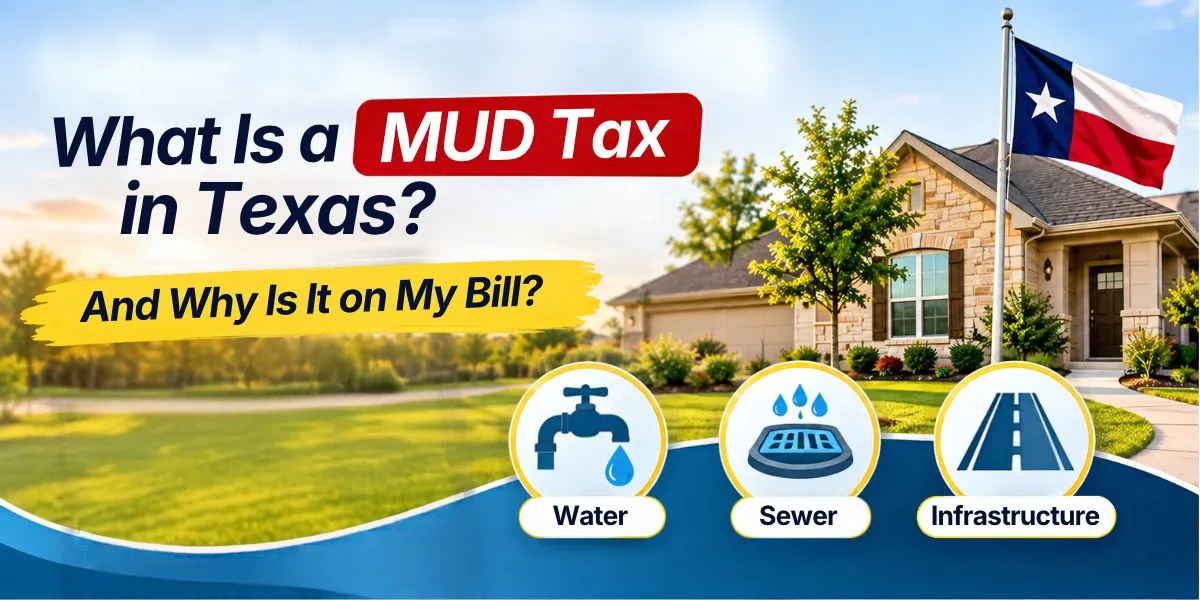
If you own a home in Texas and recently noticed something called a MUD tax on your property tax bill, you might be wondering what it means. MUD stands for Municipal Utility District. It is a local government district that helps provide important services to a neighbourhood, such as water, sewage, drainage and sometimes roads, parks and other facilities.
Article image

Why Do You Have to Pay a MUD Tax?

Many new neighbourhoods in Texas are built in areas where basic services are not already available. Before homes can be built, developers need to arrange things like water lines, sewer systems, drainage facilities and roads.

Building all this infrastructure costs a lot of money. A Municipal Utility District helps finance these projects, often by issuing bonds. The money is then repaid over time through property taxes collected from homeowners within the district.

That is why your property tax bill may include a separate MUD tax.

What Does a MUD Tax Pay For?

The money collected through MUD taxes can help pay for:

  • Water supply and water distribution systems.

  • Wastewater and sewer services.

  • Stormwater drainage facilities.

  • Roads and related infrastructure.

  • Parks and recreational facilities, where provided by the district.

  • Maintenance and operation of district facilities.

The exact services depend on the MUD in your neighbourhood. Not every district provides all these services.

How Is MUD Tax Calculated?

MUD tax is generally based on the taxable value of your property and the tax rate set by your district.

For example, suppose your home's taxable value is $300,000 and the MUD tax rate is $0.50 per $100 of taxable value.

Your estimated annual MUD tax would be:

$300,000 ÷ 100 × $0.50 = $1,500

This is only an example. Your actual amount will depend on your property's taxable value and your district's current tax rate.

Will You Have to Pay MUD Tax Forever?

Not necessarily. Some MUD taxes help repay bonds that were issued to build the neighbourhood's infrastructure. As the district pays down its debt, the tax rate may decrease.

However, a MUD may still need money for daily operations, maintenance and other services. So, you should not assume that the tax will automatically disappear after a certain number of years.

How Can You Check Your MUD Tax?

If you want to understand why you are being charged, start by checking your annual property tax statement.

Look for the name of the Municipal Utility District, its tax rate and the amount charged. You can also contact the district directly and ask how its tax rate is calculated and what the money pays for.

A MUD tax is not a random extra charge on your Texas property tax bill. It helps pay for the infrastructure and services needed to support your neighbourhood. If the amount looks higher than expected, check your district's current tax rate and ask for a breakdown of its charges before making assumptions.
R
View Profile
0
Replying to the question above
Answered on11/04/26

If you own a home in Texas and notice a MUD tax on your property tax bill, you may wonder what it means and why you have to pay it. MUD stands for Municipal Utility District. It is a local government entity that provides essential services such as water supply, wastewater treatment, drainage, and other community infrastructure.

Article image

A MUD tax is a property tax collected from homeowners whose properties are located within a Municipal Utility District. The money helps pay for infrastructure construction, maintenance, and repayment of bonds used to develop the community.

In simple words, if your home is located inside a MUD, you may have to pay this additional property tax to support local utility services and infrastructure.

1. What Is a Municipal Utility District (MUD)?

A Municipal Utility District is a special-purpose local government created under Texas law. It provides essential infrastructure and utility services, particularly in developing communities outside established city service areas.

MUDs are commonly found in growing residential neighborhoods around Houston, Austin, and other Texas communities.

The Texas Commission on Environmental Quality (TCEQ) oversees the creation and regulation of MUDs.

2. Why Is MUD Tax on My Property Tax Bill?

If your property is located within a MUD, the district may collect property taxes to fund its services and financial obligations.

Your MUD tax may help pay for:

  • Water supply systems and pipelines.

  • Wastewater and sewer treatment.

  • Stormwater drainage and flood control.

  • Infrastructure construction and maintenance.

  • Authorized roads, parks, and recreational facilities.

  • Repayment of infrastructure-related bonds.

Your property tax statement may show MUD tax separately from county, city, and school district taxes.

3. How Is MUD Tax Calculated in Texas?

MUD tax is calculated using your property's taxable value and the district's adopted tax rate.

Formula:

MUD Tax = (Taxable Property Value ÷ 100) × MUD Tax Rate

For example:

  • Taxable home value: $300,000

  • MUD tax rate: $0.80 per $100

Annual MUD tax = $2,400.

This is an illustrative example, not an actual statewide rate. Your final amount may be lower if you qualify for applicable property tax exemptions.

4. Does MUD Tax Ever Go Away?

MUD taxes may decrease over time, especially when the district repays its infrastructure bonds. However, they do not automatically disappear.

A district may continue collecting taxes to cover maintenance, operations, and other authorized expenses.

5. Is MUD Tax the Same as a Water Bill?

No. MUD property tax and monthly water bills are different.

  • MUD Tax: Helps finance district infrastructure, debt repayment, and authorized expenses.

  • Water Bill: Covers water consumption, wastewater services, and applicable utility charges.

Depending on your district, you may have to pay both.

6. How Can I Check My MUD Tax Rate?

You can find your property's MUD tax information by:

  1. Checking your annual property tax statement.

  2. Visiting your county appraisal district's official website.

  3. Searching for your property address.

  4. Identifying the Municipal Utility District listed on your tax statement.

  5. Visiting the district's official website to check its current tax rate and financial reports.

You can also contact your county tax assessor-collector for assistance.

Conclusion

A MUD tax in Texas is a local property tax that helps finance essential community infrastructure, including water supply, sewer systems, drainage, and bond repayment. If you see this charge on your property tax bill, it usually means your home is located within a Municipal Utility District.

Before purchasing a home in Texas, always check its MUD tax rate, outstanding bond obligations, and total property tax expenses. This will help you understand the actual cost of homeownership and avoid unexpected expenses.

H
View Profile

Himani Sharma is a subject matter expert and content writer with over 6 years of experience covering travel, government schemes, and personal development across digital platforms in India. She holds a Master's degree in Social Sciences from Banaras Hindu University (BHU), an academic background that informs the research depth and analytical approach she brings to every topic she covers. Her content spans domestic and international travel guides, breakdowns of central and state government welfare schemes, and practical personal development resources for Indian readers navigating career, finance, and everyday life decisions. Her work has appeared on platforms including Nativeplanet, Sarkari Result Blog, and UrbanClap Stories, where she has built a reputation for content that is thoroughly researched, clearly structured, and genuinely useful. Over six years, Himani has published 200+ articles across her subject areas, developing a methodical content approach — verified sources, evidence-based arguments, and writing that serves the reader's actual information need rather than just ranking for keywords. Her subject matter grounding gives her a consistent edge in producing content that holds up to professional scrutiny across three distinct but equally research-intensive categories. Across all her writing, her standard remains the same — research first, clarity always, and content that serves the reader rather than just filling a page.

0
Replying to the question above
Updated on11/04/26

Quick answer: A MUD tax is a property tax charged by a Municipal Utility District, a special local government that builds and runs water, sewer and drainage systems for a neighbourhood. It appears on your property tax bill because homeowners in the district repay the bonds that paid for those pipes, plus the cost of keeping them working.

Why your street has one

When a developer builds homes where no city water or sewer lines exist, someone has to pay for the infrastructure. A developer petitions the Texas Commission on Environmental Quality to create a MUD, and once voters confirm it, the district sells tax-exempt bonds to fund the work. The homeowners who arrive later repay those bonds. In effect, it works like a mortgage for the neighbourhood's plumbing.

What the tax pays for

  • Debt service: repayment of the bonds. This is usually the larger portion.

  • Operations and maintenance: water treatment, repairs and administration. This portion tends to stay steady or creep up.

How to calculate it

Divide your home's assessed value by 100, then multiply the result by the MUD rate. On a $400,000 home with a rate of $0.80 per $100, the bill is $3,200 a year.

What rates look like

Rates depend on how much debt remains. In the Austin area young districts with heavy debt often charge roughly $0.75 to $1.50 per $100, mid-life districts $0.40 to $0.75 and mature ones $0.10 to $0.40.

Will it ever go away

Not completely. The debt often takes decades to retire, and that portion of the tax often falls as bonds are repaid. The operations portion usually remains, and rates can rise again if the district issues new bonds for later phases of the development.

What the seller must tell you

Texas Water Code Section 49.452 requires a written notice to purchasers. It states the district's current tax rate, its voter-approved and issued bonds and any standby fee. The notice must be given before you sign a binding contract. If you were not given it, you may be able to terminate the contract.

Finding your rate

  • Search for your address on your county appraisal district's website and read the taxing entities list.

  • Use the Texas Commission on Environmental Quality's district map to confirm that your address is in a MUD.

Ways to keep the bill in check

You can protest your appraised value, since a lower valuation reduces every tax calculated from it. You can attend board meetings, since the elected board sets your rate.

Sources:

J
View Profile

John Andrew is a research analyst and content writer with over 7 years of experience conducting primary and secondary research across multiple industries. He holds a Master of Science in Applied Research Methods from the University of Edinburgh and a Bachelor of Arts in Social Sciences from the University of Manchester — an academic background that gives his writing a structured, evidence-based approach that distinguishes it from opinion-driven content. His content covers data analysis, industry research, policy evaluation, market trends, and cross-sector insights across topics that require depth, accuracy, and a methodical approach to evidence. His work has appeared on platforms including The Conversation, ResearchGate Blog, and Towards Data Science, where he writes for professionals, academics, and informed readers who need content built on verified research — not aggregated summaries of existing commentary. Over 7 years, John has produced research reports and analytical content for organisations across the public and private sectors, covering topics ranging from policy impact assessments to consumer behaviour analysis. He has published 150+ research-driven articles and reports, contributed to peer-reviewed publications, and is a member of the Market Research Society (MRS), UK. Across all his writing, every claim is sourced, every data point is verified against primary research, and no conclusion is drawn without identifying the evidence and its limitations — because research content that does not show its working is not research, it is assertion.

0