

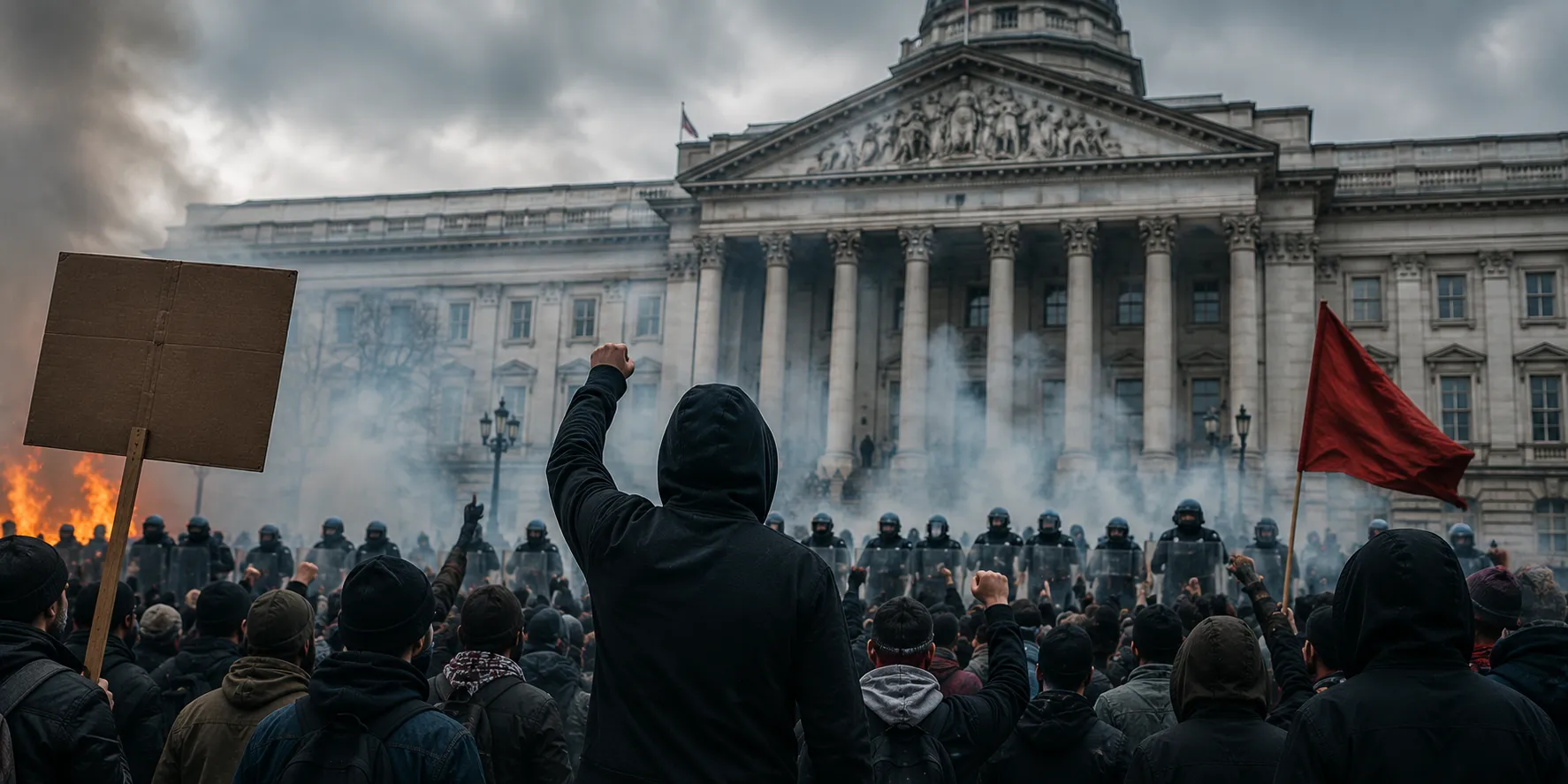
An insurrection is a violent and organized uprising against an established government or its lawful authority. It typically involves a group of people using force, violence, or intimidation to resist, obstruct, or overthrow a government or prevent it from enforcing its laws. Unlike peaceful protests or civil disobedience, an insurrection involves actions that go beyond lawful expression and enter the realm of organized resistance or violence.
The term is commonly used in law, history, and politics to describe serious attempts to challenge government authority. Although the exact legal definition may vary by country, the core idea remains the same: an insurrection is a violent rebellion against a recognized government or its laws.
Legal Meaning
In legal contexts, insurrection generally refers to an organized effort involving force or violence against a government's authority.
For example, under United States federal law (18 U.S. Code § 2383), it is a criminal offense to incite, assist, engage in, or give aid or comfort to a rebellion or insurrection against the authority or laws of the United States. A person convicted under this law may face fines, imprisonment of up to 10 years, and disqualification from holding federal office.
It's important to note that while some laws criminalize insurrection, not every country's legal system defines or prosecutes it in exactly the same way.
Related Terms
Although the terms are sometimes used interchangeably, they have different meanings.
| Term | Meaning |
|---|---|
| Insurrection | A violent uprising against a government or its authority. |
| Rebellion | A broader organized resistance against authority, often involving armed conflict. |
| Revolution | A large-scale movement that seeks to replace an existing political or social system. |
| Riot | A violent public disturbance, usually involving a crowd, but not necessarily aimed at overthrowing a government. |
| Protest | A lawful or peaceful expression of disagreement or opposition. |
| Civil Disobedience | The intentional but generally non-violent violation of laws to protest government policies. |
An important distinction is that peaceful protests and civil disobedience are generally lawful democratic activities, whereas an insurrection involves organized violence or force directed against governmental authority.
Historical Examples
Throughout history, various events have been described by historians or legal authorities as insurrections or attempted insurrections.
| Event | Year | Description |
|---|---|---|
| Whiskey Rebellion | 1794 | Armed resistance against a federal tax in the United States. |
| Easter Rising | 1916 | Irish uprising against British rule. |
| Hungarian Uprising | 1956 | Armed revolt against Soviet-backed rule in Hungary. |
| Warsaw Ghetto Uprising | 1943 | Jewish resistance against Nazi occupation during World War II. |
Whether a specific event is officially classified as an insurrection, rebellion, revolution, or riot may depend on historical interpretation, legal findings, and the country's laws.
Causes
Insurrections can arise from a combination of political, economic, social, and ideological factors.
Common causes include:
-
Political instability
-
Disputes over government legitimacy
-
Economic hardship
-
Perceived injustice or discrimination
-
Civil conflict
-
Ethnic or religious tensions
-
Attempts to overturn government authority
-
Armed resistance against state institutions
Most historians agree that insurrections usually result from multiple underlying causes rather than a single event.
Legal Consequences
Because an insurrection challenges governmental authority, participating in or supporting one can have serious legal consequences.
Depending on the country's laws, consequences may include:
-
Criminal prosecution
-
Imprisonment
-
Financial penalties
-
Disqualification from holding certain public offices
-
Additional charges if violence, property damage, or other crimes occur
In the United States, for example, 18 U.S. Code § 2383 provides penalties for inciting, assisting, or participating in a rebellion or insurrection against federal authority.
Common Misconceptions
"Every protest is an insurrection."
No.
Most protests are peaceful and legally protected forms of free expression. An insurrection generally involves organized violence or force directed against governmental authority.
"An insurrection and a riot are the same."
Not necessarily.
A riot is generally a violent public disturbance, whereas an insurrection specifically involves resistance against government authority or its laws.
"An insurrection always succeeds."
No.
Many insurrections fail or are suppressed before achieving their objectives. Historical records include both successful and unsuccessful attempts.
"Every violent political event is legally classified as an insurrection."
Incorrect.
The legal classification of an event depends on the applicable laws, judicial findings, and factual circumstances. Different jurisdictions may use different legal terms.
Frequently Asked Questions (FAQs)
1. What is an insurrection?
An insurrection is a violent and organized uprising against a government or its lawful authority.
2. Is an insurrection the same as a revolution?
No.
A revolution generally aims to replace an entire political or social system, while an insurrection is an organized uprising against government authority that may or may not lead to broader political change.
3. Is an insurrection illegal?
In many countries, yes.
Participating in or supporting an insurrection can result in serious criminal penalties under applicable laws.
4. What's the difference between an insurrection and a protest?
A protest is typically a peaceful expression of opinion or disagreement, whereas an insurrection involves organized violence or force directed against governmental authority.
5. Can an insurrection happen without weapons?
In legal and historical discussions, insurrections usually involve organized force, violence, or the credible threat of violence. Whether a particular event qualifies depends on the facts and the applicable legal framework.
An insurrection is a serious form of organized resistance involving violence or force against a government or its lawful authority. Although it is sometimes confused with protests, riots, or revolutions, each has a distinct legal and historical meaning. Understanding these differences is important because the term carries significant legal, political, and historical implications. Rather than describing every instance of public unrest, insurrection is generally reserved for events involving organized attempts to challenge or obstruct governmental authority through force.
Must Read: Is Striking Down Adultery Law Constitutionally Right