Cyclosis, also known as cytoplasmic streaming or protoplasmic streaming, is the continuous movement of the cytoplasm within a living cell. This movement helps transport organelles, nutrients, proteins, and other cellular materials from one part of the cell to another, allowing the cell to function more efficiently. Cyclosis is especially common in large plant cells, where simple diffusion alone is too slow to distribute materials throughout the cell.
The movement is driven by interactions between actin filaments (part of the cytoskeleton) and myosin motor proteins, which generate force and move the cytoplasm in a directed flow. Cyclosis is considered an important intracellular transport mechanism that supports cell growth, metabolism, and normal cellular activities.
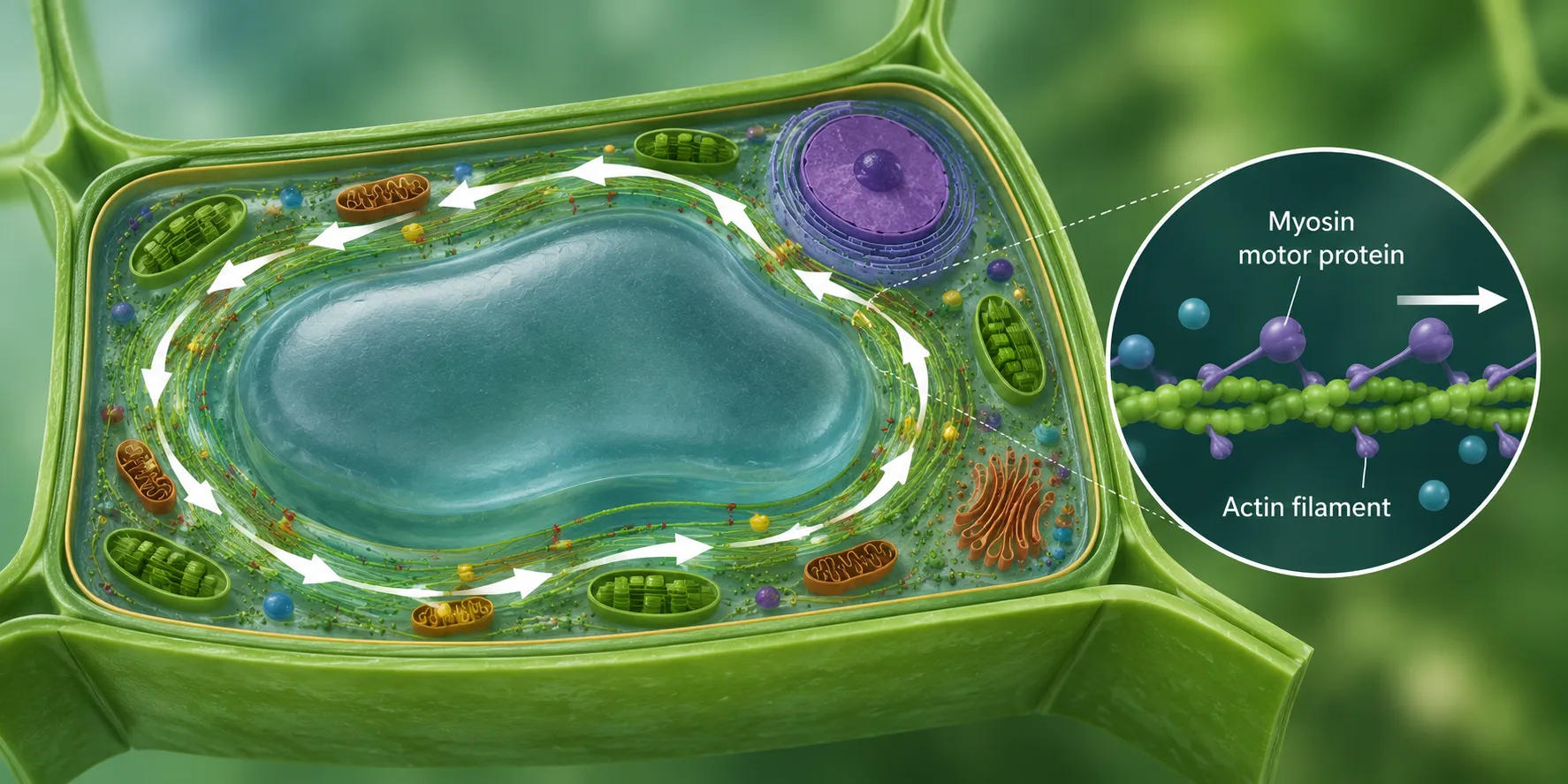
How It Works
Cyclosis occurs through the coordinated action of the cell's cytoskeleton and motor proteins.
The process generally works like this:
-
Actin filaments form pathways inside the cell.
-
Myosin motor proteins move along these actin filaments using energy from ATP.
-
As myosin moves, it carries organelles and other cellular components.
-
This movement creates a flowing motion of the surrounding cytoplasm.
-
The flowing cytoplasm distributes nutrients, proteins, and organelles throughout the cell.
As a result, essential materials reach different parts of the cell much faster than they would by diffusion alone.
Where It Occurs
Cyclosis is found in various living organisms but is most prominent in large cells.
| Organism | Occurrence |
|---|---|
| Plant Cells | Very common, especially in large cells such as Elodea and Chara |
| Green Algae | Frequently observed in species like Chara and Nitella |
| Fungi | Present in many fungal cells |
| Slime Molds | Occurs during movement and growth |
| Some Animal Cells | Observed in certain specialized cells, although generally less prominent |
Because plant cells often contain a large central vacuole, cyclosis helps move the thin layer of cytoplasm around it, ensuring efficient transport within the cell.
Functions
Cyclosis performs several essential functions inside living cells.
-
Transports nutrients to different parts of the cell.
-
Distributes organelles such as chloroplasts and mitochondria.
-
Helps move proteins, enzymes, and other molecules.
-
Supports cell growth and development.
-
Improves intracellular communication.
-
Enhances photosynthesis by repositioning chloroplasts for better light exposure.
-
Makes transport faster than diffusion alone in large cells.
Without cyclosis, large cells would struggle to distribute materials efficiently because diffusion becomes increasingly slow as cell size increases.
Factors Affecting It
Several environmental and cellular factors influence the rate of cyclosis.
| Factor | Effect |
|---|---|
| Temperature | Moderate temperatures generally increase cyclosis; extreme temperatures slow or stop it. |
| Light | Influences chloroplast movement in plant cells. |
| pH | Cyclosis works most efficiently near neutral pH. |
| ATP Availability | Required because myosin motor proteins use ATP for movement. |
| Cytoskeleton Integrity | Damage to actin filaments disrupts cyclosis. |
Changes in these factors can significantly affect the speed and efficiency of cytoplasmic streaming.
Related Processes
Cyclosis is often confused with other cellular transport processes, but they are different.
| Process | Primary Function |
|---|---|
| Cyclosis (Cytoplasmic Streaming) | Moves cytoplasm and organelles throughout the cell. |
| Diffusion | Passive movement of molecules from high to low concentration. |
| Active Transport | Uses ATP to move substances across the cell membrane against a concentration gradient. |
| Osmosis | Movement of water across a selectively permeable membrane. |
A simple way to understand the difference is:
Cyclosis transports materials inside the cell, whereas diffusion, osmosis, and active transport mainly move substances across or within cell membranes.
Importance
Cyclosis is essential for maintaining normal cellular function, particularly in large cells.
Its importance includes:
-
Speeds up intracellular transport.
-
Ensures nutrients reach all parts of the cell.
-
Helps distribute chloroplasts for efficient photosynthesis.
-
Supports cell metabolism.
-
Promotes healthy cell growth.
-
Improves overall cellular efficiency.
-
Reduces the limitations of diffusion in large cells.
Researchers also study cyclosis to better understand intracellular transport, plant physiology, and cell biology.
Common Misconceptions
"Cyclosis only occurs in plant cells."
Not entirely.
Although cyclosis is most noticeable in large plant cells, it has also been observed in algae, fungi, slime molds, and certain animal cells.
"Cyclosis and diffusion are the same."
No.
Diffusion is the passive movement of molecules, whereas cyclosis is the active movement of cytoplasm driven by the cytoskeleton and myosin motor proteins.
"Cyclosis doesn't require energy."
Incorrect.
Cyclosis depends on ATP because myosin motor proteins need energy to move along actin filaments.
"Cyclosis only moves chloroplasts."
No.
It transports many cellular components, including nutrients, proteins, enzymes, mitochondria, vesicles, and other organelles.
Frequently Asked Questions (FAQs)
1. What is cyclosis?
Cyclosis is the continuous movement of cytoplasm within a living cell that transports organelles, nutrients, and other materials throughout the cell. It is also known as cytoplasmic streaming.
2. Where does cyclosis occur?
Cyclosis occurs mainly in large plant cells but is also found in algae, fungi, slime molds, and some animal cells.
3. Why is cyclosis important?
It improves the transport of nutrients, organelles, and other cellular materials, helping cells function efficiently and supporting growth and photosynthesis.
4. What causes cyclosis?
Cyclosis is driven by myosin motor proteins moving along actin filaments using energy from ATP.
5. What is another name for cyclosis?
Cyclosis is also called cytoplasmic streaming or protoplasmic streaming.
Cyclosis is the active movement of cytoplasm inside living cells that enables the rapid transport of nutrients, organelles, and other essential materials. Also known as cytoplasmic streaming, it plays a particularly important role in large plant cells, where diffusion alone cannot efficiently distribute substances throughout the cell. Powered by actin filaments, myosin motor proteins, and ATP, cyclosis supports cell growth, metabolism, photosynthesis, and overall cellular function. Understanding cyclosis provides valuable insight into how living cells maintain efficient internal organization and carry out essential biological processes.
Must Read: Who is the Father of Biology?