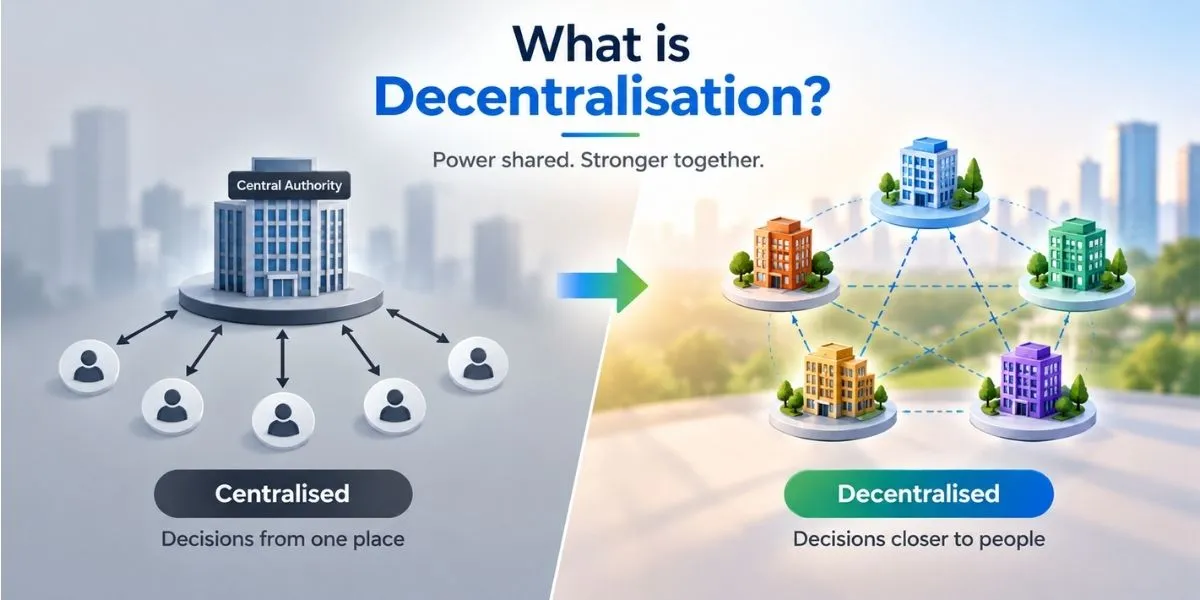
Decentralisation is the process of distributing power, authority, decision-making, and responsibilities from a central authority to smaller units, departments, local governments, organizations, or individuals. In simple words, decentralisation means sharing decision-making power instead of keeping it concentrated at one central level.
The concept of decentralisation is used in many areas, including government, business management, education, finance, technology, and blockchain. It can help organizations and communities make decisions closer to the people or activities they directly affect.
What Is the Meaning of Decentralisation?
The meaning of decentralisation can vary depending on the context. In public administration, it generally refers to transferring certain powers and responsibilities from a central government to regional or local authorities.
In business, decentralisation in management means giving managers or teams greater authority to make decisions instead of requiring every decision to be approved by senior leadership.
For example, a company with offices in different cities may allow local managers to make decisions about staffing, customer service, or day-to-day operations. This can make the organization more responsive to local needs.
Types of Decentralisation
There are several forms of decentralisation:
1. Political Decentralisation
Political decentralisation involves transferring certain decision-making powers to regional or local governments. It can allow local authorities to address issues specific to their communities.
2. Administrative Decentralisation
Administrative decentralisation distributes government functions and responsibilities among different administrative levels or organizations.
3. Fiscal Decentralisation
Fiscal decentralisation involves giving lower levels of government greater responsibility for managing revenues, budgets, and public spending.
4. Business Decentralisation
In business management, decentralisation gives employees, departments, branches, or managers more authority to make operational decisions.
5. Technological Decentralisation
In technology, decentralisation means distributing data, control, or computing processes across multiple systems rather than relying on one central server or authority. Blockchain and decentralised networks are common examples.
Advantages of Decentralisation
Decentralisation can provide several potential benefits:
Faster decision-making: Decisions can be made closer to where problems occur.
Greater flexibility: Local teams can respond to changing circumstances.
Employee empowerment: Employees and managers may receive greater responsibility.
Better local responsiveness: Local authorities can focus on community-specific needs.
Reduced pressure on central leadership: Responsibilities are distributed across multiple levels.
Encouragement of innovation: Teams may have more freedom to experiment and develop solutions.
However, decentralisation can also create challenges. Different units may make inconsistent decisions, coordination can become more difficult, and organizations may need strong systems for accountability and communication.
Decentralisation vs Centralisation
Centralisation concentrates decision-making authority at a central level, while decentralisation distributes authority among multiple levels or units.
For example, in a highly centralised organization, major decisions may require approval from senior management. In a decentralised organization, individual departments or regional managers may have authority to make many decisions independently.
Neither approach is automatically suitable for every situation. The appropriate structure depends on factors such as organizational size, goals, resources, accountability requirements, and the nature of decisions being made.
Simple Example of Decentralisation
Imagine a large retail company with stores across India. Instead of requiring the head office to approve every local decision, store managers may be allowed to adjust certain operations according to local customer demand. This is an example of decentralised decision-making.
Conclusion
In simple terms, decentralisation is the distribution of authority, power, and responsibility away from a single central authority. It can be applied to government, businesses, organizations, and technology.
Understanding what decentralisation is, its types, advantages, limitations, and examples makes it easier to understand how modern organizations and systems distribute decision-making power. When implemented with clear responsibilities, coordination, and accountability, decentralisation can support flexibility, responsiveness, and effective decision-making.
Also Read: what is data science?