S

Shayraa .

Updated on Jun 23, 2026education

What is japanese word for blood?

432
6 Answers

T
Nakul Chauhan | Writer & Knowledge Explorer | Turning Everyday Questions into Cl...
Updated on Jun 23, 2026

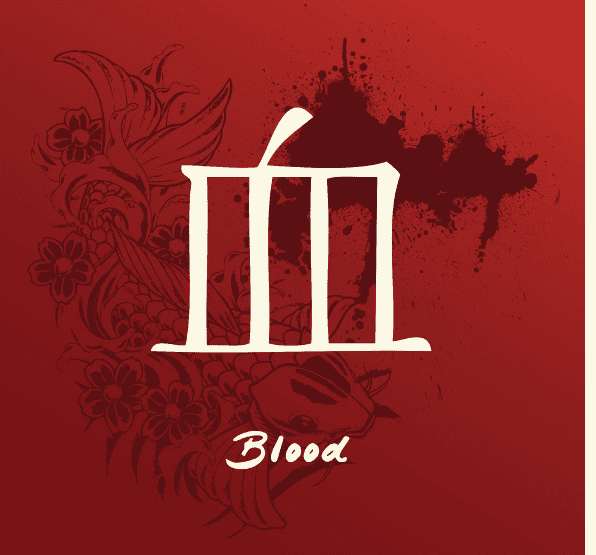
The Japanese word for blood is Chi (血) — pronounced chee, written in Kanji as 血, and in Hiragana as ち.

But there's a second word you must know: Ketsueki (血液) — pronounced ket-su-eh-ki.

Both mean "blood." The difference? Context and formality.

Chi vs Ketsueki — What's the Difference?

 Chi (血)Ketsueki (血液)
PronunciationCheeKet-su-eh-ki
Script血 / ち血液 / けつえき
UsageEveryday speechMedical / formal settings
Example"He's bleeding""Blood test results"

Simple rule:

  • Use Chi in normal conversation
  • Use Ketsueki when talking to a doctor or reading a medical report

Example Sentences

  • 彼の手から血が出ている (Kare no te kara chi ga dete iru) — His hand is bleeding.
  • 血液検査を受けました (Ketsueki kensa wo ukemashita) — I got a blood test.

Blood-Related Japanese Words (Bonus)

EnglishJapaneseRomaji
Blood relation血縁Ketsuen
Vampire吸血鬼Kyūketsuki
Blood demon血に悪魔Chi ni akuma
Bleeding出血Shukketsu
Blood type血液型Ketsueki-gata

Cultural Note Worth Knowing

In Japan, blood type (血液型 / Ketsueki-gata) is taken seriously — people use it the same way Westerners use zodiac signs. It's tied to personality, compatibility, even job hiring. This makes "blood" culturally loaded in Japan beyond just biology.

Quick Answer Summary

  • Everyday word: Chi (血)
  • Formal/medical word: Ketsueki (血液)
  • Kanji character: 血 (this single character covers both)

Also Read: How to say please in Japanese?
 

T
ABOUT THE AUTHORTara Verma

Tara Verma is a practising teacher and education content writer with over 10 years of classroom experience across primary and secondary levels. She holds a Master's degree in Education (M.Ed.) from Delhi University and a Bachelor of Education (B.Ed.) from Jamia Millia Islamia — qualifications that ground her writing in both pedagogical theory and the day-to-day realities of teaching in India. Her content covers exam preparation strategies, learning methodologies, curriculum guidance, student mental health, career counselling for students, and the evolving state of school and higher education in India. Her work has appeared on platforms including TeacherVision India, Jagran Josh, and Careers360, where she writes for students, parents, and fellow educators who need content built on actual teaching experience — not theory alone. Over a decade of working directly with students across age groups and learning levels has given Tara a practical understanding of how education content should be written — clearly, accessibly, and with genuine awareness of the challenges students and teachers face on the ground. She has taught 1,000+ students, contributed to school curriculum development initiatives, and published 250+ articles on education across digital platforms. She is an active member of the National Council of Teachers of English (NCTE) India. Across all her writing, every recommendation is classroom-tested, every insight comes from direct teaching experience, and every article is held to the same standard she applies in her own classroom — accuracy, clarity, and genuine usefulness for the reader.

React
V
Updated on Jun 23, 2026

Traditional Japanese words for blood are jin no shi and a rei, although in modern Japanese, the word is usually written as Ichigo. In English, there are two nouns used to mean "blood," "blood" and "bloody." The word "blood" can be found in place of the term in the name of both TV series and awards: Blood (TV Series) or Bloody (Animated Film). There are several variations of this noun, including hiragana 

V
ABOUT THE AUTHORVanisha Anand

Hey! I am Vanisha Anand from indore, and i am pursuing graduation right now.

221
S
Updated on Jun 23, 2026

Japanese language is a bit difficult for the beginner as it has three types of alphabets Kanji, Hiragana, and Katakana to learn, with each one having a specific role in the language. Hiragana and Katakana are phonetic alphabets and were developed from the main kanji.

There are different ways to say blood in Japanese and it depends on the usage of the word in which context.
Ketsueki is blood in the literal meaning Chi is used when you mean to say the blood relation of a person. From which ancestors they have come from. Chishio also means blood in Japanese.
105
B
Updated on Jun 23, 2026

The Japanese language is considered one of the most difficult to learn with three separate writing alphabets, sentence formation is the opposite of English, and a complicated level of politeness, it's complicated for a beginner.

Blood is known as Ketsueki in the Japanese language. Chishio also is used to mean the same. Chi is used to denote individuals related by blood or descended from the same ancestor. It is said as Romaji buraddo for blood in Hiragana which is the correct Japanese usage of the language.
324
S
Human Behavior Decoder
Updated on Jun 23, 2026

Ouch, so blood is coming out! This is what we say in English. But the same sentence does have a translation in Japanese too. But here we are only going to discuss the Japanese translation of blood in the sentence. We are also going to discuss the Japanese word for vampire and, the Japanese word for red. Because vampires love to drink blood, the color of blood is red. Vampire and red color have a close connection with blood. However, a discussion about the Japanese translation of Blood Dust and blood demons will also be interesting.

  1. 'Chi' is the Japanese translation for the word 'blood'. There is another similar word 'Ketsueki'. But both the words have different meanings.
  2. 'Chi' is the naming word that resembles 'blood' in the Japanese language.
 
Let us now explain the meaning of 'Chi' where it has been used typically.
 
Let us take an example of an English sentence: His hand is bleeding.
 
Its Japanese translation is: kare no te kara chi ga de te iru.
 
Chi is the indication that blood is coming out.
 
Have you heard of “Ketsueki” in kanji? “Ketsueki” is also used in Japanese to mean blood. Both “Ketsueki '' and "chi" have variations in the level of their formality. To express anything more formal concerning the word 'blood', Japanese people prefer to use the word “Ketsueki ''.
 
It concludes that blood has two translations in Japan i.e. 'chi' and 'Akatsuki'. Or we can say that Japanese words that mean blood are “Ketsueki" and "chi".
 
The Japanese word for red is interesting and it is pronounced as Aka.
 
Chi ni akuma is the Japanese word for blood demon.
 
Are you interested to know the Japanese word for vampire? Well, it is Kyūketsuki.
 
Last but not least, the last two interesting Japanese translations are:
  • The Japanese word for blood moon is Buraddo mūn.
  • The Japanese word for bloodlust is Chimamire.
We hope you have the following Japanese translation.
864
R
Updated on Jun 23, 2026

The Japanese language is the Eastern Asian language. It is the national language of Japan. Basically, it is spoken by about 128 million people. It is one of the best foreign languages to learn. As we know learning foreign languages can help in business with the world, trade all over the world, work from foreign countries, etc. The term 'blood' can be pronounced in the Japanese language like Ketsueki, Chi, Chishio, Dokei, Tasatsu, etc. The benefits of learning Japanese are more than others.

R
ABOUT THE AUTHORRIYA KUMARI

I am a quick learner and hardworking person. I am so sincere towards my studies. I am most interested in science and technology. I am always curious about knowing something new.

218