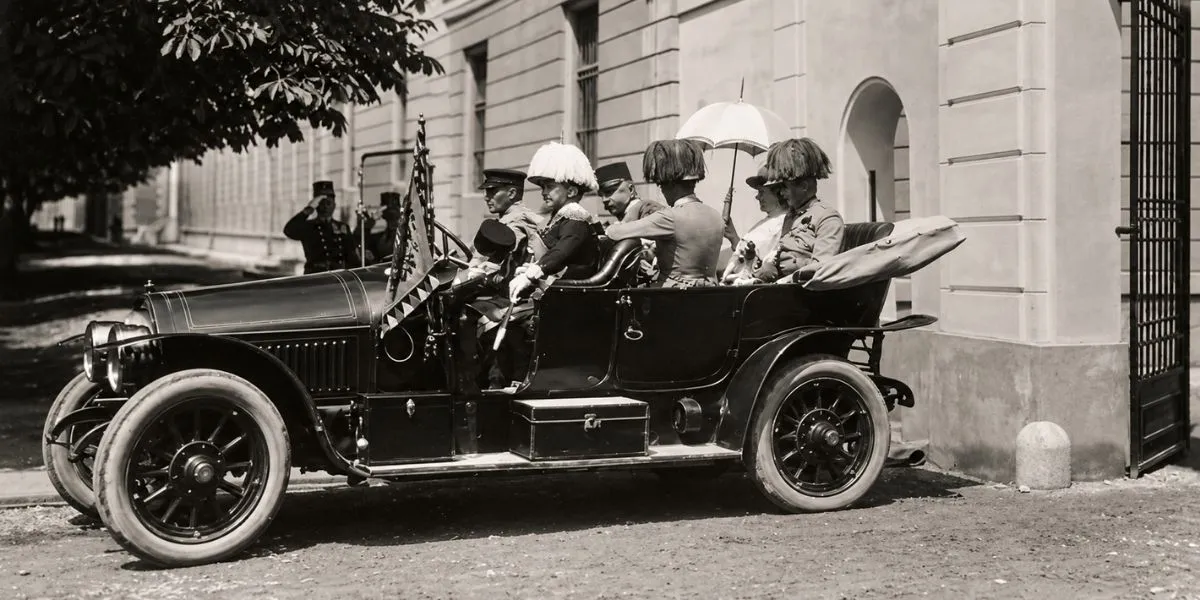
The First World War (World War I) started on 28 July 1914, when Austria-Hungary declared war on Serbia. This declaration followed the assassination of Archduke Franz Ferdinand, heir to the Austro-Hungarian throne, and his wife Sophie in Sarajevo on 28 June 1914. The assassination triggered a diplomatic crisis that quickly developed into a much wider European war.
What Caused the First World War?
The First World War did not have one single cause. Several long-term tensions had developed among European powers before 1914. These included military competition, rival alliances, nationalism, imperial interests, and political disputes.
Europe was divided into major alliance groups. Germany, Austria-Hungary, and Italy were members of the Triple Alliance, while France, Russia, and Britain were associated with the Triple Entente. These alliances meant that a conflict involving one country could quickly involve other major powers.
The Assassination of Archduke Franz Ferdinand
The immediate trigger of the July Crisis was the assassination of Archduke Franz Ferdinand and Sophie in Sarajevo on 28 June 1914. The assassin, Gavrilo Princip, was a Bosnian Serb nationalist.
Austria-Hungary blamed Serbia for the political crisis and presented Serbia with an ultimatum. After the diplomatic situation deteriorated, Austria-Hungary declared war on Serbia on 28 July 1914, beginning the war between the two countries.
How Did the War Spread?
The conflict quickly expanded because of the commitments and alliances among European powers.
Russia supported Serbia, while Germany supported Austria-Hungary. Germany then declared war on Russia and France. Germany's military plan involved moving through neutral Belgium to attack France. Germany's invasion of Belgium helped lead Britain to enter the conflict.
Britain declared war on Germany on 4 August 1914. Within days, what had begun as a conflict between Austria-Hungary and Serbia had developed into a much larger European war.
How Long Did World War I Last?
The First World War lasted from 1914 to 1918. The major fighting ended with the Armistice of 11 November 1918, which took effect on the Western Front and brought the main fighting to an end.
The war had a major impact on soldiers, civilians, governments, and societies across Europe and beyond.
First World War: Key Dates
Event | Date |
|---|---|
Assassination of Archduke Franz Ferdinand | 28 June 1914 |
Austria-Hungary declared war on Serbia | 28 July 1914 |
Germany declared war on Russia | 1 August 1914 |
Britain declared war on Germany | 4 August 1914 |
Armistice ended the major fighting | 11 November 1918 |
Conclusion
The First World War started on 28 July 1914, when Austria-Hungary declared war on Serbia. The assassination of Archduke Franz Ferdinand one month earlier had triggered the July Crisis, while existing alliances, military preparations, nationalism, and political tensions helped turn the crisis into a much larger conflict.
In short, 28 June 1914 was the date of the assassination, while 28 July 1914 is the commonly recognized start date of the First World War.
Also Read: What is education?