Quick Answer
Every student in the Indian education system experiences a mix of anticipation and anxiety as they enter their board exam year. Among all the subjects, Mathematics often carries the heaviest weight and the highest expectations. If you are a student or a parent navigating this crucial academic milestone, you might pause and ask: "Why CBSE Maths Class 10 is Important?" The answer goes far beyond simply passing a board examination. Class 10 Mathematics acts as the ultimate academic crossroads. It is the foundational stepping stone for stream selection in Class 11, the bedrock for national competitive exams, and a critical tool for developing the logical and analytical thinking skills required in everyday adult life.
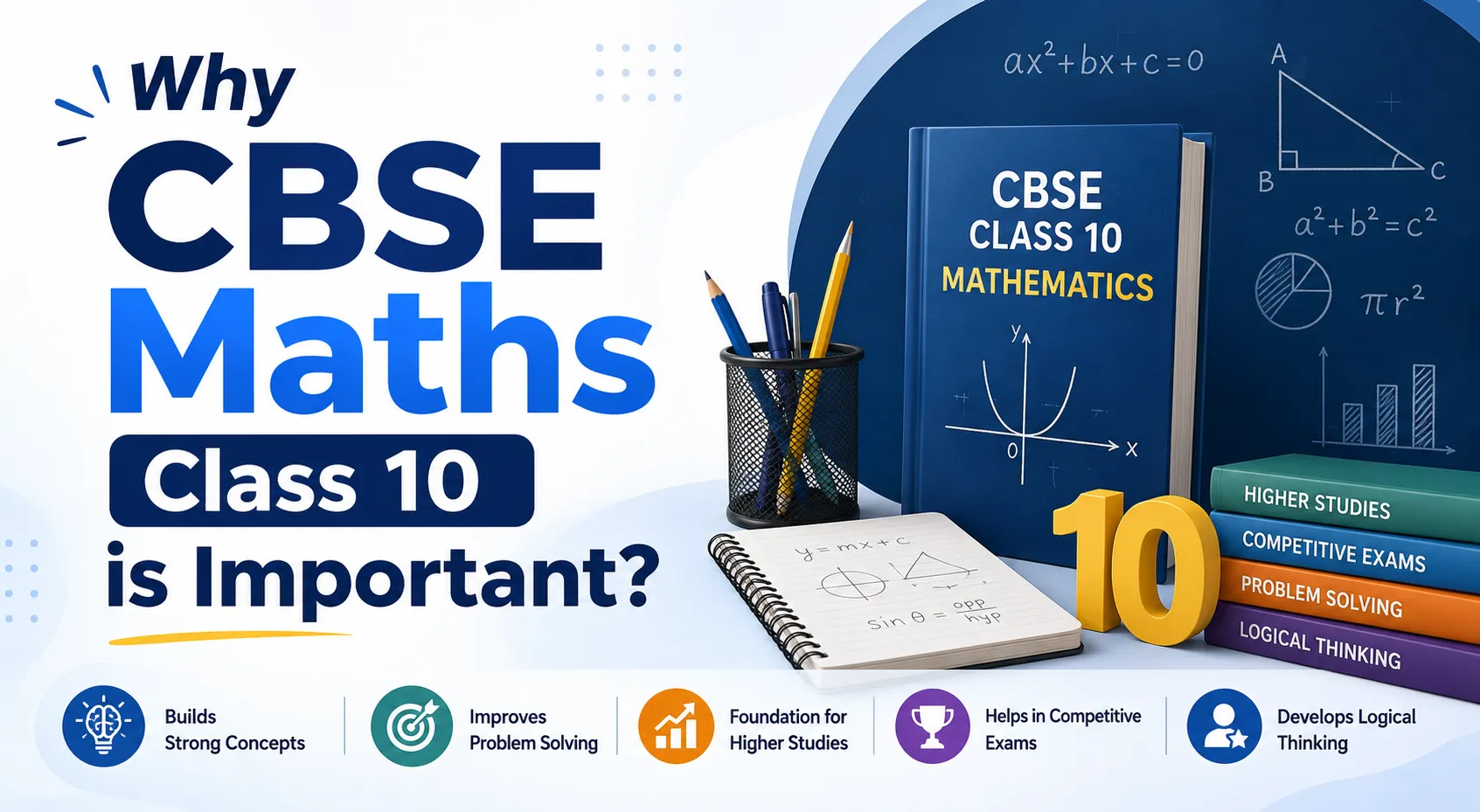
The Gateway to Higher Education and Stream Selection
In the Central Board of Secondary Education (CBSE) curriculum, Class 10 is the final year where all students study a uniform syllabus. Once you clear this hurdle, you must choose a specific academic stream: Science, Commerce, or Humanities. Your performance and understanding of Class 10 Mathematics play a pivotal role in this decision.
If you dream of pursuing engineering, architecture, or pure sciences, a strong command of algebra, trigonometry, and geometry is absolutely non-negotiable. Even if you choose Commerce, subjects like Accountancy, Economics, and Financial Management rely heavily on the statistical and arithmetic foundations laid in Class 10. By mastering this subject now, you keep all of your future academic and career doors wide open.
Building Real-World Analytical Skills
Beyond the classroom, mathematics is the language of logic. The CBSE Class 10 syllabus is designed not just to test memory, but to build cognitive frameworks. When you solve complex word problems in linear equations or calculate surface areas, you are actually training your brain to break down large, intimidating problems into smaller, manageable steps. This type of analytical thinking is highly transferable and is required in almost every modern profession, from software development and digital marketing to business management and architecture.
Class 10 Syllabus and Future Relevance at a Glance
To better understand how this specific curriculum shapes your future, here is a breakdown of key Class 10 mathematical concepts and their real-world or future academic applications:
Key Mathematical Concept | Focus in Class 10 | Future Academic & Career Relevance |
|---|
Trigonometry | Basics of angles, heights, and distances. | Essential for Physics, Engineering, Architecture, and Astronomy. |
Algebra (Quadratic Equations) | Finding roots and solving variables. | The backbone of Computer Science, Coding, and Economics. |
Statistics & Probability | Mean, median, mode, and chance. | Crucial for Data Science, Market Research, and Financial Analysis. |
Mensuration (Surface Area & Volume) | Calculating 3D shapes and capacities. | Used heavily in Civil Engineering, Interior Design, and Manufacturing. |
Top Benefits of Mastering the Subject
Understanding exactly Why CBSE Maths Class 10 is Important? helps alleviate exam anxiety by replacing it with a sense of purpose. Here are the core benefits of dedicating yourself to this subject:
Foundation for Competitive Exams: National-level entrance exams like JEE (Joint Entrance Examination), NEET, NDA (National Defence Academy), and even banking or civil service exams (UPSC) heavily test the quantitative aptitude and basic mathematics taught at the Class 10 level.
Boosts Overall Percentage: Mathematics is a highly scoring subject. Unlike literature or social sciences where marks can be subjective, a correct mathematical answer yields full marks, significantly boosting your overall board exam aggregate.
Improves Financial Literacy: Concepts like compound interest, percentages, and statistics taught in middle and high school are the exact tools you need to manage personal finances, investments, and taxes in adulthood.
Options Between Standard and Basic: CBSE now offers "Standard" and "Basic" maths, allowing students to choose a difficulty level aligned with their future goals, reducing unnecessary stress for those pursuing the Arts.
Frequently Asked Questions (FAQs)
Are NCERT books sufficient for scoring 90+ in Class 10 Maths?
Yes, the NCERT textbook should be your primary resource. The CBSE board strictly follows the NCERT syllabus, and the majority of board exam questions are directly sourced or slightly modified from this book. Only after mastering NCERT should you move on to reference books like R.D. Sharma or R.S. Aggarwal for extra practice.
What is the difference between Basic and Standard Maths in CBSE?
Introduced recently by CBSE, Standard Maths is for students who wish to pursue Mathematics at the Senior Secondary level (Class 11 and 12). Basic Maths is an easier paper designed for students who do not plan to study Mathematics after Class 10, typically those opting for Humanities or medical streams without Math.
How can I overcome the fear of Class 10 Mathematics?
The fear of math usually stems from a weak foundation in earlier classes. The best way to overcome it is through consistent, daily practice. Focus on understanding the "why" behind a formula rather than just memorizing it. Solving previous years' question papers and taking timed mock tests will also drastically reduce exam-day anxiety.
Conclusion
Whenever a student feels overwhelmed by formulas and asks, "Why CBSE Maths Class 10 is Important?", it is crucial to look at the bigger picture. This subject is not merely an academic hurdle designed to cause stress; it is a vital training ground for the mind. By dedicating time to understand these core concepts, you are not just preparing for a three-hour board exam. You are actively building the logical reasoning, problem-solving skills, and academic foundation that will serve you throughout your higher education and well into your professional career.
Sources & References: CBSE
Also Read: Why are the NCERT books so confusing for students?