
K
Kanika Kapur· 5 years ago
Exploring innovations, digital trends, and scientific discoveries through reliable, practical, and easy-to-understand content.

How is North Pole different from South Pole ?

0
1.3K

Join this conversation

Sort By
Replying to the question above
Updated on07/21/26

The North and South Poles are the two extreme points of Earth, located at opposite ends of the planet. Although both regions are known for freezing temperatures, vast ice-covered landscapes, and months of continuous daylight or darkness, they are surprisingly different. Their geography, climate, wildlife, and human activity set them apart in many ways. Understanding these differences also helps explain their importance in Earth's climate system and why scientists closely monitor these regions.
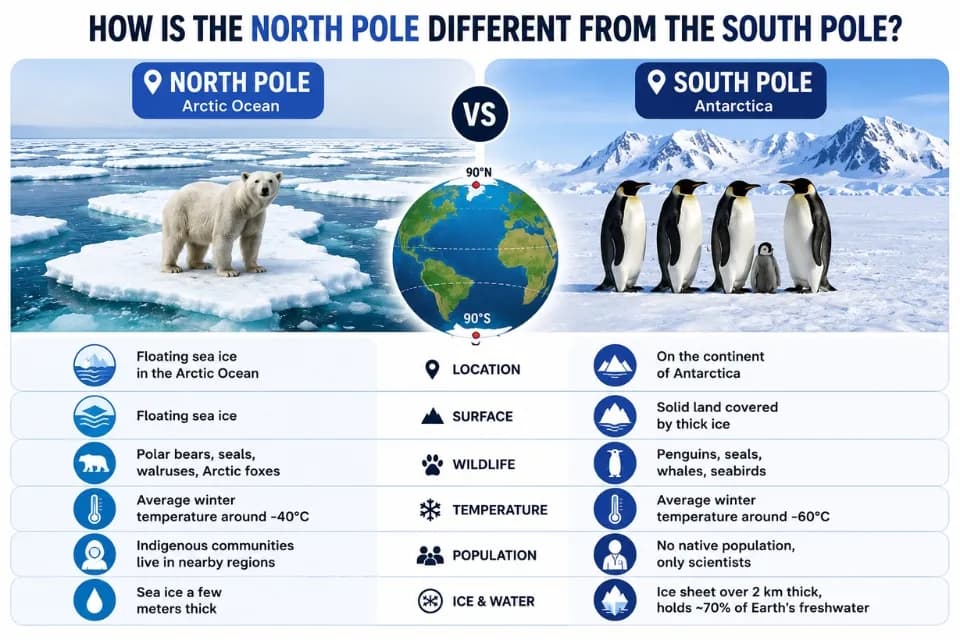
 

Comparison infographic showing the differences between the North Pole and South Pole, including location, climate, wildlife, temperature, ice type, and human presence.

Many people search for the North Pole and South Pole to understand how they differ or ask questions such as "Is the North Pole actually the South Pole?" While these questions may seem confusing, the answer becomes clear once you understand the difference between Earth's geographic poles and its magnetic poles.

Key Takeaways

  • The North and South Poles are located at opposite ends of Earth.

  • The North Pole is a floating sheet of sea ice in the Arctic Ocean, while the South Pole is located on the continent of Antarctica.

  • Antarctica is colder because it sits on a high-altitude landmass covered by thick ice.

  • Polar bears live in the Arctic, whereas penguins naturally live around Antarctica.

  • Neither geographic pole has a permanent population, although scientists regularly conduct research in both regions.

  • Questions such as "Is the North Pole actually the South Pole?" are based on magnetic terminology rather than geography.

What Are the North and South Poles?

The North and South Poles mark the points where Earth's axis of rotation meets the planet's surface. The North Pole lies at 90° North latitude in the middle of the Arctic Ocean, while the South Pole lies at 90° South latitude on the Antarctic continent.

Although both locations experience extreme cold and long polar nights, they are formed in completely different environments. The Arctic is an ocean surrounded by continents, whereas Antarctica is a continent surrounded by oceans.

Major Differences Between the North Pole and South Pole

1. Geography

The biggest difference is the surface beneath the ice.

North Pole

  • Located in the Arctic Ocean

  • Covered by floating sea ice

  • No permanent land underneath

South Pole

  • Located on Antarctica

  • Covered by a massive ice sheet

  • Built on solid continental land

This geographical difference affects everything from climate to wildlife.

2. Climate

The South Pole is significantly colder than the North Pole.

At the North Pole, winter temperatures usually average around −40°C, while summer temperatures can approach the freezing point. The South Pole often experiences winter temperatures below −60°C, making it the coldest place on Earth.

The higher elevation of Antarctica and the absence of the ocean's warming influence explain why it remains much colder throughout the year.

3. Wildlife

Wildlife differs greatly between the two polar regions.

Animals commonly found in the Arctic include:

  • Polar bears

  • Arctic foxes

  • Walruses

  • Seals

  • Beluga whales

  • Snowy owls

Animals commonly found in Antarctica include:

  • Emperor penguins

  • Adélie penguins

  • Leopard seals

  • Elephant seals

  • Orcas

  • Various seabirds

One interesting fact is that polar bears and penguins never meet in the wild because they live on opposite sides of the Earth.

4. Human Presence

There are no permanent cities at either geographic pole.

However, Indigenous communities have lived in Arctic regions near the North Pole for thousands of years. In contrast, Antarctica has no native population. Only scientists and support teams stay temporarily at research stations to study weather, climate, wildlife, and astronomy.

5. Ice and Freshwater

The Arctic's sea ice generally measures only a few meters thick and floats on ocean water. Antarctica, however, contains an ice sheet that is several kilometers thick and stores nearly 90% of Earth's freshwater ice. This makes Antarctica one of the most important freshwater reserves on the planet.

Is the North Pole Actually the South Pole?

A common online question is "Is the North Pole actually the South Pole?"

The answer is No.

The geographic North Pole and South Pole are fixed locations at opposite ends of Earth. The confusion comes from Earth's magnetic field. In magnetic science, the area known as the Magnetic North Pole behaves like a magnetic south pole because opposite magnetic poles attract. However, this scientific concept does not change the geographic positions of Earth's poles.

Is the North Pole Really the South Pole?

Another frequently searched question is "Is the North Pole really the South Pole?"

Again, the answer is No.

The geographic North Pole remains Earth's northernmost point, while the geographic South Pole remains its southernmost point. Magnetic poles and geographic poles are different scientific concepts, which is why many people misunderstand this topic.

Why Are the Polar Regions Important?

The polar regions play a critical role in maintaining Earth's climate. Their bright ice reflects sunlight back into space, helping regulate global temperatures. They also influence ocean currents, weather systems, and sea levels.

Scientists continue to study these regions because climate change is causing Arctic sea ice to shrink and parts of Antarctica's ice sheets to melt. These changes can affect ecosystems, weather patterns, and coastal communities around the world.

Quick Comparison Table

FeatureNorth PoleSouth PoleLocationArctic OceanAntarcticaSurfaceFloating sea iceSolid land covered by iceHemisphereNorthernSouthernAverage Winter TemperatureAround −40°CAround −60°CElevationNear sea levelAbout 2,835 metersFamous WildlifePolar bearsPenguinsNative PopulationIndigenous communities nearbyNone

Did You Know?

Although both poles remain frozen for most of the year, the Arctic is actually an ocean covered by sea ice, while Antarctica is the world's fifth-largest continent hidden beneath an enormous ice sheet. This single difference explains why the South Pole is colder, drier, and windier than the North Pole.

Frequently Asked Questions (FAQs)

What is the main difference between the North Pole and South Pole?

The North Pole is located on floating sea ice in the Arctic Ocean, while the South Pole is located on the continent of Antarctica beneath a thick ice sheet.

Which pole is colder?

The South Pole is colder because it sits on a high-altitude continent and lacks the warming effect of the surrounding ocean.

Is the North Pole actually the South Pole?

No. They are different geographic locations. The confusion comes from the way Earth's magnetic field works.

Is the North Pole really the South Pole?

No. Geographic poles and magnetic poles are separate scientific concepts with different meanings.

Why are the poles important?

They help regulate Earth's climate, influence ocean currents, support unique ecosystems, and provide valuable scientific information about climate change.

Key Perspective

The North and South Poles may both appear as frozen wildernesses, but they are remarkably different. The North Pole is a floating ice-covered ocean surrounded by Arctic nations, while the South Pole stands on the continent of Antarctica beneath one of the thickest ice sheets on Earth. These differences influence their climate, wildlife, and role in the global environment.

Learning about the North Pole and South Pole also helps answer common questions such as "Is the North Pole actually the South Pole?" and "Is the North Pole really the South Pole?" By understanding the distinction between geographic and magnetic poles, it becomes easier to separate myths from scientific facts. As climate change continues to affect both regions, protecting these unique environments is essential for the future of our planet.

You May Also Like

Source & Reference:

Joe Rose
Eleven years building systems at scale — writing about technology from the inside, where architecture decisions have real consequences.
View Profile

Joe Rose is a Systems Architect and science and technology writer with over 11 years of hands-on experience designing and building large-scale distributed systems, cloud infrastructure, and enterprise technology solutions. He holds a Master of Science in Computer Science from Carnegie Mellon University and a Bachelor of Engineering in Software Engineering from the University of Toronto — credentials that anchor his technical writing in one of the most rigorous engineering traditions in North America. His content covers systems design, cloud architecture, distributed computing, cybersecurity, AI and machine learning infrastructure, software engineering best practices, and the practical implications of emerging technology for enterprises and developers. His work has appeared on platforms including IEEE Spectrum, Wired, and ACM Queue, where he contributes technically rigorous articles and analyses for engineers, technology leaders, and informed readers who want science and technology content written by someone who has actually built the systems being discussed. Over 11 years, Joe has architected enterprise systems for organisations across North America and Europe, working across sectors including fintech, healthcare technology, and cloud infrastructure. He holds AWS Solutions Architect Professional and Google Cloud Professional Cloud Architect certifications, has published 300+ articles and technical papers, and has presented at AWS re:Invent and QCon London. He is a Senior Member of the Institute of Electrical and Electronics Engineers (IEEE). Across all his writing, every technical claim is verified against current engineering practice, every architectural recommendation reflects real-world implementation experience, and no technology trend is covered without examining the systemic tradeoffs that practitioners actually face — because technology writing that ignores how systems behave under real conditions is not useful to the people who build them.

0
Replying to the question above
Answered on06/23/26

The North Pole and the South Pole are the two opposite ends of the Earth, but they are very different from each other. The North Pole lies in the middle of the Arctic Ocean and is covered by floating sea ice, while the South Pole is located on the continent of Antarctica and sits on a massive sheet of land covered with ice.

Whenever people hear the words North Pole and South Pole, they usually think they're almost identical because both are freezing cold. In reality, they're completely different in terms of geography, wildlife, climate, and even who lives there.

What Is the North Pole?

The North Pole is the northernmost point on Earth.

It is located in the Arctic Ocean, so there is no land beneath it, only thick floating sea ice. The Arctic is home to animals like polar bears, Arctic foxes, seals, and walruses.

There are no permanent cities at the North Pole, but people do live in other parts of the Arctic region.

What Is the South Pole?

The South Pole is the southernmost point on Earth.

Unlike the North Pole, it sits on the continent of Antarctica, which is covered by a thick ice sheet. Antarctica has no permanent human population, although scientists from different countries stay there temporarily for research.

The South Pole is also colder and drier than the North Pole.

North Pole vs South Pole

FeatureNorth PoleSouth Pole
LocationArctic OceanAntarctica
SurfaceFloating sea iceLand covered with ice
HemisphereNorthern HemisphereSouthern Hemisphere
Average TemperatureWarmer than the South PoleColdest place on Earth
People Living NearbyYes, in Arctic regionsNo permanent residents
Famous AnimalsPolar bears, walruses, Arctic foxesPenguins, seals
Country OwnershipNo single country owns itGoverned under the Antarctic Treaty

Interesting Facts

Here are a few fascinating facts:

  • Polar bears live in the Arctic, but not in Antarctica.

  • Penguins live in Antarctica, but not at the North Pole.

  • The South Pole receives less snowfall than many people expect because Antarctica is technically a polar desert.

  • Both poles experience about six months of daylight followed by six months of darkness each year.

North Pole vs South Pole at a Glance

FeatureDetails
North PoleOcean covered by floating sea ice
South PoleContinent covered by ice
Coldest PoleSouth Pole
Home to Polar BearsNorth Pole
Home to PenguinsSouth Pole
Permanent Human PopulationNone at either pole

Although both poles are extremely cold, they are far from being the same. The North Pole is an ocean covered with ice, while the South Pole is a continent buried beneath a massive ice sheet. They support different wildlife, have different climates, and play an important role in regulating Earth's climate.

Must Read: How many continents are there in the world?

A
Making geography easy through simple comparisons and real facts
View Profile

Aanya Sharma is a science and technology writer with over 5 years of experience and 300+ published articles across leading digital platforms. She holds a Bachelor's degree in Science (Physics) from Delhi University, which grounds her writing in scientific literacy and gives her the ability to evaluate technical claims with accuracy. Her work has appeared on platforms including The Wire Science, Analytics India Magazine, and Digit.in, where she has covered artificial intelligence, space exploration, consumer technology, environmental science, and emerging tech policy. With a focus on accuracy and clarity, her writing makes complex scientific and technological developments accessible to readers without a technical background. Aanya has participated in science communication panels at events including the India Science Festival and has been recognised as a contributor to responsible tech journalism in India. She is an active member of the National Association of Science Writers (NASW) and maintains a public portfolio of her published work. Across all her work, her writing is grounded in verified sources and a commitment to editorial standards — delivering content that readers can rely on in a space where misinformation spreads easily.

0
Replying to the question above
Answered on05/26/21

North & South Poles are top & bottom of the world, where daylight is for six months & other six are of the night. Both have extreme temperatures and are icy cold places. Planet EARTH spins on the axis which gives us day & night. The axis is slightly tilted & it’s each end is categorized as NORTH & SOUTH POLE. The structure of imaginary lines which runs between the poles are called LONGITUDES. Other which runs around the globe are called LATITUDES. Poles are located at 90 degrees north & 90 degrees south.

NORTH POLE is further classified into 3 types, namely GEOGRAPHIC, MAGNETIC, and GEOMAGNETIC. The north pole mainly consists of sea ice, which is located about 725 km of Greenland, in the middle of the ARCTIC Ocean. A magnetic pole is formed due to the magnetic fields that are generated deep from the core of the earth. Slowly & gradually they keep flipping from north to south, on a very long time scale. Magnetic North Pole is about 160 km south of the geographic north pole.

The first people to reach the North Pole were ROBERT PEARY & MATTHEW HENSON, with four Inuit guides, on the 9th of April 1909. RONALD AMUNDSEN was the first person to see both poles.

SOUTH POLE is further classified into 4 types, namely GEOGRAPHIC POLE, MAGNETIC POLE, GEOMAGNETIC POLE and CEREMONIAL SOUTH POLE. The geographic south pole is the bottom part of the earth’s axis, from where longitude lines on the map radiate out. RONALD AMUNDSEN, on the 14th of December 1911, leads the first expedition to reach the south pole. Whereas, ROBERT FALCON SCOTT reached the pole five weeks later, on 18th January 1912. CEREMONIAL SOUTH POLE is the decorated copper pole surrounded by the flags of the 12 original Nations that signed the Antarctic Treaty and have their territories here. Magnetic Southpole is in the Antarctic Ocean & not located on Antarctica. It’s the southern pole of the earth’s magnet field. This also has a technical name is SOUTH MAGNETIC DIP POLE. Here compass needle can move vertically as well as horizontally, points straight up.

K
View Profile

I'm ambitious. I love to explore & read about various topics. Keen in building a career in writing.

0