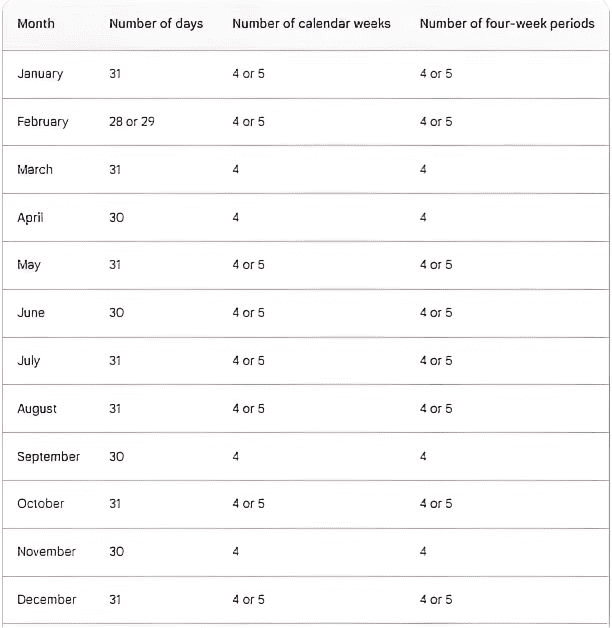
When people ask, "How many weeks are in a month?", they're usually looking for a simple answer. While many people say a month has 4 weeks, that's only true for a 28-day month. In reality, the average month contains 4.345 weeks, because calendar months range from 28 to 31 days.
Whether you're calculating payroll, pregnancy weeks, budgeting, fitness goals, or planning a schedule, knowing the average number of weeks in a month can help you make more accurate calculations.
In this guide, you'll learn:
The average number of weeks in a month.
How many weeks are in 28, 29, 30, and 31-day months.
Why a month isn't exactly four weeks.
Common conversions between months and weeks.
Answers to frequently asked questions.
Weeks in a Month at a Glance
If you're looking for a quick answer, here's an easy reference table.
Month Length | Number of Weeks |
|---|---|
28 days | 4 weeks |
29 days | 4 weeks and 1 day |
30 days | 4 weeks and 2 days |
31 days | 4 weeks and 3 days |
Average month | 4.345 weeks |
Understanding How Many Weeks Are in a Month
Unlike weeks, which always contain 7 days, calendar months have different lengths. That's why there isn't one exact answer for every month.
1. A 28-Day Month
February in a common year has 28 days, making it the only month with exactly 4 weeks.
2. A 29-Day Month
During a leap year, February has 29 days, which equals 4 weeks and 1 extra day.
3. A 30-Day Month
Months with 30 days contain 4 weeks and 2 extra days.
Examples include:
April
June
September
November
4. A 31-Day Month
Months with 31 days contain 4 weeks and 3 extra days.
Examples include:
January
March
May
July
August
October
December
Why Isn't Every Month Exactly Four Weeks?
Many people assume one month equals four weeks because:
Four weeks equals 28 days.
It's easy to remember.
Many planners and schedules use four-week cycles.
However, since most months have 30 or 31 days, they extend beyond four complete weeks.
Looking at an entire year:
365 days ÷ 7 = 52.143 weeks
52.143 weeks ÷ 12 months = 4.345 weeks per month
This is why 4.345 weeks is the accepted average.
When Does the Average Matter?
Knowing the average number of weeks in a month is useful for:
Payroll
Many employers convert monthly salaries into weekly earnings using 4.345 weeks per month.
Budgeting
Monthly budgets can be converted into weekly spending plans more accurately.
Pregnancy
Pregnancy is measured in weeks, so understanding month-to-week conversions helps expectant parents track milestones.
Fitness and Goal Planning
Workout plans, savings goals, and study schedules often require converting months into weeks.
Month-to-Week Conversion Examples
Time Period | Approximate Weeks |
|---|---|
1 month | 4.345 weeks |
2 months | 8.69 weeks |
3 months | 13.04 weeks |
6 months | 26.07 weeks |
12 months | 52.14 weeks |
Frequently Asked Questions
How many weeks are in one month?
On average, one month contains 4.345 weeks, although the exact number depends on whether the month has 28, 29, 30, or 31 days.
Is a month exactly four weeks?
No. Only a 28-day month has exactly four weeks. Most months contain four weeks plus additional days.
How many weeks are in 30 days?
Thirty days equals 4 weeks and 2 days.
How many weeks are in 31 days?
Thirty-one days equals 4 weeks and 3 days.
Why do people say a month has four weeks?
People usually round down because it's simpler for everyday conversation. For calculations, 4.345 weeks per month is much more accurate.
How many weeks are in a year?
A calendar year contains approximately 52.143 weeks, commonly rounded to 52 weeks.
Key Takeaways
A month contains approximately 4.345 weeks on average.
A 28-day month has exactly 4 weeks.
A 29-day month has 4 weeks and 1 day.
A 30-day month has 4 weeks and 2 days.
A 31-day month has 4 weeks and 3 days.
The average is calculated by dividing 52.143 weeks in a year by 12 months.
Understanding these differences makes it easier to calculate salaries, budgets, pregnancy timelines, project schedules, and other time-based plans more accurately.
Source & Reference:
Also Read