Asked 6 years ago

How Many Weeks are in a Year?

Education#Online discussion forum#how many days in a year#how many weeks in a month#how many days are in a year
Like
2
9.6K
C
Chhavi TyagiAuthor

Advertisement

Hey, help the community by sharing your answer.

Earn up to 300 points for helpful answers.

Login to Answer

The short answer is:

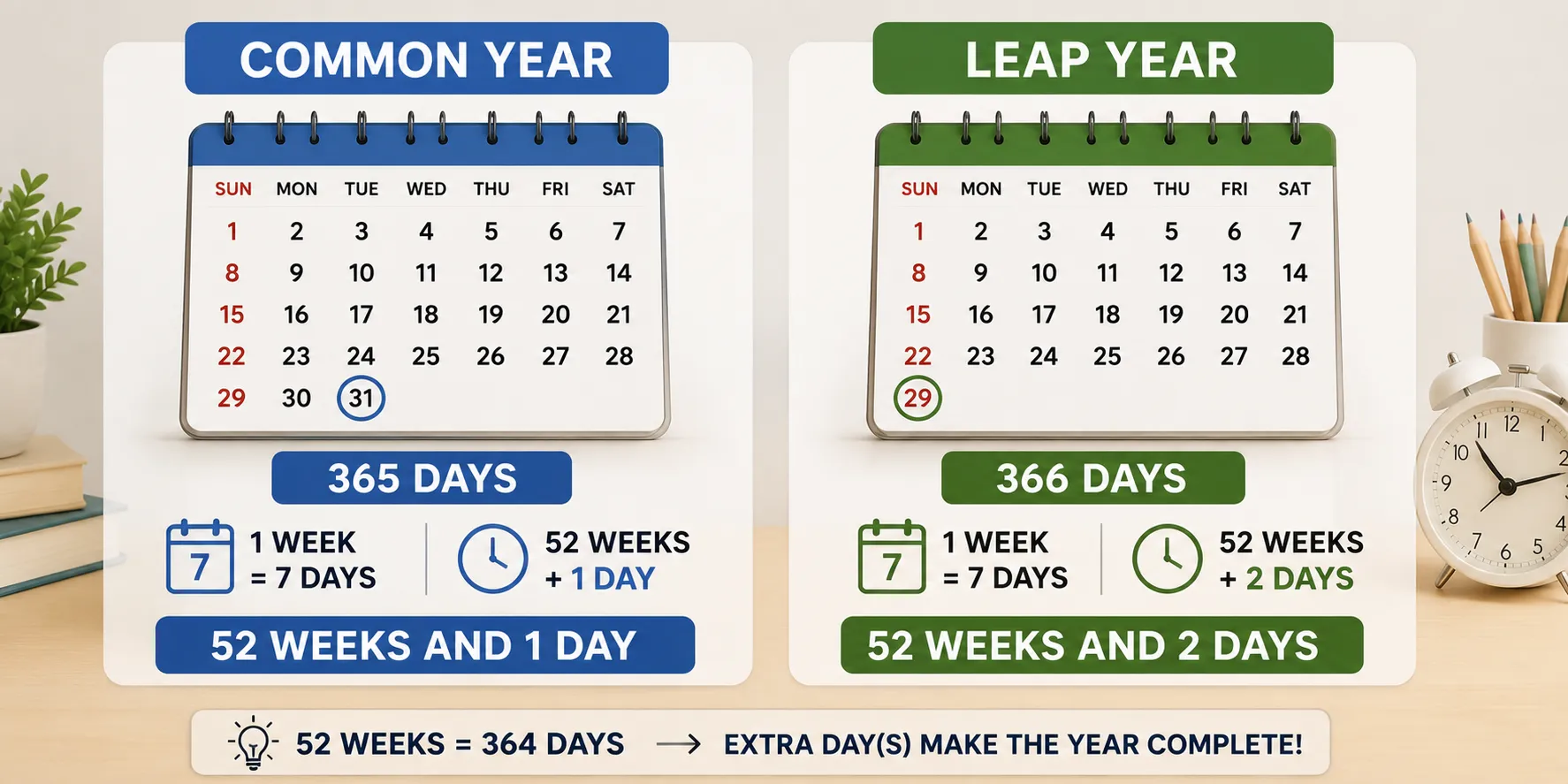
A common year has 52 weeks and 1 day.

A leap year has:

52 weeks and 2 days.

People often say a year has 52 weeks, which is technically correct for everyday use. However, if you're looking for the mathematically accurate answer, a 365-day year doesn't divide evenly into weeks, so there's always one extra day left over.

Calculation

Let's calculate it step by step.

Common Year

A common year has:

365 days

Since:

1 week = 7 days

Calculation:

365 ÷ 7 = 52 weeks + 1 day

So the complete answer is:

52 weeks and 1 day

Leap Year

A leap year has:

366 days

Calculation:

366 ÷ 7 = 52 weeks + 2 days

So:

52 weeks and 2 days

Conversion Table

Calendar PeriodDaysWeeks
1 Week71
1 Month (Average)30.44~4.35
Common Year36552 weeks + 1 day
Leap Year36652 weeks + 2 days

A simple way to remember it is:

  • Common Year → 52 weeks + 1 day

  • Leap Year → 52 weeks + 2 days

Article image

Many people wonder why we don't simply say a year has exactly 52 weeks.

The reason is simple.

52 weeks contain only 364 days.

A common year has 365 days, leaving 1 extra day.

A leap year has 366 days, leaving 2 extra days.

Those extra days are one reason the day of the week changes every New Year. For example, if January 1 falls on a Monday this year, it usually falls on a Tuesday the following common year. During leap years, it jumps by two days.

Practical Examples

Knowing how many weeks are in a year is surprisingly useful.

Annual Planning

Businesses often divide projects into 52 weekly goals instead of 12 monthly goals because weeks are easier to measure consistently.

Fitness Programs

Many workout plans are designed as:

  • 12-week programs
  • 26-week programs
  • 52-week transformations

School Calendars

Academic planners frequently organize the year by weeks rather than months for timetables and lesson planning.

Competitive Exams & Aptitude Tests

A lot of people think questions like "How many weeks are in a year?" are too simple to matter.

In reality, these questions regularly appear in:

  • SSC exams
  • Banking aptitude tests
  • Government recruitment exams
  • Campus placement tests
  • Interview aptitude rounds

They're not really testing whether you memorized the answer. They're checking your comfort with everyday calculations, numerical awareness, and how quickly you can solve basic problems under time pressure. Candidates who know these conversions instinctively often save valuable seconds during exams.

Common Misconceptions

"A year has exactly 52 weeks."

Not exactly.

A common year has:

52 weeks and 1 day.

"Leap years also have 52 weeks."

They do, but with:

2 extra days.

"There are 53 weeks every year."

No.

Some calendar years are referred to as having 53 ISO calendar weeks, but that follows a different international week-numbering system. It doesn't mean the year contains 53 full seven-day weeks.

Frequently Asked Questions (FAQs)

1. How many weeks are in a normal year?

A common year has 52 weeks and 1 extra day because 365 ÷ 7 = 52 remainder 1.

2. How many weeks are in a leap year?

A leap year has 52 weeks and 2 extra days because it contains 366 days.

3. Why do some calendars show 53 weeks?

The ISO week date system occasionally labels a year as having 53 calendar weeks, but those aren't 53 complete weeks of seven days within a standard calendar year.

4. Why do aptitude exams ask questions like this?

These questions evaluate numerical reasoning, mental calculation speed, and familiarity with everyday measurements rather than advanced mathematics.

5. What's the easiest way to remember the answer?

Remember this simple rule:

  • 365 days = 52 weeks + 1 day

  • 366 days = 52 weeks + 2 days

A year is commonly said to have 52 weeks, but the complete mathematical answer is slightly more precise. A common year contains 52 weeks and 1 day, while a leap year contains 52 weeks and 2 days. Understanding this small difference is useful not only for calendars and scheduling but also for competitive exams, aptitude tests, and interview questions where quick numerical reasoning is often assessed. Once you know that a week has 7 days, the calculation becomes simple and easy to remember.

Must Read:How Many Minutes in a Year?

M

Answered By Madan Singh

Making everyday math and calendar concepts easy to understand with practical explanations, real-world examples, and exam-focused insights.
View Profile

Madan Singh is an education consultant and content writer with 8+ years of experience advising students, parents, and educational institutions on academic pathways, career planning, and learning strategies. He holds a Master's degree in Education Management from Delhi University, a background that grounds his writing in structured pedagogical thinking rather than generic career advice. His work spans college admissions guidance, career counselling, study abroad pathways, and competitive exam preparation, with a focus on both Indian and international education systems. He writes for CollegeDekho, Shiksha.com, and Collegedunia, where his articles are aimed at students and families making academic decisions. Over the course of his consulting practice, Madan has advised 150+ students on admissions, scholarship applications, and career planning. He has published 80+ articles across education platforms during this time, covering topics from exam strategy to international study options. Madan's approach is practice-first: his writing reflects the questions he actually gets from students and parents, not templated advice. He does not claim to cover every education topic — his focus stays on admissions, career planning, and study-abroad guidance, where his consulting experience directly applies.

Updated on07/01/26
0

Advertisement

Many people wonder exactly how many weeks are in a year, especially when planning school schedules, work projects, fitness goals, or personal milestones. The simple answer is that a standard year contains 52 weeks and 1 day, while a leap year contains 52 weeks and 2 days.

This calculation comes from the fact that a regular year has 365 days. When you divide 365 by 7 (the number of days in a week), you get 52 full weeks with 1 day left over. In a leap year, which occurs every four years and contains 366 days, there are 52 full weeks and 2 extra days.

Although the answer seems straightforward, it can sometimes cause confusion. For example, many calendars show parts of 53 different weeks within a year. This happens because weeks do not always begin on January 1st and end on December 31st. Depending on how the dates fall, a calendar may display portions of an additional week even though the year still contains only 365 or 366 days.

In practical terms, most people use 52 weeks per year for planning purposes. Businesses often calculate annual schedules, payroll periods, and project timelines based on 52 weeks. Similarly, fitness coaches, teachers, and productivity experts commonly break long-term goals into weekly milestones because weeks provide an easy way to track progress throughout the year.

If you're calculating dates for financial, academic, or professional reasons, it's worth remembering that the extra one or two days each year can slightly affect long-term schedules. This is one reason why calendars and accounting systems occasionally handle weeks differently depending on their specific requirements.

A useful way to think about it is that a year is made up of approximately 52 weeks, with a small number of extra days added to complete the full calendar year. This simple fact helps explain why birthdays, holidays, and annual events shift to different days of the week as each new year begins.

So, if someone asks, "How many weeks are in a year?" the most accurate and commonly accepted answer is 52 weeks and 1 day in a regular year, or 52 weeks and 2 days in a leap year. For everyday planning, however, people generally round this to 52 weeks per year.

Also read : How many weeks in a school year?

T

Answered By Tara Verma

Calendar Systems & Time Measurement Enthusiast
View Profile

Tara Verma is a practising teacher and education content writer with over 10 years of classroom experience across primary and secondary levels. She holds a Master's degree in Education (M.Ed.) from Delhi University and a Bachelor of Education (B.Ed.) from Jamia Millia Islamia — qualifications that ground her writing in both pedagogical theory and the day-to-day realities of teaching in India. Her content covers exam preparation strategies, learning methodologies, curriculum guidance, student mental health, career counselling for students, and the evolving state of school and higher education in India. Her work has appeared on platforms including TeacherVision India, Jagran Josh, and Careers360, where she writes for students, parents, and fellow educators who need content built on actual teaching experience — not theory alone. Over a decade of working directly with students across age groups and learning levels has given Tara a practical understanding of how education content should be written — clearly, accessibly, and with genuine awareness of the challenges students and teachers face on the ground. She has taught 1,000+ students, contributed to school curriculum development initiatives, and published 250+ articles on education across digital platforms. She is an active member of the National Council of Teachers of English (NCTE) India. Across all her writing, every recommendation is classroom-tested, every insight comes from direct teaching experience, and every article is held to the same standard she applies in her own classroom — accuracy, clarity, and genuine usefulness for the reader.

Answered on06/17/26
0

To understand time intricacies, especially in relation to how a year can be divided into weeks, provides a glimpse at the pattern of our lives. A year is known as a journey around the sun that lasts for a long period of time, but this journey consists of many different parts that are significant in their own right. The year has been split into portions by means of these units, with such divisions helping to make it passable. The present-day calendar systems usually have fifty two weeks in one full year. This uniformity demonstrates humans’ desire to bring order in time, which flows endlessly.

Weeks have more concrete associations than months or years because they are an integral part of our daily lives. Weeks serve as practical frameworks for planning, executing and reflecting on what we do within them. An olden belief resonates from seven days representing the traditional seven great luminaries among cultures on earth. From Monday through Sunday, there is a regular rhythm set forth by the days of the week that helps us live cyclically and anticipate future events.

Letsdiskuss

Besides merely being discrete sections of something larger, weeks possess extended meanings. Henceforth; they become important indicators both at societal and individual levels while also functioning as checkpoints and deadlines among others. Business operates according to weekly cycles which form project timelines most often.
In any case, the inherent complexity of our calendar systems belies the apparent simplicity of a 52-week structure. Leap years which occur approximately every four years add an extra week to realign the calendar with Earth’s orbit around the sun. This subtle modification shows that human beings continuously try and integrate artificial constructs with natural patterns in the universe.

Moreover, different cultures and religions also influence how weeks are perceived and used within societies. Other societies even use other types of calendars altogether where some weeks may not be as important as others or even differ in length.

Clearly, this is an indication of man’s creative nature in organizing and discerning time. Throughout time, from ancient civilizations up to contemporary ones, dividing a year into weeks has given us orderliness and coherence as well as rhythm for our common journey through time. As we go through these coming weeks, let us respect their importance to us while embracing the chances that they provide for personal growth, meditation and linkage.

Abhisek Ghosh

Answered By Abhisek Ghosh

Organic Life Lover
View Profile
Updated on11/03/25
Like
1

Advertisement

Time has continually been a fundamental element of our lives, directing our moves, planning our calendars, and structuring our lives. A prominent role amongst time-measuring devices is occupied by way of the week. It organizes our painting schedules, social conventions, and calendars. That being stated, have you ever wondered what number of weeks there are in a year? We take a look at the origins of the week, the intricacies of calendars, and the mathematical accuracy involved in determining the number of weeks in a 12-month as we dig into this charming subject matter in this text.

Influence of Calendars:

Various calendar structures ought to be considered with the purpose of realizing the range of weeks in a year. The Gregorian calendar, which changed the Julian calendar in use until 1582 and is currently the most often used, changed into instituted by way of Pope Gregory XIII. Based on Earth's orbit across the Sun, the Gregorian calendar is a sun calendar with one year in every day 12 months, and 366 days in a bounce 12 months.

The Gregorian calendar divides a year into months, however, these months do not healthy up exactly with the seven days of a week. The result is that there may be a touch annual version in the total variety of weeks.

Letsdiskuss

Calculating Weeks in a Year:

We start by way of considering the whole wide variety of days on the way to arrive at the number of weeks in a year. There are 365 days in a regular 12 months and three hundred and sixty-six days in a solar year.

We can now calculate the form of weeks by way of dividing the general quantity of days by way of manner of seven, as there are seven days in a week. The overall range of days in 12 months may not continually be precisely divisible by 7, consequently, this computation does not usually offer a full variety.

In regular years, there are 52.142857 weeks (365 days ÷ 7 days/week).

For leap years: 52. 285714 weeks (three hundred and sixty-six days ÷ 7 days/week).

Thus, there are kind of 52 weeks and 1 extra day in common years and almost 52 weeks and 2 more days in jump years.

How many weeks in a school year?

The number of weeks in an ordinary college year would possibly be exchanged based totally on the instructional calendar that the faculty uses. Nonetheless, 36 to 40 weeks of teaching make up the majority of school years.

Holidays, breaks, and other events are often factored into the schedules of number one and secondary colleges. The quantity of weeks in an educational year is decided via the sum of those vacations and weekends.

An educational year typically consists of 180 academic days, or around 36 weeks of instruction if one assumes a five-day workweek. On the other hand, positive schools may additionally have longer instructional years with greater days of coaching, which would grow the variety of weeks correspondingly.

The typical wide variety of weeks in a faculty year is likewise determined using the length of terms or semesters that some establishments use similarly to ordinary educational weeks. Institutional choices, national laws, and academic necessities are a number of the variables influencing these scheduling discrepancies.

In fashionable, a school year includes 36 to 40 weeks of education, consisting of teaching days and breaks. However, the precise wide variety of weeks may vary depending on the school and the vicinity. For each teacher and college student, this association enables a healthy balance between educational intensity and required rest.

How many weeks in a month?

Because months range in length and feature an uneven quantity of days, there is probably a little version within the wide variety of weeks in a month. Except for February, which has 29 days in leap years and 28 days in ordinary years, the majority of months have both 30 or 31 days.

A month is around four. Three weeks long on average. Since there are seven days in every week, the common is decided by dividing the entire range of days in the month using seven. A month with thirty days, for example, could be round four.29 weeks long, but a month with 30 days would be kind of four.43 weeks lengthy.

The fluctuation in the number of weeks in a month may affect several making plans and scheduling tasks. Time-sensitive tactics along with assignment timetables and payroll computations are impacted. But despite this small deviation, the concept of weeks gives a reliable shape for planning and monitoring time on a month-to-month basis.

Human civilization is based on the concept of time, particularly the week, which directs our day-by-day exercises, plans, and cultural customs. Although the variety of weeks in 12 months appears easy at the start, a deeper examine calendar systems and jump years exhibits more subtlety.

We understand that there are roughly 52 weeks in an ordinary year and 52 weeks plus one or two extra days in a soaring year because of appropriate arithmetic and historic improvement of calendars. This perception highlights the complex link between human civilization and time measurement, further improving our hold close of timekeeping.

A

Answered By Anushka

Author
View Profile
Updated on11/03/25
Like
2