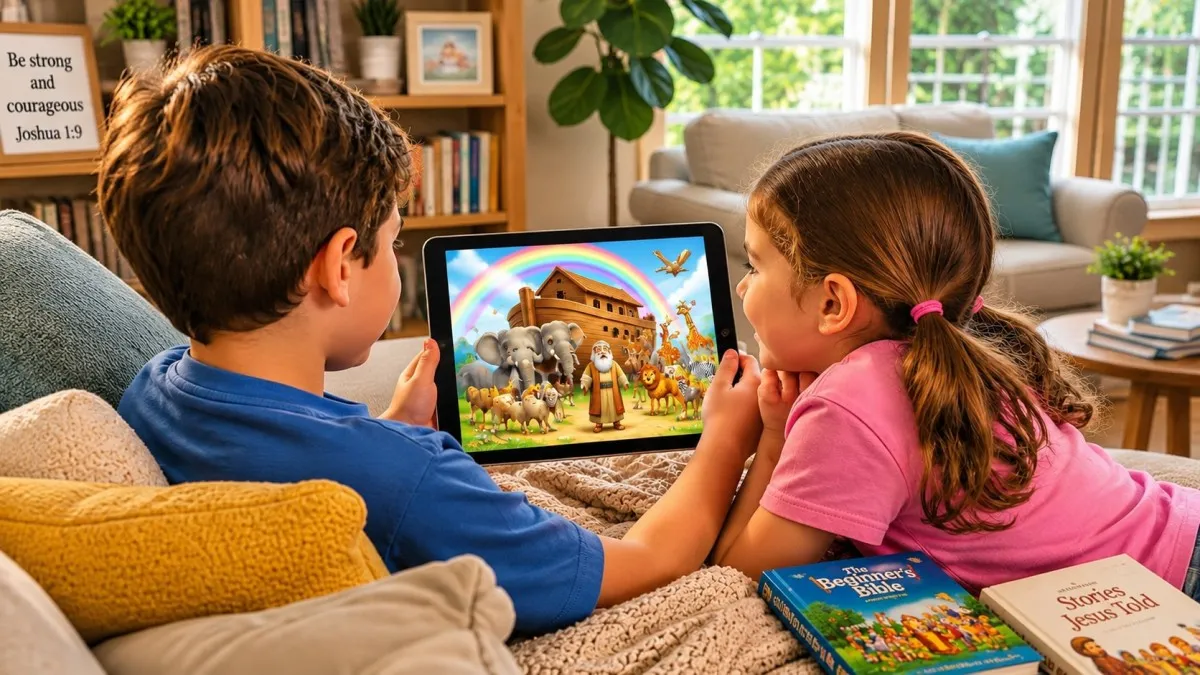
It was a Tuesday, around 5:40. Pasta water not boiling yet, onion half chopped, and my four-year-old lying face-down on the kitchen floor telling me she was so bored she might die. I handed her the tablet. Obviously.
Then I did the thing I always do, which is stand at the stove feeling vaguely guilty about it. But I've started to think the guilt's aimed at the wrong thing. It's not the screen, exactly. It's what's on it. Twenty minutes of some kid unboxing toys and twenty minutes of animated stories from the Bible look identical from across the kitchen. They're not, though. Not even close.
Why kids remember the story, not the lesson
Ask a five-year-old what generosity means. You'll get a blank look, maybe a guess involving candy. Now ask what the boy did with his five loaves and two fish. You'll get the whole thing, sound effects included.
Kids this age don't really do definitions. They do people. Someone who was scared and went anyway. Someone who shared when nobody made them. The lesson's in there, it just comes in through the back door.
The animation part matters more than I expected, too. When my son was three I tried reading him Jonah out of one of those chunky toddler Bibles. He made it to the storm. Then he left to look for crackers. A few weeks later he watched a cartoon version, twice in a row, and the next morning I found his stuffed whale in the bathtub "spitting out" a Lego guy onto the bathmat. Nobody had asked him a single question about it. He just had it.
Small opinion while we're here: I'll take a well-told story over one that stops every couple of minutes so a narrator can explain the moral. Kids know when they're being lectured. Pretty sure we do too.
How to pick a good Bible cartoon (and what to skip)
Not every Bible cartoon deserves your kid's twenty minutes. I've gotten pickier over the years. Here's roughly what I look at now.
Length, first. Five to ten minutes is plenty for a preschooler. Past that they're watching colors, not a story.
Ads and autoplay are the big one for me. A friend put on a Noah's ark video for her daughter on one of the free video sites, went to switch the laundry, and came back to find her watching a stranger squish slime. Three autoplays. That's all it took.
I also want the actual Bible story to still be in there. Some cartoons pile on so many jokes and goofy sidekicks you can't find it anymore. A bit of silliness is fine, my kids would riot without it. But if the comic-relief camel gets more lines than Moses, I'm out.
And pace. Maybe this is just me, but the frantic, flashy stuff isn't worth it even when the content's good. If she comes out more wound up than she went in, what was the point?
If you want somewhere to start, have a look at the AbbaKid app. It's made for kids roughly three to eight, and it's ad-free, which solves my biggest complaint right there. The stories are grouped by theme (Bible characters, animals, family, kindness, bedtime), so you're not scrolling forever while dinner burns. After a story there's a little quiz with small rewards, which is honestly a pretty low-effort way to find out what sank in. Some stories are free, so you can poke around before deciding if the rest is worth paying for. It's also not tied to any one denomination. That mattered more to us than I'd have guessed, with half the grandparents going to a different church.
What to say when the episode ends
The watching's only half of it, honestly. The other half happens in the couple of minutes after the screen goes off. If you catch them.
You don't need a discussion guide. One question does it. "Who was brave in that one?" Or, "What would you have done if it was your lunch?" Ask it sideways, though. In the car, while you're wiping the table. Look a four-year-old in the eye and ask a serious question and they'll clam up like it's a pop quiz.
Full disclosure: most nights I forget. The tablet goes off, somebody needs water, somebody else needs a different water, and the moment's gone. A mom from our playgroup tapes one question to the fridge every week. I copied her. It lasted about ten days. Still, even when I only remember once or twice a week, it shows up later. Usually weeks later, out of nowhere, when your kid brings the story up on their own.
Do Bible cartoons still count as screen time?
Yep. I wish they didn't. A screen's a screen, and putting a Bible story on it doesn't make two hours on the couch a great plan.
What finally worked for us wasn't a time limit. It was a time slot. I tried "faith cartoons on Sunday afternoons only" for a while, and it didn't survive week two, mostly because I kept losing track of what day it was. What stuck was one story at bedtime. After teeth, before lights out. It ends on its own, so nobody's begging for five more minutes, and it gives us something to pray about besides "thanks for today."
And on the nights it's just what keeps your kid busy while you cook? Fine. Really. Nobody's grading your screen-time philosophy. You still get to pick what's on.
A few weeks after that Tuesday, my daughter stopped in the middle of her spaghetti and asked if the boy with the fish got anything to eat. After he gave it all away, she meant.
I said I figured he ate with everybody else. She thought about it, nodded, and went back to her noodles.
Thirty seconds, maybe. I'm still thinking about it.