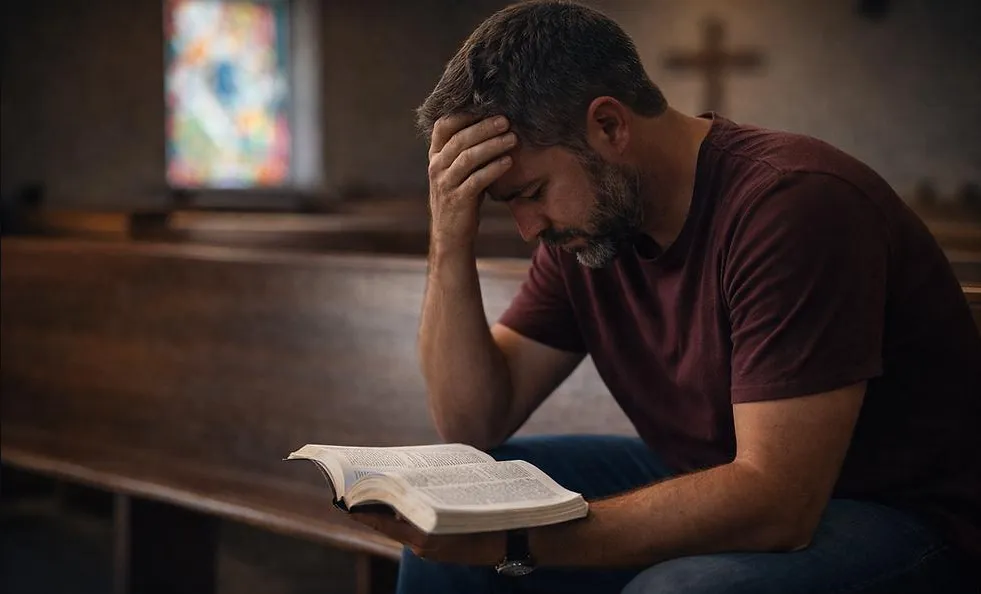
Mark called me on a Wednesday night, which he never does. His daughter’s scan had come back with a word nobody wants to hear, and he’d been sitting in his truck in the hospital parking garage for forty minutes. He didn’t want advice. He wanted to know if it was normal to feel like God had stopped picking up the phone.
It is normal. When your faith is tested, the first thing to go usually isn’t belief itself but the sense that anyone is listening. I’ve led more than one bible study on faith where we spent weeks in Hebrews 11 with its long list of heroes, and I’ve come to think we read those names too fast. Those people weren’t calm. They were frightened, stubborn, confused and sometimes furious, and God kept hold of them anyway.
The People in the Bible Struggled Out Loud
“How long, Lord? Will you forget me forever?” That’s Psalm 13:1 (NIV), and David wrote it. The same man who faced Goliath and wrote “The Lord is my shepherd” also sat down and accused God of hiding His face. He didn’t tidy it up before he prayed it.
Job is the extreme case. He lost his children, his money and his health, and then his friends showed up with theology that sounded right and helped nobody. Job argued with God for most of the book. Yet at the end, God said Job had spoken rightly about Him and the friends hadn’t (Job 42:7). Honest complaint, it turns out, sits closer to faith than polished answers do.
Then there’s the father in Mark 9 whose son had suffered for years. “I do believe; help me overcome my unbelief!” (Mark 9:24, NIV). I’ve prayed that exact sentence more times than I’d like to admit. Jesus didn’t send the man away to work on his belief first. He healed the boy right there, with the doubt still hanging in the air.
What to Do When Your Faith Is Tested This Week
Start with your body before you start fixing your theology. Right after the biggest victory of his ministry on Mount Carmel, Elijah ran a full day into the wilderness, sat under a broom bush and asked God to take his life (1 Kings 19:4). God’s response surprises me every time. There was no lecture at all. An angel let him sleep, woke him to eat bread baked on hot coals, and then let him sleep again.
Some of you need that before you need a sermon. Go to bed early tonight. Eat an actual meal instead of whatever’s in the car. Spiritual exhaustion and physical exhaustion often wear the same coat, and a worn-out mind is a terrible judge of whether God is faithful.
A retired schoolteacher I meet with on Tuesday mornings told me she stopped praying for almost a year after her husband died. What brought her back wasn’t some breakthrough moment. It was the Psalms, read out loud at her kitchen table, one a day, whether she felt anything or not. “I borrowed David’s words until I had my own again,” she told me over lukewarm diner coffee.
People still call him Doubting Thomas, which has always felt a little unfair. He simply wanted to see what the others had seen (John 20:25). Notice where Jesus found him, though. A week later Thomas was back in the room with the other disciples, doubting among people who believed. Isolation is where a trial of faith quietly turns into drifting, so tell somebody. Not the whole internet. Pick one person who’ll pray and won’t panic.
When the Test Comes From Your Own Failure
Not every season of doubt arrives from outside. Some of the hardest ones come from the mirror. Peter swore he’d never deny Jesus and then did it three times before the rooster crowed. But Jesus had already told him, “I have prayed for you, Simon, that your faith may not fail” (Luke 22:32, NIV), and then gave him an assignment for afterward: strengthen your brothers.
Jesus expected Peter to come back. He’d planned a job for him when he did. I still get this wrong, by the way. I treat my failures like evidence against God instead of the very place He promised to meet me. On a beach in John 21, Jesus cooked Peter breakfast before He asked him a single hard question.
Hold On to What You Knew in the Light
Abraham waited decades for Isaac, then heard God ask for him back (Genesis 22). He didn’t understand the command, and I don’t think we’re meant to find it easy to read. Hebrews 11:19 says Abraham reasoned that God could even raise the dead. When the instructions made no sense, he leaned on what he already knew about God’s character.
That’s the most practical thing I can hand you. Write down three times God came through for you, and make them specific. The rent that got covered in March. The friend who called at exactly the right hour. When your faith is tested and everything inside you gets loud, you’ll want a record in your own handwriting. James 1:3 says the testing of your faith produces perseverance, and perseverance usually looks less like strength and more like showing up again on a gray Tuesday.
Mark still calls me. His daughter is in treatment now, and some weeks are better than others. Last month he told me he’s stopped waiting to feel God near before he prays. He just prays in the truck on the way to the hospital, out loud, with the radio off.
Before Friday, choose one person you trust and tell them where your faith honestly stands right now. Not the Sunday version, either. Then ask them to check on you next week, and let them.