
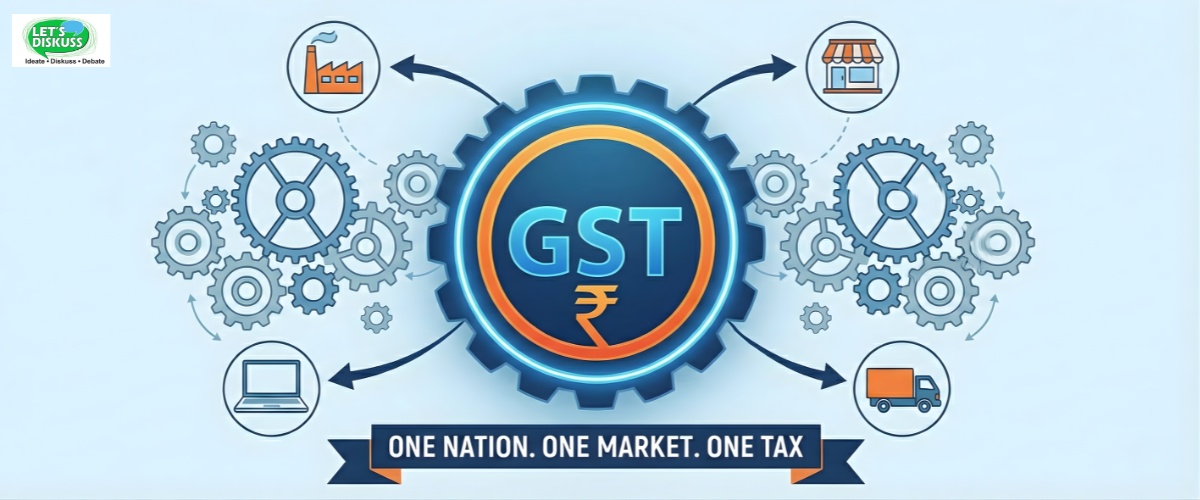
Introduction to GST
Goods and Services Tax (GST) Is the most recent tax reform that has been introduced in India. It was implemented on the 1st of July 2017, replacing multiple indirect taxes like VAT, excise, service tax and other taxes which are based on a single unified system. The goal of GST is tax simplification and elimination of double taxation. Under one tax structure, businesses can operate better and comply with tax laws duly.
Structure of GST
India has a dual GST model. It means that both Centre and state can revive GST. This structure is made so that a balanced distribution of revenue can be achieved.
GST has different components and percentages depending upon the type of goods, nature of transaction and also the state in which the transaction is taking place.
Tax is divided into CGST and SGST for intra state transactions.
Integrated GST, which is called IGST is Lee wide for imports and interstate transactions.
UTGST is applied in all the union territories of India
A constitutional body called the GST Council was set up which plays an important role in recommendation of GST policy, changes, rate of taxes, exemptions, etc.
Scope of GST
GST is limited to goods and services that come under the umbrella of sale, barter, exchange, transfer, lease and disposal. Any good or service under the mentioned category has been classified as either taxable, zero rated or exempt. Supplies that are exempted attract no tax.Zero rated supplies like exports comes under the bracket of 0% tax. These are also eligible for input tax credit
There is also a concept of composite and mixed supply under GST. This helps in the correct tax rate when multiple goods and services are taxed together. There are also defined rules regarding the time and place of supply of goods and services, which is important for establishing whether CGST and SGST or IGST is applicable.
Registration Under GST
GST registration is mandatory for all those businesses who are over and above the prescribed threshold of turnover.
Businesses supplying goods exceeding the value of 40 lakhs rupees must register for GST.
While businesses who are dealing in services have the threshold limit of 20 lakhs rupees.
Certain businesses like e-commerce sellers and interstate suppliers are required to register for GST irrespective of turnover threshold
After registration, a unique GSTIN (GST identification number) is issued. This is a PAN-based and state specific number.
Registration of GST can be regular, special category or composite based.
If any business closes or changes, its detail like office address or location or name of the company, GST laws allows cancellation or amendment of registration
Levy and Collection of GST
GST is divided on the total value of transaction. This means that it includes the price paid or payable along with the other expenses.
There are slabs of GST which are- 0%, 5%, 12%, 18%, and 28%. Depending upon the nature of goods and services, the payable slab is Levite. Certain items are exempted from GST taxation or are taxed at a special rate.
In specific cases, there is a system of reverse charge mechanism (RCM) which shifts the liability of tax from the supplier to the recipient.
Input Tax Credit (ITC)
One of the core features of GST is input tax credit known as ITC. It allows businesses to have a reduced tax liability by claiming credit. The credit is against the GST paid on purchases made for the purpose of business. To claim ITC, business holders must showcase a valid tax invoice, and ensure that the supplier has also filed returns.
There are certain credits that are blocked and cannot be claimed. For example GST paid on personal consumption of goods and services.
GST Returns
Filing periodic returns that have details of outward supplies, tax payments, inwards supplies, etc. must be submitted as per GST compliance. Returns can be claimed monthly, quarterly or annual, depending upon the category in which the taxpayer lies. Regular taxpayers typically filed GSTR 1 and GSTR 3B.
Filing GST return on time is critical as late fee and interest can be relied on by the taxpayer. If the delay happens. Filing GST return accurately should also be insured by the taxpayer to get uninterrupted flow of input tax credit.
GST Payment and Refunds
GST payments can be made electronically through the portal of GST. Add the portal, the option to pay through net banking, debit card, credit card or NEFT and RTGS is available.
To track payments and credits, taxpayers can maintain electronic cash and credit ledgers
A timely payment of GST is required as delayed payment can lead to fine and interest as given under GST law
If taxpayer has paid tax on access, or there is an inverted, duty structure or cancelled registration, then there are provisions for refund
The refund mechanism has been put in place to ensure that business has liquidity.
GST Compliance and Assessment
GST has a system of self assessment where a taxpayer calculates by themselves what is their tax liability and that is how they file the returns accordingly. Tax authority may conduct audits or scrutinise in order to verify what the taxpayer has paid. In case of any discrepancy, the proceedings of the assessment order according to GST laws.
GST laws also give a detailed procedure for recovery of unpaid taxes, which may include sending notices, levying penalties and interest. If the taxpayer does not comply with the provisions under GST laws, then it may attract legal complications.
Offences, Penalties, and Appeals
As mentioned, GST laws has defined a number of offences that can attract penalties. For example, invasion of tax, submitting fake invoices and claiming wrong ITC Can lead to prosecution and fines depending upon the severity of the offence.
In case the taxpayer finds offence and penalties unreasonable, then GST provisions also provides them a right to appeal. Taxpayers can appeal through the appellate system. There is also a system called advance ruling system in place which allows business holders to get clarity on tax implications in advance. This reduces uncertainty and any possibility of dispute.
Benefits and Challenges of GST
GST has a number of benefits:
It has streamlined indirect taxation
It removes multiple taxes
It creates unified market
It provides transparency
It enhanced tax compliance
It allows businesses to have seamless credit flow
It has simplified the whole tax procedure
There are a number of challenges of GST as well:
Frequent changes in slab rates leads to confusion
There are often technical issues on the portal of GST
GST compliance is a burden for small businesses
Conclusion
GST plays a huge role in reshaping India's tax system by simplifying the procedures of taxation. It promotes ease of doing business by making concepts like registration, returns, etc. Simple to understand and process. With digital integration and continuous reforms, GST has proven itself to be the cornerstone of India's fiscal structure.
FAQs
What are the different types of GST?
Different types of GST are: CGST, SGST, IGST, and UTGSTWho needs to register for GST?
Businesses who have a turnover threshold of over 40 lakhs of supply of goods and over 20 lakhs of supply of services fall under GST provisionsWhat is Input Tax Credit (ITC) under GST?
ITC is the amount of credit that can be claimed by the taxpayer. This credit is claimed against various purchases made for business purposes.What is the GST registration threshold limit?
₹40 lakhs for goods and ₹20 lakhs for services is the GST threshold limit.What is the composition scheme in GST?
The composite scheme in GST is meant for small taxpayers who get lower tax rates levy.