Quick Summary: In March, my article on "Top Accounting & Finance Colleges in India" successfully broke through Google's algorithm and was cited directly inside the Google AI Overview box. In this practical case study, I reverse-engineer exactly why Google chose my page over competitors and share the exact SOURCE framework you can use to optimize your own content for AI search.
I noticed one of my articles appearing in Google AI Overviews.
Let me tell you what happened. In March, I published an article on "Top Accounting & Finance Colleges in India" and it was later featured in AI-generated search results.
Most people today talk about how AEO, GEO, and LLMS.txt are eating up SEO. However, when I studied Google’s official latest generative AI update, I understood why most of my other content was not featured and what exactly went wrong.
This article isn't a theory about AI search. It's a practical analysis of one page that was cited in Google AI Overviews, compared against Google's latest guidance. I'll explain what likely contributed to that visibility, where the article still falls short, and what I'd change if I were publishing it today.
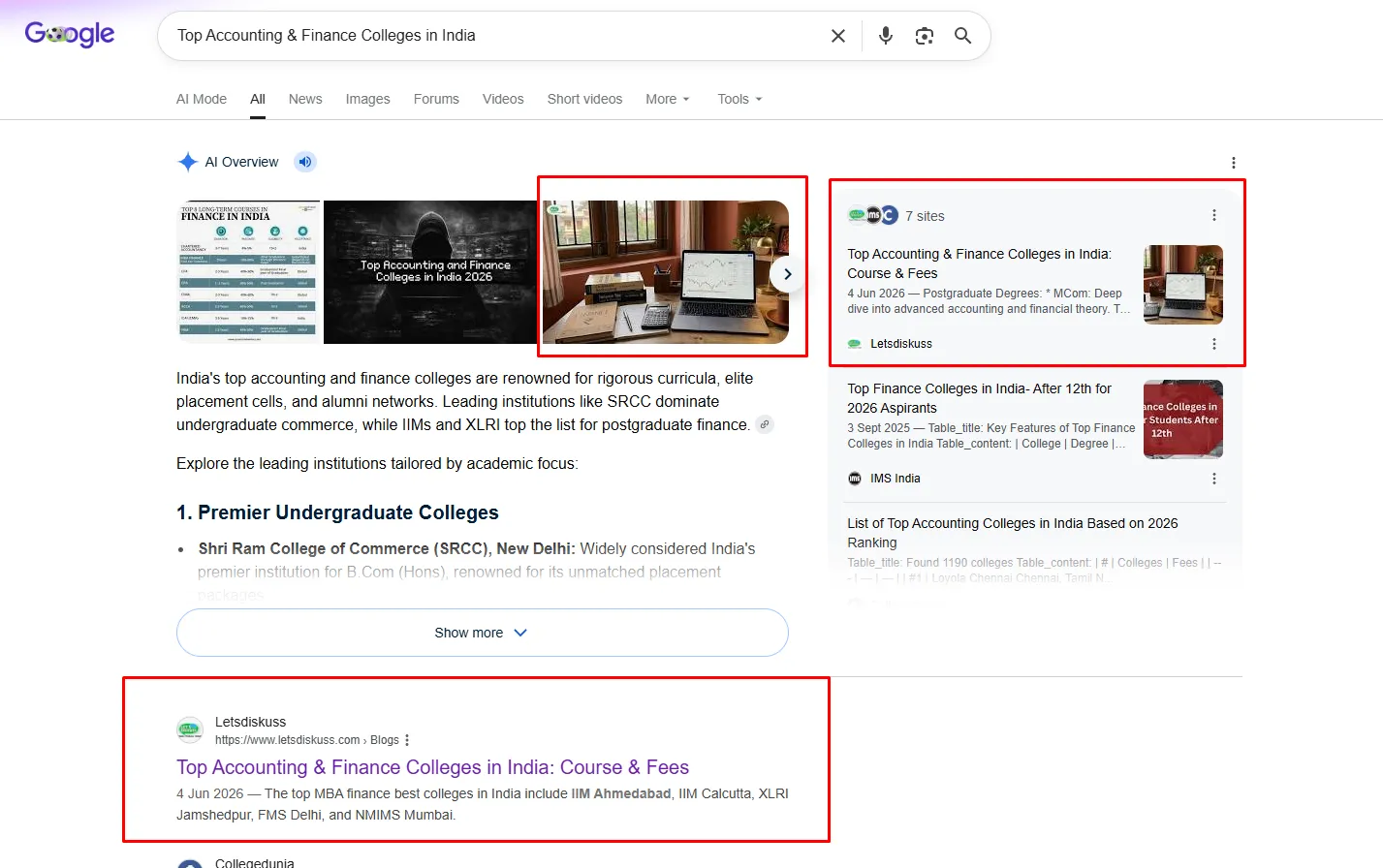
Screenshot: Google AI Overview featuring my article
(Note: This analysis reflects observations from a single real-world case study and should not be interpreted as Google's official ranking formula.)
What Is Google AI Overview, and How Does It Choose Content?
Google AI Overviews are summaries that appear at the top of search results. These summaries are AI-generated and pull key points from multiple links to provide useful and relevant responses for the actual query.
How Does AI Overview Improve Search Visibility?
Google AI Overviews can improve search visibility by citing content they determine to be relevant, authoritative, and useful. When your content is structured, comprehensive, and easy to extract — using techniques Safari Digital recommends like content chunking and top-loading key information — Google may use it as a source within AI Overviews, even when users don't interact with traditional organic results first.
How AI Search Results Actually Work
Many people think optimizing for AI Overviews means adding as much information as possible to a page. In reality, Google AI Overview may reference information from webpages it considers relevant and useful. This retrieval-first approach is why concepts like information retrieval and Retrieval-Augmented Generation (RAG) are often discussed in AI-powered search.
- Intent Analysis: Determines whether an AI-generated summary adds value.
- Query Fan-out: Expands complex queries into related subtopics.
- Retrieval: Identifies relevant information from multiple web sources.
- Synthesis: Combines retrieved information into a coherent summary.
- Citation: Links users to supporting sources for deeper reading.
Understanding this process helps explain why comprehensive, well-structured content has a stronger chance of being referenced in AI-powered search.
Why My “Top Accounting & Finance Colleges in India” Article Got Featured
Rather than assuming why the article was cited, I evaluated it against Google's published guidance for AI-powered search, including content quality, user intent, structure, and technical accessibility. Because Google's selection process is not publicly documented, every conclusion in this article should be viewed as an evidence-based observation rather than a confirmed ranking factor.
Why I Believe This Article Was Selected
Rather than treating this as proof of a ranking formula, I reviewed the article against Google's published guidance and compared it with several of my own pages that weren't cited.
The biggest differences I observed were the following:
| Observation | Featured Article | Other Articles (5 Reviewed) |
|---|---|---|
| Complete topic coverage | ✅ | 2/5 |
| Tables & comparisons | ✅ | 1/5 |
| FAQs | ✅ | 2/5 |
| Structured headings | ✅ | 3/5 |
| Clear user journey | ✅ | 1/5 |
Notice what's missing from this list: keyword stuffing, AI SEO hacks, or LLMS.txt.
1. It Solved the Entire Search Intent, Not Just One Keyword
When I analyzed my article, I realized that it wasn't ranking because I targeted a single keyword. It ranked because it answered almost every question a user might have after searching “Top Accounting & Finance Colleges in India.”
Instead of publishing separate articles, I created one comprehensive guide that covered the complete user journey.
| User Question | Covered? |
|---|---|
| Best Accounting & Finance Colleges | ✅ |
| Annual Fees | ✅ |
| BCom vs BBA vs MBA | ✅ |
| CA, CFA, CS & CMA | ✅ |
| Admission Process | ✅ |
| Career Opportunities | ✅ |
| Salary Expectations | ✅ |
| International Students | ✅ |
This approach aligns with Google's Query Fan-out system. Rather than looking at a single keyword, Google explores multiple related questions to build an AI Overview. Since my article naturally answered many of those questions, it became a strong candidate to be cited.
The biggest takeaway was that comprehensive topic coverage appeared to matter more than simply targeting additional keyword variations. When you answer related follow-up questions in one resource, the page becomes more useful for both readers and AI-powered search systems.
2. I Created an Information-Dense Resource
This case study suggests that my article was not just long but highly structured. Instead of presenting everything in large blocks of text, I organized the information into sections, tables, comparisons, and FAQs that made it easier to understand.
Here's how the content was structured:
| Content Element | Purpose |
|---|---|
| Public & Private University Tables | Compare colleges, fees, and specializations quickly |
| Degree Comparison Table | Help users choose between BCom, BBA, MBA, and MCom |
| Salary Comparison | Set realistic career expectations |
| Professional Certifications | Explain CA, CFA, CS, and CMA pathways |
| Step-by-Step Admission Process | Guide both Indian and international students |
| FAQs | Answer common follow-up questions in one place |
This structure made the article easy to scan, navigate, and compare. Readers could quickly find admission details, salary expectations, or professional certifications without reading the entire page.
Google's AI systems can interpret structured content such as tables, comparisons, headings, and lists. This case study suggests that information density and clear organization matter more than article length.
3. I Mapped the Entire User Journey—Not Just the Search Query
One thing my analysis suggests is that my article didn't stop at answering the main query. It anticipated what readers would want to know next.
Someone searching for “Top Accounting & Finance Colleges in India” isn't just looking for a list of colleges. They also want to understand degrees, admissions, career prospects, salaries, and professional certifications before making a decision.
Instead of scattering this information across multiple articles, I covered the entire journey in one guide:
This approach aligns with Google's people-first philosophy: create one comprehensive resource that satisfies the user's journey instead of multiple pages targeting individual keywords.
4. It Was Easy to Read, Navigate, and Extract
While reviewing my article, I noticed that the information wasn't hidden inside long paragraphs. Every major topic had its own heading, important details were presented in tables, and related concepts were grouped.
Some of the elements that improved readability included:
- Clear H2 and H3 headings
- Comparison tables for colleges, degrees, and salaries
- Step-by-step admission process
- Bullet points for key takeaways
- FAQs addressing common questions
This made the article easier to scan for readers and easier for Google to identify the most relevant sections when generating AI Overviews.
The takeaway is simple: optimize for comprehension, not AI. Clear structure helps users consume information more efficiently while also making key facts easier for search systems to identify and reference.
Key Findings From This Case Study
The article wasn't necessarily the most authoritative page on the internet, but it presented a complete answer in a format that Google's systems could easily interpret and reference.
| Priority | Action | Impact |
|---|---|---|
| 1 | Add original data/research | Very High |
| 2 | Add author expertise section | Very High |
| 3 | Add statistics and metrics | Very High |
| 4 | Create a proprietary framework | High |
| 5 | Add expert quotes/interviews | High |
| 6 | Strengthen entity coverage | High |
| 7 | Add summary blocks and key findings | High |
| 8 | Improve the title | Medium |
| 9 | Add visuals and charts | Medium |
| 10 | Expand the schema | Medium |
The SOURCE Framework: My Process for Creating AI-Ready Content
Based on this case study and Google's published guidance, this is the framework I'll use when creating content for AI-powered search.
| Step | What It Means |
|---|---|
| S – Solve | Answer the complete user journey, not just one keyword. |
| O – Organize | Structure information with headings, tables, comparisons, and FAQs so it's easy to scan and understand. |
| U – Uniqueness | Add original insights, first-hand experience, or research that other pages don't offer. |
| R – Reinforce | Build authority through strong technical SEO, internal linking, and supporting evidence. |
| C – Clarify | Present information in a clear, concise, and easy-to-reference format. |
| E – Evolve | Regularly update the content as information, search behavior, and user needs change. |
The SOURCE Checklist
Before publishing, I now ask myself:
- Does this page solve the complete user journey?
- Is the information organized for both readers and AI retrieval?
- Does it include something original that other pages don't?
- Can key information be found within seconds?
- Is the page technically optimized and internally connected?
- Would I confidently cite this page if I were answering the same question?
If I can't answer “yes” to most of these questions, the content still has room for improvement. My goal is no longer just to rank in search results but to publish content that deserves to become a source for both users and AI-powered search.
Why Being Cited Doesn't Mean the Article Was Perfect
Appearing in Google AI Overviews doesn't necessarily mean an article is complete or the best available resource. Looking back, I found several opportunities that could have made this page even more original, authoritative, and useful for readers.
1. More First-Hand Experience
Most of the content was based on publicly available information. Adding expert opinions, real student experiences, or personal observations would have created stronger original value.
2. More Original Research
Beyond listing colleges and fees, I could have included original insights such as ROI comparisons, placement trends, or emerging career opportunities. Unique research is harder to replicate and provides greater long-term value.
3. Better Visual Assets
Comparison charts, admission timelines, and career roadmaps would have made key information easier to understand while improving the overall user experience.
4. Stronger Topic Connections
Linking to related resources on CA, CFA, CUET, and finance careers would have strengthened topical authority and helped users continue their learning journey.
Biggest Takeaway
This experience changed how I think about AI search. Being cited doesn't prove an article is the “best” result—it simply means Google's systems found part of it useful enough to support a specific answer. The goal isn't earning one AI Overview citation; it's consistently publishing content that deserves to be referenced.
Common AI Overview Myths
If you spend enough time on LinkedIn, X, or YouTube, you'll come across countless AI SEO tips claiming that LLMS.txt, content chunking, or other AI-specific tactics are essential for AI Overview visibility. However, neither my case study nor Google's published guidance supported those claims.
| Common AI SEO Advice | What My Case Study Suggested |
|---|---|
| More keywords improve AI visibility | Covering the complete topic worked better |
| Longer articles rank higher | A well-structured article performed better |
| AI SEO hacks are necessary | People-first content mattered more |
| LLMS.txt is required | Strong SEO fundamentals were enough |
| More pages increase visibility | One comprehensive resource performed better |
What Google Officially Recommends
After analyzing my article, I compared it with Google's official guidance on optimizing content for AI-powered search. Interestingly, many of the things that helped my article appear in AI Overview were the same best practices Google recommends.
Here's a quick summary:
| Google's Recommendation | Why It Matters |
|---|---|
| Create unique, people-first content | Focus on helping users instead of chasing rankings. |
| Cover topics comprehensively | Answer related questions instead of targeting a single keyword. |
| Organize content clearly | Use headings, tables, lists, and comparisons to improve readability. |
| Build a strong technical foundation | Ensure your pages are crawlable, indexable, mobile-friendly, and fast. |
| Add relevant images and videos | Visual content improves the user experience and creates additional opportunities for visibility. |
| Avoid AI SEO hacks | Google doesn't recommend tactics like LLMS.txt, excessive content chunking, or creating separate pages for every keyword variation. |
While Google hasn't introduced a separate optimization framework for AI Overviews, its published guidance consistently emphasizes the same principles: create original, people-first content, organize it clearly, and maintain strong technical SEO. Those fundamentals remain the strongest foundation for AI-powered search visibility.
Source: Google Developer
Final Thoughts
If this case study taught me one thing, it's that AI search rewards content that is useful, original, and easy to reference; not content that's optimized for shortcuts. My goal is no longer just to rank but to create resources that deserve to become trusted sources.
Frequently Asked Questions (FAQ)
Why isn't my content appearing in Google AI Overview?
Does appearing in Google AI Overview guarantee the #1 organic ranking?
Is AEO different from SEO?
Do backlinks help content appear in AI Overviews?
Does longer content increase the chances of appearing in AI Overviews?
What type of content is most likely to appear in Google AI Overviews?
Should I create separate pages for every keyword variation?
Does Google recommend using LLMS.txt for AI Overview optimization?
How can I improve my chances of getting featured in Google AI Overviews?
What was the biggest lesson from my AI Overview case study?
About the Author
Follow @Himanshu"Himanshu Bansal is a Digital Marketing Executive specializing in SEO, AI search visibility, and content strategy. His work focuses on understanding how Google AI Overviews retrieve, evaluate, and reference web content through real-world case studies and Search Console analysis."
Research Methodology: This analysis is based on one AI Overview-cited article, five unpublished comparison articles, Google Search Console observations, and Google's official documentation on AI-powered search. It represents an observational case study rather than a controlled experiment.