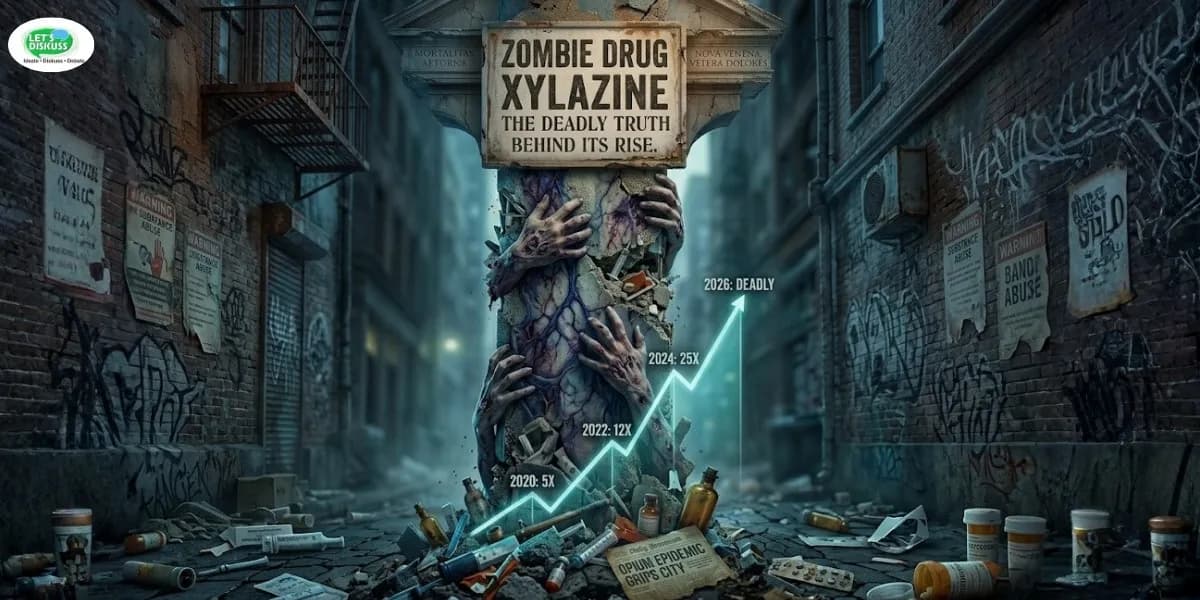
People lying motionless on sidewalks, covered in wounds that look like something out of a horror film. That is not fiction. That is what the so-called zombie drug does to real people in real cities across the US, UK, and now globally.
-
The drug in question is xylazine, a veterinary sedative with zero approved use in humans, now being secretly mixed into fentanyl and heroin by street-level drug dealers.
☰ Table of Contents
In this blog, you will get the full picture: what it is, what it does, the hard data, why it breaks the standard overdose response, and what is being done to stop it. Stay till the end because the FAQ section answers the questions most people are too confused to ask.
What Exactly Is the Zombie Drug?
Xylazine is not a new chemical. It was developed as a sedative and analgesic for large animals like horses and cattle. Veterinarians have used it safely in animals for decades. The problem started when it migrated from the barn to the street.
On the street, xylazine goes by several names:
- Tranq (when used alone)
- Tranq dope (when mixed with fentanyl or heroin)
- Zombie drug (a media and street term referring to its visible effects on users)
Why was Xylazine used in Animals?
Xylazine is classified as a strong alpha-2 adrenergic agonist, originally designed to calm animals during medical procedures while minimizing their suffering. It is not an opioid. It does not work through the brain's opioid receptors. That distinction, as you will see, is what makes it so dangerous for humans trapped in the drug supply.
How is the Zombie Drug (Xylazine) made?
In the illicit drug market, xylazine is typically found as a powder, produced by cooking down the liquid veterinary solution, and is then mixed into fentanyl, heroin, or cocaine or pressed into counterfeit pills designed to look like Percocet or Xanax.
Why Do Drug Dealers Add Xylazine at All?
This is the part that should make everyone pause. Drug dealers are not adding xylazine because users are asking for it. Most users have no idea they are taking it.
The reason is purely economic. Chinese suppliers sell xylazine online for as little as $6 to $20 per kilogram, and since it is not federally controlled, it is remarkably easy to acquire.
- Dealers add it to fentanyl because it extends the sedative high, meaning buyers stay dependent longer and come back more often.
- Less fentanyl in each dose, more bulk from cheap xylazine, and the same paying customers.
- It is, from a dealer's perspective, an efficient business decision. For the person on the receiving end, it can be a death sentence.
- University of Florida professor Bruce Goldberger has stated clearly that users of fentanyl do not seek illicitly manufactured fentanyl with xylazine. Xylazine is ingested unknowingly.
What the Zombie Drug Does to the Human Body
The Skin Wounds Nobody Saw Coming
If there is one thing that gave the zombie drug its name, it is the wounds. And calling them wounds almost undersells what they are.
Xylazine causes severe vasoconstriction, a tightening of blood vessels that dramatically reduces blood flow to tissues. The result is distinctive, spreading ulcers that can appear even on parts of the body far from injection sites.
- The wounds begin as abscesses forming underneath the skin
- They rise slowly to the surface, and by the time they are visible, the damage underneath is severe
- The skin wounds can be so severe that the infected body part may require amputation if left untreated
- Without early intervention, patients face an increased risk of sepsis, endocarditis, limb amputation, and death
What are People Saying?
One US support worker described the wounds as looking like people had been through “some sort of horrendous chemical warfare.”
A forensic expert at Tulane told Psychology Today:
"Imagine that in addition to the greater than 100,000 drug overdose deaths, we now add to that a generation of young people missing fingers, toes, and limbs."
Medical associations have not yet created formal guidelines for treating xylazine-associated wounds. Early evidence suggests keeping the wounds clean but open, without stitches or skin grafts.
What Happens Inside the Body
The skin wounds are visible. The internal damage is just as serious but harder to see:
- Respiratory depression: The drug slows breathing, just like opioids do, but through a completely different mechanism
- Bradycardia: Dangerously slow heart rate
- Severe hypotension: Blood pressure can crash
- Hyperglycemia: Elevated blood sugar levels
- Deep sedation: Users can become completely unresponsive for extended periods, hence the zombie appearance
The combination of xylazine and fentanyl has been linked to increased cardiovascular instability, with reports of severe hypotension and bradycardia requiring intensive medical intervention
The Numbers That Should Alarm Everyone
Metric Figure Increase in fatal xylazine overdoses (2015 to 2020) 20-fold Increase in overdose deaths involving xylazine (2018 to 2021) 30-fold Share of overdose deaths involving xylazine in the US (2022) Nearly 7% nationally, up to 26% in some states Rise in xylazine-positive overdose deaths in the South 1,127% Rise in xylazine-positive overdose deaths in the West 750% NYC fatal overdose share involving xylazine (2021 to 2023) 14% to 23% Nashville xylazine detections change in 2024 vs 2023 Nearly doubled States where xylazine has been detected 36 states + Washington D.C. In Nashville, xylazine only appeared in about 5% of toxicology reports for suspected overdose deaths in 2022. By 2024, that number had climbed to nearly 13%.
These are not projections. These are confirmed data from toxicology labs, medical examiners, and federal health agencies.
What’s Naloxone, and Why It Won't Fully Save You This Time
Naloxone, sold as Narcan, is the medication that has saved countless lives during the opioid crisis. It reverses the effects of opioids by blocking opioid receptors in the brain. It works beautifully against heroin, fentanyl, and prescription painkillers.
- It does not work against xylazine.
- Naloxone can address the opioid component when fentanyl is mixed with xylazine, but the person may remain in life-threatening sedation from the xylazine itself.
- This is the trap first responders now face.
- They administer naloxone; the person partially revives from the fentanyl component but remains in dangerous sedation from the zombie drug portion.
- Blood pressure may still be crashing. Breathing may still be compromised.
- Experts still recommend giving opioid overdose reversal medications to someone who shows symptoms of an overdose, even if you know xylazine is present, because xylazine is most often found mixed with opioids like fentanyl.
- So carry Narcan. Use it. Just understand that it is only solving half the problem.
How Far Has the Zombie Drug Spread?
It is no longer a Philadelphia problem. It started there, concentrated in the Northeast, and then moved fast.
Region Status United States (Northeast) Highest concentration; first epicenter United States (South, West, Midwest) Rapid spread; 1,127% increase in the South United Kingdom Banned as of January 2025 Scotland Detected in several deaths; widely flagged India Reports of suspected cases, none officially confirmed Canada Under monitoring, harm reduction alerts issued The UK government banned xylazine alongside 21 other dangerous substances in January 2025, after researchers at King's College London confirmed that the drug was widespread in the UK's illicit drug market, with traces even found in cannabis vapes.
Pennsylvania (40.3%), New York (36.5%), and Ohio (34.6%) recorded the highest xylazine positivity rates among states in recent urine drug testing data.
Is There Any Real Treatment?
Here is an honest answer: treatment for xylazine is still being figured out. The drug is relatively new in human populations, which means the medical community is playing catch-up.
For withdrawal:
- The current treatment regimen for xylazine withdrawal consists of buprenorphine or methadone used in combination with alpha-2 agonists such as dexmedetomidine, tizanidine, or clonidine
- Atipamezole, an alpha-2 receptor antagonist, has shown potential as a possible antidote in animal studies, though it is not yet approved for human use
- For wound care, the current guidance is to keep wounds clean and open rather than stitching them
What’s the Bigger Picture?
For overdose response, first responders rely on supportive care: ensuring the airway is clear, assisting breathing, and stabilizing blood pressure. There is no approved antidote.
The bigger picture concern is this: the opioid epidemic is projected to claim an estimated 1.2 million additional lives by 2029 unless policy reforms are implemented, and xylazine is accelerating that trajectory.
What Governments Are Doing About It
Movement is happening, but critics say it is too slow:
- In April 2023, the Biden Administration declared xylazine-laced fentanyl an emerging drug threat in the United States, and in 2022, the DEA reported that nearly a quarter of seized fentanyl powder contained xylazine
- The White House Office of National Drug Control Policy set a goal of reducing xylazine-positive overdose deaths by 15% in at least three of four US regions by 2025
- Congress is considering the Combating Illicit Xylazine Act (H.R. 1839/S. 993), which would classify xylazine as Schedule III but only for illicit use, so as not to disrupt veterinary medicine
- The UK banned xylazine and 21 other substances under updated legislation that came into force in January 2025, also including new variants of nitazenes, synthetic opioids that can be hundreds of times stronger than heroin
- Xylazine test strips are now available in some regions, so users can check their drugs before using them
The challenge is that xylazine is still not a federally controlled substance in the US. That limits what the DEA can legally do about it right now.
Frequently Asked Questions (Faqs)
Q1 Is the zombie drug the same as fentanyl?
No. Xylazine and fentanyl are completely different substances. Fentanyl is a synthetic opioid. Xylazine is a veterinary sedative that is not an opioid. They are frequently found mixed together in the street drug supply, but they are separate chemicals with different mechanisms in the body.Q2 Can someone survive a zombie drug overdose?
Yes, survival is possible, but it requires immediate medical intervention. Because naloxone only reverses the opioid component of a mixed xylazine-fentanyl overdose, emergency responders must also provide airway support, assist breathing, and stabilize cardiovascular function. The sooner medical help arrives, the better the outcome.Q3 Do people know when they're taking xylazine?
Most of the time, no. Users typically have no idea xylazine is in their drugs. It is added by dealers as a cheap cutting agent without the buyer's knowledge. Xylazine test strips are available in some areas and can detect its presence in a drug sample before use.Q4 Why can't doctors just give an antidote as they do for opioids?
Because no approved antidote for xylazine exists for humans yet. Atipamezole and yohimbine have shown some potential in animal studies, but neither is approved nor available as a standard treatment in emergency medicine. Research is ongoing.Q5 Is the zombie drug spreading outside the United States?
Yes. The UK has confirmed its presence in the illicit drug market and banned the substance in January 2025. Cases have been detected in Scotland, and health authorities in Canada and parts of Europe are monitoring the situation. Global spread is a real and growing concern as the drug is cheap, accessible, and difficult to detect without specific toxicology testing.