
Table of Content
- Introduction
- The Entry Barrier: Preparation & Recruitment
- Financial Comparison & Benefits
- Nature of Work & Impact
- Lifestyle & Stability
- Career Growth & Resilience
- Conclusion
- FAQs
Introduction
UPSC or a private job, which is better? The Ultimate Dilemma
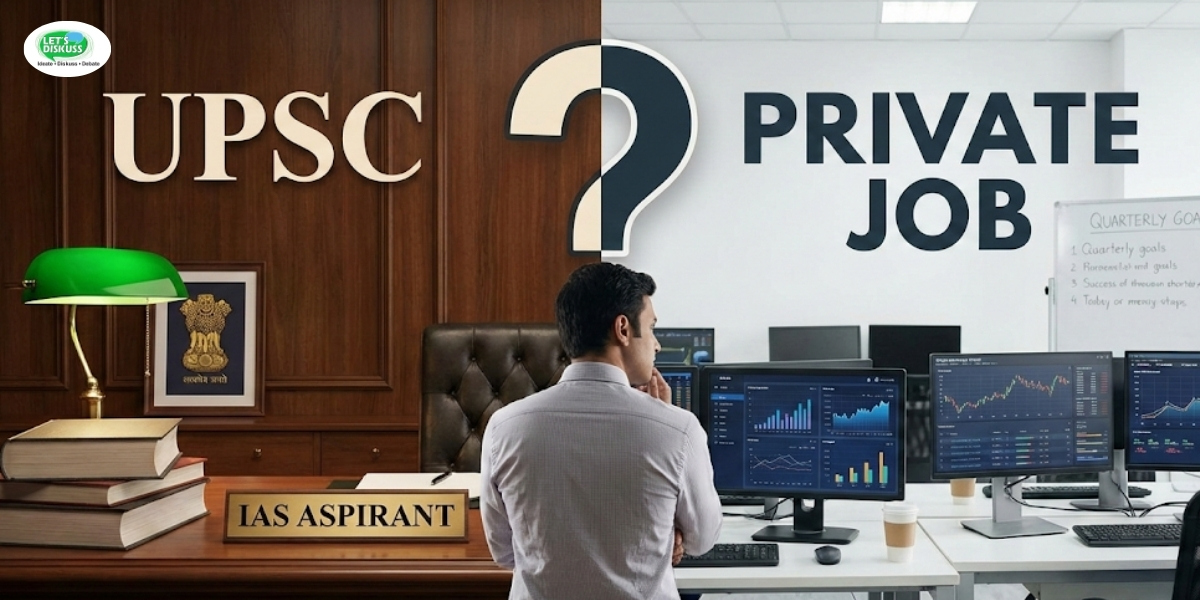
Every year in India, millions of graduates face the ultimate dilemma: UPSC or private job, which is better? This question is most-researched across various search engines as student wants to obtain a secure life against rapid growth and global exposure.
If you are reading this blog, there are high chances that you are also stuck in the same situation and asking yourself the very same question: Should I prepare for UPSC or do private job? It’s completely normal to feel overwhelmed as it’s a matter of high stakes. See, honestly, the truth is that everyone is not made for the same thing. You really need to figure out and assess whether a UPSC vs private sector career aligns with your long-term goals and how you see them changing your life.
Civil Services vs. the Modern Corporate Renaissance
Have you ever seen a home celebrating when one of their family member passes the Civil Service Examination (CSE)? It’s literally seen as the pinnacle of success for Indians. Passing Government exams like CSE means you now have power, respect in society, and lifetime security.
However, this scenario is somewhat shifting in 2026. Now, we are witnessing people longing for a corporate renaissance. This generation is more interested in inventing something new, global-tech products innovation, and getting startup equity rather than going for 3 or 4 years of civil services examination preparation.
When you are in a debate on UPSC or private job which is better, you are actually standing against two of the most renowned and prestigious careers. One is a fast-paced, high-reward environment, while the other gets you social prestige of being a District Magistrate and handling administration. It's about understanding that a UPSC vs private sector career is not just a choice of where you work, but how you are going to spend your life.
The Entry Barrier: Preparation & Recruitment
UPSC Preparation vs. Private Job
| Feature | UPSC Civil Services | Private Sector (Corporate) |
|---|---|---|
| Primary Skillset | Deep knowledge of diverse subjects (History, Polity, Ethics, Current Affairs). | A mix of soft skills + technical skills based on your job role. (Communication, interpersonal skills, coding, etc.) |
| Cognitive Demand | You must be able to connect dots across different sectors and memorise vast amounts of data. | You must pursue the ability to use specific tools to solve immediate business problems and drive revenue for the business. |
| Entry Barrier | A three-stage elimination process (Prelims, Mains, Interview) with a less than 1% success rate. | Entry Barrier includes making a good portfolio, networking with others, internships in your field, and understanding how the market is demanding job roles and skills. |
| Preparation Style | You must spend around 12-14 hours daily in studying and preparation. | You must continuously upskill yourself while you are working and learn through various certifications and internships. |
| Academic Background | Anyone with a degree can compete. UPSC does not look into your academic background specifically. | Often requires relevant degrees or proven bootcamps/portfolios in a specific field. |
| Adaptability | The syllabus changes slightly, but the core fundamentals remain constant for years. | Skills can become obsolete quickly. Hence, you must adhere to the latest tools and re-learn things every 6-12 months. |
Should I prepare for UPSC or do private job?
If you do UPSC, here are your Rewards:
-
You get unmatched authority. You actually have the power to sign orders that can affect people’s lives. It’s about how you are utilizing your power to create a social impact that you cannot when you are in a corporate role.
-
You get a lifetime Iron-Clad Security. You don’t need to take care of the recession period. You get a lifetime assurance of your income and stability. No Market crash or revolution can hamper your position.
-
You get more than enough social prestige, which is the most modern human requirement. Have you ever heard about the red beacon legacy? It gives you and your family the respect in society, which you cannot simply buy otherwise.
What’s at Stake?
-
During the preparation phase, it’s hardly likely to clear all the examinations in one go, which creates a void in your resume as you give your whole days and years only to the preparation. Sometimes, you still may not clear the exam.
-
If you pass it, you have all the wordly happiness. However, if you don’t, you come back to square one. You will have to restart your entire career, feel that emotional burden, and look for things again.
The private sector can give you this:
-
A private sector job gives you early money. Think you are earning at 22 or 23, which means you can invest this money, go on a trip, support your family, and still grow in your career as well.
-
When you are doing a job, handling clients, dealing with the members, you get to know that practical understanding of how a corporation works. Not only that, you earn real-life skills like negotiation, adaptability, and problem-solving.
-
A strong private job exposure can provide you with the opportunity to get a global ticket and move to other countries. You can experience different working environments, sharpen your personality, and learn new technology.
You are risking this:
-
See, your job is not secure in a private sector career. A recession or market crash can lead to layoffs as your company might lose revenue.
-
High salaries often come with increased responsibilities, which can lead to immense burnout and a life in which you are only serving as a machine into corporate world.
Success Ratios: The Marathon of Exams vs. the Market-Driven Interview
| Feature | UPSC Civil Services | Private Sector |
|---|---|---|
| Success Rate | ~0.1% | High (as it varies by skill demand) |
| Entry Timeline | 1 to 5+ years of preparation | 1 to 6 months of interviewing |
| Risk Level | Very High (all or nothing) | Low to Medium (abundant alternatives available) |
Financial Comparison & Benefits
UPSC vs Private Sector Salary
A lot of the time, money is the focal point in the spot. When you look at "UPSC vs private sector salary," the paths are completely different.
The basic remuneration for an entry-level IAS officer is ₹56,100 a month. With DA, HRA, and other benefits, the gross amount in hand is about ₹1.5 Lakhs a month. The highest remuneration for a Cabinet Secretary is ₹2.5 Lakhs.
On the other hand, high-level private jobs (like consultancy or IT) can easily start at ₹15-20 Lakhs a year and grow to crores in ten years.
So, while you're trying to decide which is better, UPSC or a private job, keep in mind that a UPSC vs. private sector wage comparison isn't about the initial number but how it is prevailing in the long-term. The upper-limit is literally boundless in the private sector career.
Let’s Compare the Perks
This is where the debate of government job vs private job India gets interesting.
The government provides compensation to even the lower salary cap employees with a sprawling bungalow, office vehicles, job security, and social power.
However, when it comes to corporates, it fights back with incentives like:
-
Employee Stock Ownership Plans (ESOPs)
-
Performance bonuses
-
Health insurance
-
Global exposure
Long-term Wealth: Pensions and EPF
If you're asking, "Should I study for the UPSC or get a private job for long-term safety?" Look for the benefits of retirement.
The government recently started the Unified Pension Scheme (UPS), which promises that people who have worked for 25 years will get 50% of their last wage as a pension.
Whereas you depend on the Employee Provident Fund (EPF) and your personal money management in the private sector.
Hence, whether UPSC or private job which is better for your finances depends on whether you want guaranteed comfort or want to get money quickly.
Nature of Work & Impact
UPSC vs Private Sector Career
A UPSC vs private sector career can seem like a night and day difference when you're a public servant. On one hand, you're a generalist administrator, but on the other, you might be in charge of rural healthcare on Thursday and a flood crisis on Monday. The difference is immediate, local, and will have a profound impact on your life.
On the other hand, if you go the corporate route, you'll become a specialist. For example, you could spend months optimizing an algorithm that saves a company millions of dollars.
When you ask yourself, "UPSC or private job which is better?", consider whether you'd rather manage systems and innovations or people and crises.
UPSC or Corporate Job: How does your Personality plays a role?
The key to your success is your personality traits.
Now, let's look at an actual case:
Introducing Priya, she is an outgoing individual who excels in dynamic settings and loves solving problems. The everyday opportunity to engage with people from all walks of life was a major factor in her decision to pursue the UPSC route.
Amit, her brother, is extremely reserved, meticulous, and passionate about computer programming. In his corporate tech role, he flourished.
The choice between a UPSC or a corporate job depends on your understanding of yourself.
When faced with political pressure, are you able to react diplomatically? In that case, the UPSC needs to know you.
Are you into data-solving or designing interiors? Go for the private sector.
Global Opportunities in Corporate vs. Local Grassroots Impact in Administration
You can go from Bengaluru to Berlin to San Francisco when you are in a corporate job or private employment. Your skills can be used anywhere in the world.
The civil services keep you in India, except for the Indian Foreign Service.
So, when deciding between UPSC or a corporate job, ask yourself if you want to be a global citizen or a local leader.
Is it worth it to take the UPSC? Yes, if you love working for the Indian government at the local level.
Lifestyle & Stability
Work-Life Balance: UPSC vs Private Job
There is a lot of dispute about UPSC vs. private job when it comes to work-life balance.
A lot of people think that working for the government is a laid-back 9-to-5 job. But the reality is totally different.
You are basically on call 24/7 for high-level civil servants (IAS/IPS). Natural disasters, riots, and political visits don't care about your weekends.
The modern private sector, on the other hand, is becoming more demanding.
It now offers things like:
-
Remote work
-
Flexible hours
-
Time off for mental health reasons
If you're trying to decide between a work life balance UPSC vs private job career, the business sector in 2026 has clearer borders than district administration.
Government Job vs Private Job in India
In the classic debate about government jobs vs. private jobs in India, the government has the upper hand when it comes to job security.
You won't have to worry about job losses, economic downturns, or AI automation once you work for the government.
The private sector is well-known for being unstable.
Companies are always downsizing, restructuring, and changing direction.
UPSC:
-
Almost complete employment security.
-
It's not easy to fire you.
Private:
-
Your performance and the state of the market are the only things that affect security.
So, UPSC or private job, which is better for peace of mind?
The government sector wins if you can't sleep because the market is so unstable.
If you are sure you can learn new skills, the fact that the private sector isn't very safe won't bother you.
Career Growth & Resilience
Is UPSC worth it?
It all depends on whether you pass it or not.
If you can do it, the four years of being alone seem like a little price to pay for a lifetime of power and respect.
But what if you don't?
This leads us to a painful truth.
A lot of people who want to be somebody spend 5 to 6 years getting ready. When they first start working in the private sector, they often have to compete with considerably younger people for entry-level jobs.
When considering “UPSC or private job which is better,” you need to be honest with yourself about whether the potential of getting a better social status is worth the time you would lose.
UPSC Failure vs Private Job
It is important to concentrate on. It's hard but not impossible to go from "UPSC failure vs. private job" to the real world.
Look at Rahul.
He was confused, tried the interview four times, and failed each time. But he switched gears and became a successful public policy consultant. He used the skills that he developed when he was preparing for the UPSC Exams.
It does not matter now whether you succeed or not, as pivoting to the next step is what your ewuire.
Ample opportunities are in front of you that you can pursue based on your skills and interests.
Meritocratic Growth in Private Sectors vs. Tenure-Based Promotions in Govt.
In the government, promotions are mostly based on how long you've been there and take a long time.
When your group is ready, you will become a Joint Secretary.
In the business world, if you do a great job, you can jump ahead of your coworkers and become a VP in your late twenties.
It’s up to you when you decide UPSC or private job, which is better, as per how you desire your progress and the duration that comes with it.
Conclusion
What’s the Final Intake?
So, UPSC or private job which is better?
There is no one winner.
It all comes down to what you really desire from your short time on Earth.
Yes, you should fight for the civil services if you want to serve the public, have a lot of social respect, and have the power to make big changes in a district.
The private sector, on the other hand, is ringing your name if you want financial freedom, the ability to move around the world, fast meritocratic growth, and the chance to make new things.
Don't allow society push you into a career that doesn't fit your personality.
Look at the government job vs private job India, based on your own life, not your parents' memories.
The Rise of Lateral Entry and Public-Private Collaboration
Interestingly, the distinctions between a UPSC or corporate job are starting to fade.
The government is now allowing domain specialists to join the Joint Secretary level from other fields.
This means that in the future, you can have a great UPSC vs private sector career and then work for the government.
In the end, no matter if you pick the marathon of the UPSC or the sprint of the business world, do your best.
Final Comparison
| Choose UPSC If... | Choose Private Job If... |
|---|---|
| You crave social prestige and red beacon legacy. | You crave financial freedom and wealth creation. |
| You want to work at the grassroots of the nation. | You want global mobility (London, SF, Singapore). |
| You value a guaranteed, tenure-based career. | You want merit-based growth where you jump ranks. |
| You have the risk appetite for 3-5 years of study. | You want to start your professional life at age 22. |