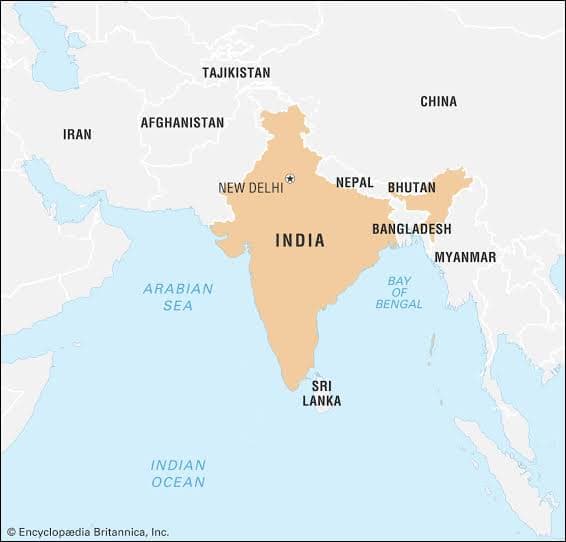
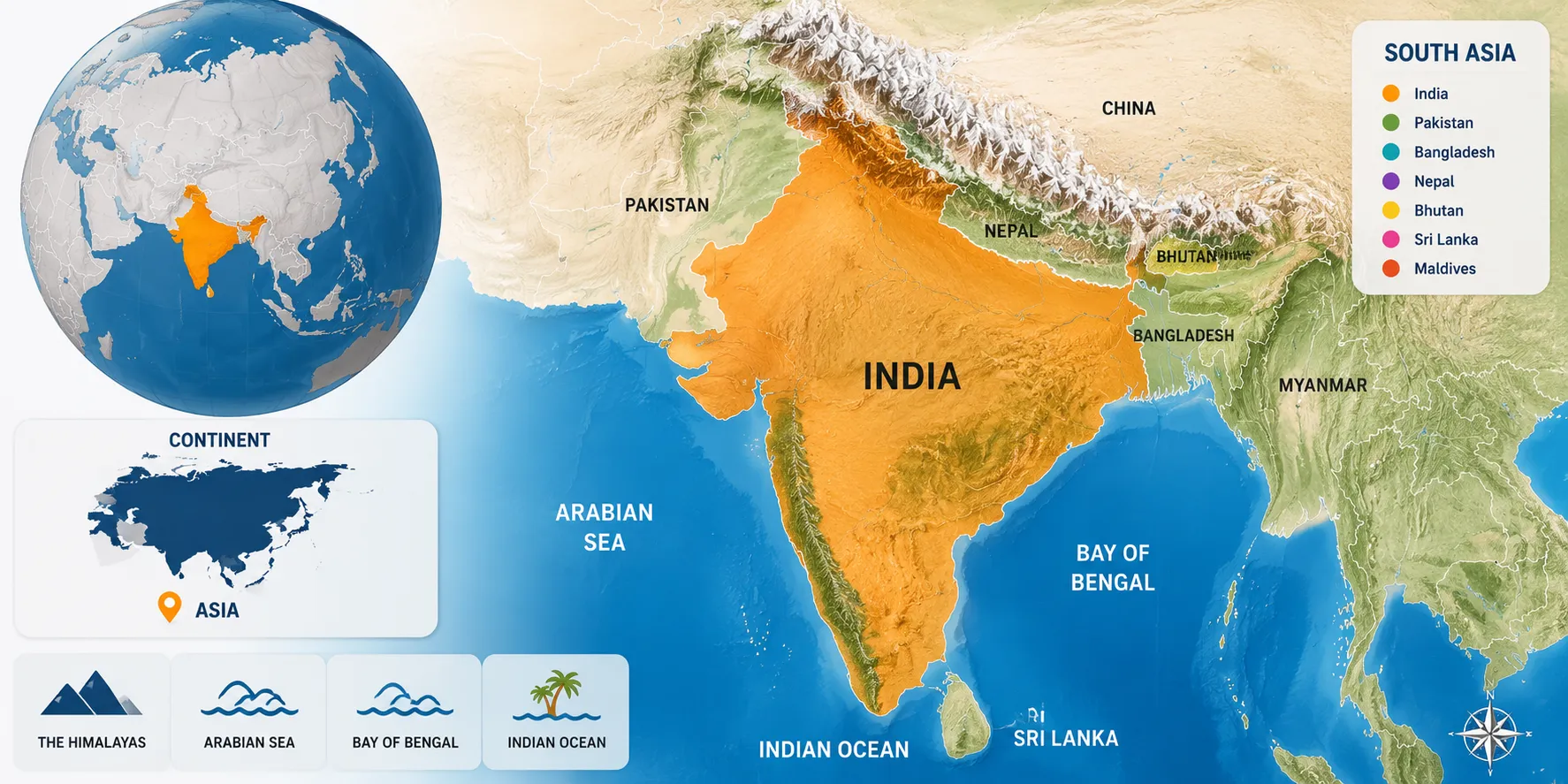
India is located in the continent of Asia. More specifically, it is part of South Asia, a region that also includes countries such as Pakistan, Bangladesh, Nepal, Bhutan, Sri Lanka, and the Maldives. Geographically, India occupies the largest portion of the Indian subcontinent, a distinct landmass separated from the rest of Asia by the Himalayas.
Many people get confused because the term Indian subcontinent is often used alongside South Asia. The important thing to remember is that the Indian subcontinent is a geographical region, while Asia is the continent.
Geographic Location
India lies in the southern part of the Asian continent.
Its geographical position is:
-
Continent: Asia
-
Region: South Asia
-
Hemispheres: Northern and Eastern
-
Surrounded by: The Arabian Sea (west), the Bay of Bengal (east), and the Indian Ocean (south).
India's location has made it an important center for trade, culture, and civilization for thousands of years.
Regional Context
Asia is the largest continent in the world and is commonly divided into several regions.
| Region of Asia | Example Countries |
|---|---|
| South Asia | India, Pakistan, Bangladesh, Nepal, Bhutan, Sri Lanka, Maldives |
| East Asia | China, Japan, South Korea, North Korea, Mongolia |
| Southeast Asia | Thailand, Indonesia, Vietnam, Malaysia, Singapore |
| Central Asia | Kazakhstan, Uzbekistan, Kyrgyzstan, Tajikistan, Turkmenistan |
| West Asia | Saudi Arabia, UAE, Qatar, Iran, Iraq |
| North Asia | Asian part of Russia (Siberia) |
India belongs to South Asia, not East Asia or Southeast Asia.
Neighboring Countries & Physical Features
India shares land borders with several countries.
| Direction | Neighbor |
|---|---|
| Northwest | Pakistan |
| North | China, Nepal, Bhutan |
| East | Bangladesh, Myanmar |
| South | Indian Ocean |
| West | Arabian Sea |
| East | Bay of Bengal |
Some of India's most important physical features include:
-
The Himalayas, the world's highest mountain range.
-
The Indo-Gangetic Plain, one of the world's most fertile regions.
-
The Deccan Plateau, which covers much of southern India.
-
A coastline of more than 7,500 kilometers.
Interesting Facts
India's location makes it one of the most geographically diverse countries in the world.
Here are a few interesting facts:
-
India is the seventh-largest country by land area.
-
It forms the largest part of the Indian subcontinent.
-
The country lies on the Indian tectonic plate, which collided with the Eurasian Plate millions of years ago to form the Himalayas.
-
India is surrounded by water on three sides, making it a peninsula.
-
Because of its strategic location between the Middle East, Southeast Asia, and East Asia, India has historically been an important hub for trade and maritime routes.
India's geography is one of the reasons it has such incredible diversity in climate, wildlife, languages, agriculture, and cultures. From snow-covered mountains in the north to tropical beaches in the south, very few countries offer such a wide variety of landscapes within a single nation.
Common Misconceptions
"India is a continent."
No.
India is a country, while Asia is the continent.
"The Indian subcontinent is the same as a continent."
Not exactly.
The Indian subcontinent is a geographical region within Asia, not a separate continent.
"India is located in Southeast Asia."
No.
India is part of South Asia, which is a different region of the Asian continent.
Frequently Asked Questions (FAQs)
1. Which continent is India in?
India is located in Asia, specifically in the South Asian region.
2. Is India part of South Asia?
Yes. India is the largest country in South Asia and occupies most of the Indian subcontinent.
3. Why is it called the Indian subcontinent?
The region is called the Indian subcontinent because it forms a distinct geographical landmass that projects southward from Asia and is separated from the rest of the continent by the Himalayas.
4. Which oceans surround India?
India is bordered by the Arabian Sea to the west, the Bay of Bengal to the east, and the Indian Ocean to the south.
5. Is India in the Northern Hemisphere?
Yes. India lies in both the Northern Hemisphere and the Eastern Hemisphere.
India's Location at a Glance
| Feature | Answer |
|---|---|
| Continent | Asia |
| Region | South Asia |
| Geographical Landmass | Indian Subcontinent |
| Bordering Water Bodies | Arabian Sea, Bay of Bengal, Indian Ocean |
| Most Famous Physical Feature | The Himalayas |
India is an integral part of Asia and serves as the geographic, cultural, and economic heart of South Asia. Its unique location, diverse landscapes, and strategic position between major regions of the world have shaped its history and continue to make it one of the most influential countries on the Asian continent.
Must Read: How many continents are there in the world?
 Answered by