
A window wall and a curtain wall are both non-load-bearing exterior façade systems that combine glass and framing to enclose a building. However, the key difference lies in how they are installed and supported.
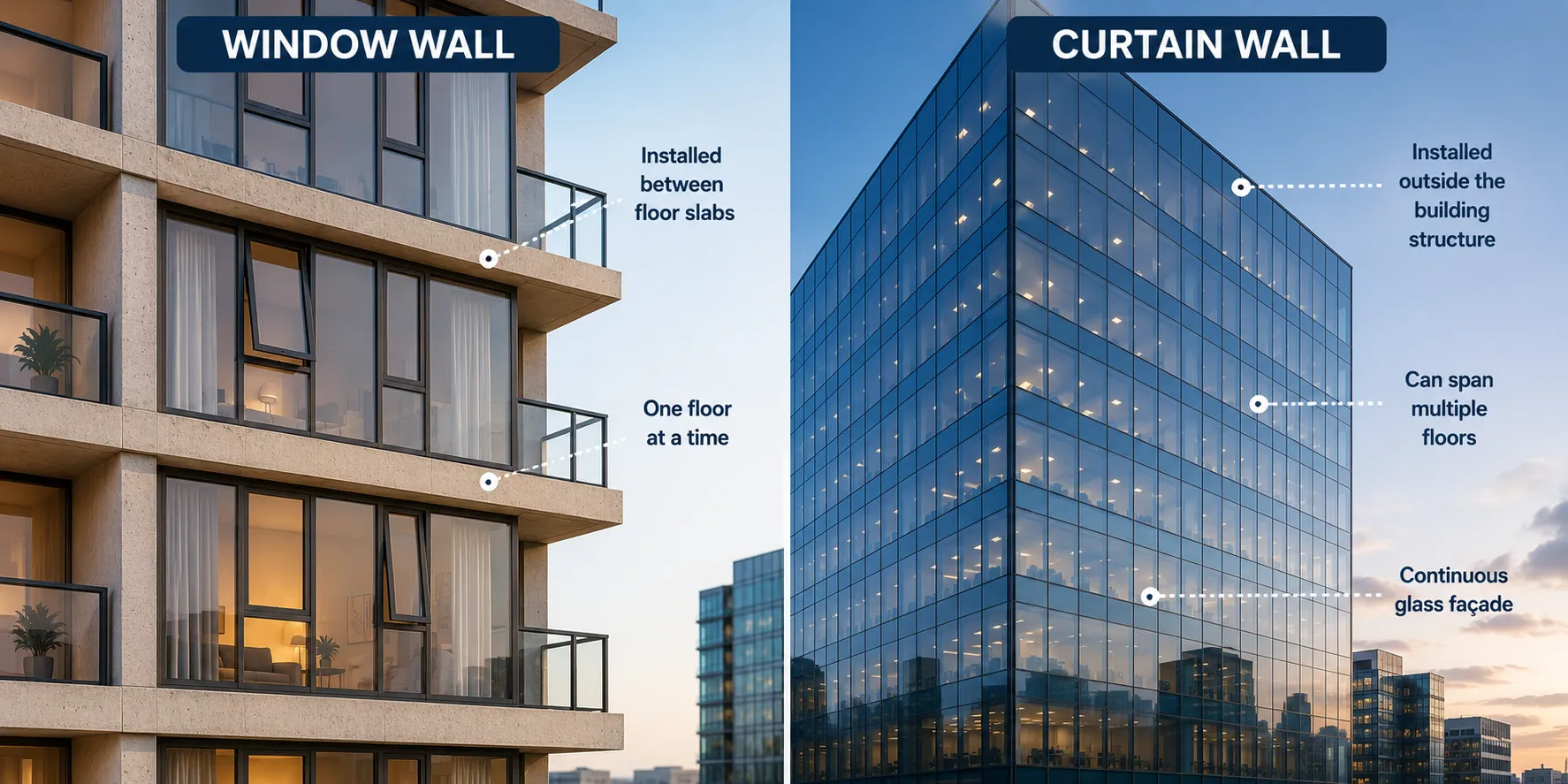
A window wall is installed between two floor slabs (slab-to-slab), meaning each floor has its own separate wall section that is supported by the slabs above and below. In contrast, a curtain wall is attached to the outside of a building's structural frame and can span multiple floors, creating a continuous exterior glass façade.
In simple terms:
-
Window Wall = Installed between floor slabs, one floor at a time.
-
Curtain Wall = Hung outside the building structure and can span multiple floors.
Although both systems improve natural lighting and building aesthetics, they differ in installation, structural design, cost, thermal performance, maintenance, and typical applications.
| Feature | Window Wall | Curtain Wall |
|---|---|---|
| Installation | Installed between floor slabs (slab-to-slab) | Installed outside the building structure |
| Structural Support | Supported by the slabs above and below | Hung from the building frame; structurally independent |
| Floor Span | One floor at a time | Can span multiple stories |
| Building Appearance | Visible horizontal slab lines | Continuous glass façade with minimal slab visibility |
| Cost | Generally lower | Generally higher |
| Installation Complexity | Easier and faster | More complex and labor-intensive |
| Thermal & Weather Performance | Good | Typically better for high-rise applications |
| Typical Buildings | Residential apartments, hotels, condominiums | Office towers, airports, commercial high-rises |
Window walls and curtain walls both protect the building from weather, but they are engineered differently to meet different architectural and structural requirements.
What Is a Window Wall?
A window wall is an exterior glazing system installed between the concrete floor slabs of a building. Each floor has an independent window wall unit that transfers its load to the slabs above and below. Because the floor slabs interrupt the façade, the horizontal floor lines are usually visible from the outside. Window walls are commonly used in residential towers, hotels, and mixed-use buildings.
What Is a Curtain Wall?
A curtain wall is a non-structural exterior wall system attached to the outside of a building's structural frame. It does not support the building's weight; instead, it supports only its own weight and transfers wind and other environmental loads to the building structure. Curtain walls often extend across multiple floors, creating the seamless glass façades commonly seen on modern commercial skyscrapers.
Advantages & Disadvantages
Window Wall
Advantages
-
Lower installation cost.
-
Faster construction.
-
Easier to replace individual units.
-
Better natural sound separation because floor slabs separate each level.
-
Can include operable windows for natural ventilation.
Disadvantages
-
Less architectural flexibility.
-
Visible floor slab lines interrupt the façade.
-
Generally not ideal for very tall buildings.
-
Lower structural performance for extreme wind conditions compared with curtain walls.
Curtain Wall
Advantages
-
Modern, continuous glass appearance.
-
Suitable for tall and complex buildings.
-
Greater architectural design flexibility.
-
Excellent resistance to wind, rain, and building movement.
-
Can achieve high levels of thermal performance with advanced glazing systems.
Disadvantages
-
Higher material and installation costs.
-
More complex engineering and installation.
-
Maintenance and repairs may require specialized access equipment.
-
Installation generally takes longer than window wall systems.
Applications
Both systems are selected based on building type, height, budget, and design goals.
Window Walls
Commonly used in:
-
Residential apartment buildings.
-
Condominiums.
-
Hotels.
-
Student housing.
-
Mid-rise mixed-use developments.
Curtain Walls
Commonly used in:
-
Office towers.
-
Corporate headquarters.
-
Airports.
-
Hospitals.
-
Universities.
-
Shopping malls.
-
High-rise commercial buildings.
-
Landmark architectural projects.
Generally, window walls are preferred where cost efficiency and simpler installation are priorities, while curtain walls are chosen when architectural appearance and high-performance façades are more important.
Cost & Performance
When comparing cost and overall performance:
| Factor | Window Wall | Curtain Wall |
|---|---|---|
| Initial Cost | Lower | Higher |
| Installation Time | Faster | Longer |
| Engineering Complexity | Moderate | High |
| Weather Resistance | Good | Excellent |
| High-Rise Performance | Moderate | Excellent |
| Design Flexibility | Moderate | Excellent |
| Maintenance | Easier unit replacement | More specialized maintenance |
Although curtain walls usually cost more, they often provide better long-term performance for large commercial buildings where durability, weather resistance, and architectural aesthetics are major priorities. Window walls offer an economical solution for many residential projects without sacrificing functionality.
Common Misconceptions
"Window walls and curtain walls are the same."
No.
Both are exterior glazing systems, but window walls are installed between floor slabs, while curtain walls are attached outside the structural frame and may span multiple floors.
"Curtain walls support the weight of a building."
Incorrect.
Curtain walls are non-load-bearing. They support only their own weight and environmental loads such as wind, while the building's structural frame carries the building's weight.
"Window walls are only windows."
Not exactly.
A window wall is a complete façade assembly consisting of framing, glazing, insulation, seals, and other components—not just individual windows.
"Curtain walls are always the better option."
Not necessarily.
The best system depends on the project's height, structural design, climate, budget, maintenance requirements, and architectural goals.
Frequently Asked Questions (FAQs)
1. What is the main difference between a window wall and a curtain wall?
A window wall fits between floor slabs, while a curtain wall hangs outside the building structure and can span multiple floors.
2. Which system is more expensive?
Curtain walls are generally more expensive because they require more engineering, specialized installation, and structural support.
3. Which buildings typically use curtain walls?
Curtain walls are commonly used in high-rise office buildings, airports, hospitals, and commercial towers because they provide excellent weather protection and architectural flexibility.
4. Can window walls be used in high-rise buildings?
Yes.
Window walls are used in many residential high-rise buildings, hotels, and condominiums, although curtain walls are often preferred for very tall commercial structures due to their performance characteristics.
5. Which system is easier to maintain?
Window walls are generally easier to repair because individual floor units can often be replaced independently, whereas curtain wall maintenance may require specialized façade access systems.
