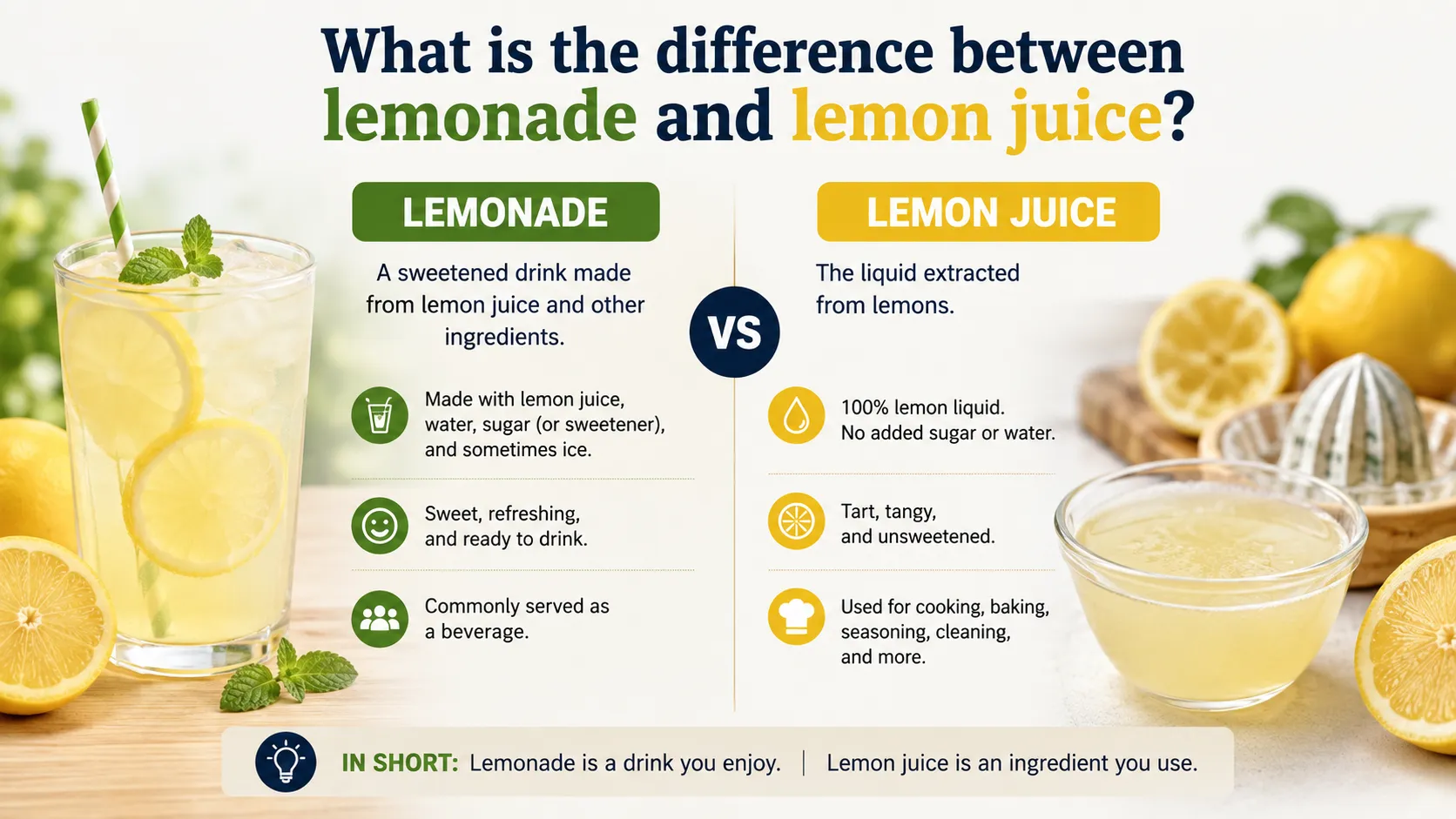
Lemon juice is what comes out of a lemon when you squeeze it. Lemonade is a recipe — lemon juice, water, and sugar, mixed to a rough ratio. That's the whole difference. Everything else people ask about — which is healthier, whether you can swap one for the other, why the names split at all — falls out of that one fact.
If you need acid for cooking, you want lemon juice. If you want something to drink, you want lemonade. Nobody's actually confused about this in practice. They get confused when a recipe says one and the fridge has the other.
Can you actually substitute one for the other?
Sort of, but "dilute it" — which is what most pages tell you — isn't a ratio.
Lemonade generally runs around 15–20% lemon juice by volume, the rest water and sugar. So if a recipe calls for a cup of lemonade and all you've got is straight lemon juice: 3 tablespoons of juice, a similar amount of sugar dissolved in, water to fill the cup. Taste before you commit — lemons vary.
Going the other direction doesn't work. Using lemonade where a recipe wants lemon juice throws off the sugar balance in a marinade or dressing, and you can't subtract it back out. Don't do it.
Why "lemonade" and not "lemon juice"?
Lemon juice on its own is close to undrinkable in any real quantity. Add sugar and water and you've made a different thing — different enough to earn its own name, same pattern as limeade or cherryade.
It gets messier outside the US. In Britain, Australia, and New Zealand, "lemonade" often means a carbonated lemon-lime soft drink — closer to Sprite than to anything from a farmers' market pitcher Lemonade is a sweetened lemon-flavored drink that may be carbonated or un-carbonated, with the un-carbonated, homemade version dominant in some regions and the carbonated soft drink version dominant in others. If you're writing for a US audience and see "lemonade" used in a British source, don't assume it's the same drink.
Which one is actually healthier?
Lemon juice, by a real margin — but not by the margin some pages claim.
Raw lemon juice has about 38.7 mg of vitamin C per 100g based on USDA FoodData Central figures for raw lemon juice. Whole lemon flesh runs a bit higher, around 53 mg per 100g reflecting USDA data comparing whole lemon to juice-only nutrition, because some vitamin C sits in the pulp and gets left behind when you juice it.
Lemonade dilutes that number twice — once from water, once from sugar taking up space where juice used to be. And vitamin C doesn't sit still once exposed to air: the vitamin C content of freshly squeezed lemon juice starts oxidizing rapidly once exposed to air, so it's best used quickly. Juice that's been sitting in your fridge for two weeks isn't delivering what the label implies. Same problem, worse, with bottled concentrate — it's been processed and stored longer, and most brands add preservatives to stay shelf-stable. Fine for cooking. Weaker case for a daily immunity shot.
One caveat that gets skipped everywhere: straight lemon juice, taken often, is hard on tooth enamel. That's not a reason to avoid it — it's a reason to drink it through a straw or rinse with water after, not skip your morning shot.
The actual recommendation
If a recipe says lemon juice, use lemon juice — not lemonade, not lemon water. If you're out of lemon juice and need lemonade, mix 1 part juice to roughly 1 part dissolved sugar to 6–8 parts water, then adjust to taste. And if you're drinking either one for the vitamin C, squeeze it fresh and drink it within the hour — the bottle in your fridge is mostly doing flavor work at that point, not nutrition.




.jpeg&w=640&q=75)