
Quick Answer
When people ask, "Why nepal is not a democratic country?", the question is actually based on a common misconception. Nepal is a democratic country. Officially known as the Federal Democratic Republic of Nepal, it transitioned from a monarchy to a federal republic following a Comprehensive Peace Agreement and the promulgation of its 2015 Constitution .
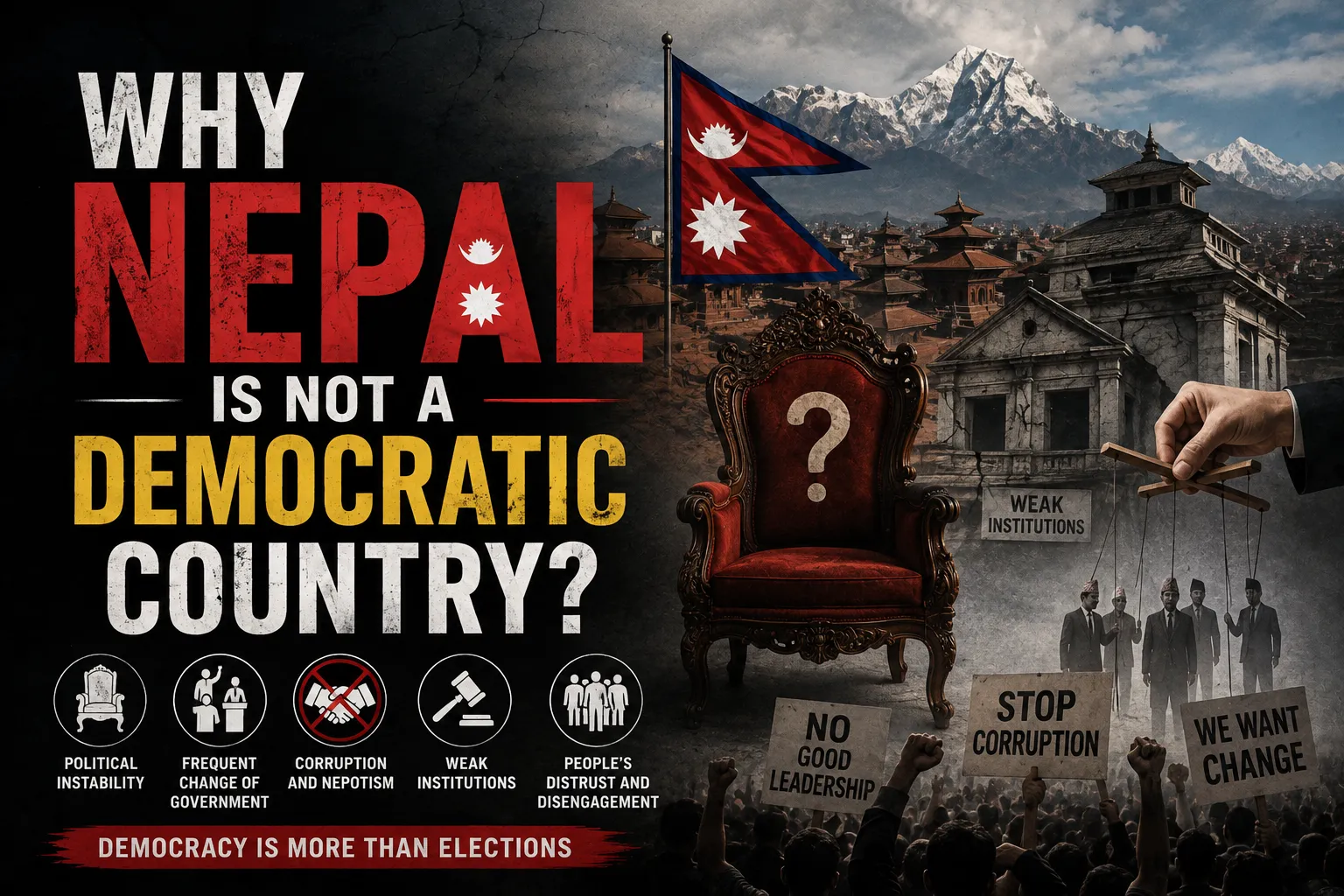
However, the confusion arises because Nepal’s democracy faces significant challenges. While it holds credible, multi-party elections, its political system suffers from frequent government turnover, institutional inefficiency, and endemic corruption . It is a functioning democracy, but one that is often described as fragile or "partly free" by international observers .
In this guide, you will learn:
The history of Nepal's transition to a democratic country.
How the current three-tiered federal system works.
The key challenges preventing effective governance.
Why international indices rate Nepal as a mid-range democracy.
Nepal's Governance at a Glance
For readers looking for a quick breakdown, here is the current structure and status of Nepal's political system:
Feature | Details |
|---|---|
Official Name | Federal Democratic Republic of Nepal |
System of Government | Federal parliamentary republic |
Current Constitution | Promulgated in 2015 [1] |
Administrative Structure | 1 Federal Gov., 7 Provincial Govs., 753 Local Govs. [1] |
Freedom House Status | "Partly Free" (Score: 59/100) [3] |
The Journey to Becoming a Democratic Country
Nepal’s path to becoming a nepal democratic country has been long and turbulent. For much of its history, Nepal was a unitary state ruled by a Hindu monarchy.
A decade-long Maoist insurgency ended with a Comprehensive Peace Agreement in 2006. This paved the way for the abolition of the monarchy in 2008 and the eventual adoption of the 2015 Constitution . This landmark document fundamentally restructured the nation into a federal democratic republic, aiming to decentralize power and provide greater representation for marginalized groups.
The Federal Structure
Today, Nepal operates under a three-tiered system designed to bring governance closer to the people:
Federal Level: The central government in Kathmandu, led by a Prime Minister (head of government) and a President (head of state) .
Provincial Level: Seven provinces, each with its own government and legislative assembly.
Local Level: 753 local governments tasked with essential service delivery and community development .
If It Is a Democracy, Why the Confusion?
The question of "why nepal is not a democratic country?" usually stems from the quality of governance rather than the absence of democratic systems. While democratic procedures like voting are generally respected, the system's effectiveness is hampered by several deep-rooted issues.
1.Political Instability:Frequent government turnover.
Since 2013, Nepal has experienced numerous short-lived administrations driven by fragile coalition politics [2]. This constant shifting of power undermines policy continuity and long-term development.
2.Implementation Challenges:Struggles with the 2015 Constitution.
While federalism was a massive step forward, roles between the federal and provincial levels are often poorly defined, leading to weak intergovernmental coordination and administrative friction.
3.Endemic Corruption:Systemic issues across levels.
Corruption and clientelism remain significant problems. While progress has been made, vested political interests often subvert the fair provision of public goods and services.
International Rankings
These institutional challenges are reflected in international rankings. For example, the V-Dem Liberal Democracy Index scores Nepal at 50.5/100, placing it among functioning democracies but noting weaknesses in liberal safeguards. Similarly, Freedom House classifies Nepal as "Partly Free," citing issues with political pressure on the judiciary and restrictions on civil society
Frequently Asked Questions (FAQ)
Is the monarchy ever coming back to Nepal?
The monarchy was officially abolished in 2008, making Nepal a republic. While there are small political factions that advocate for the return of the monarchy or a Hindu state, the current Constitution firmly establishes Nepal as a secular, federal democratic republic.
Are elections in Nepal considered fair?
Generally, yes. Domestic and international observers have characterized recent elections (such as those in 2022) as competitive and credible, demonstrating the public's commitment to democratic processes.
What is the biggest economic challenge for democratic Nepal?
Despite remarkable success in reducing poverty (from 55% in 1995 to 0.37% in 2022), Nepal relies heavily on remittances from citizens working abroad. The greatest challenge for the government is creating sustained domestic growth and quality jobs within the country.
Conclusion
To state that nepal is not a democracy is factually incorrect, but it is entirely accurate to say it is a democracy undergoing severe growing pains. Since the adoption of the 2015 Constitution, Nepal has built a comprehensive framework for a decentralized, multi-party system. The struggles it faces today—political instability, corruption, and complex federal integration—are not signs of a failed democracy, but rather the difficult hurdles of a developing democratic country striving to realize its full potential.
Sources & References
Also Read: