
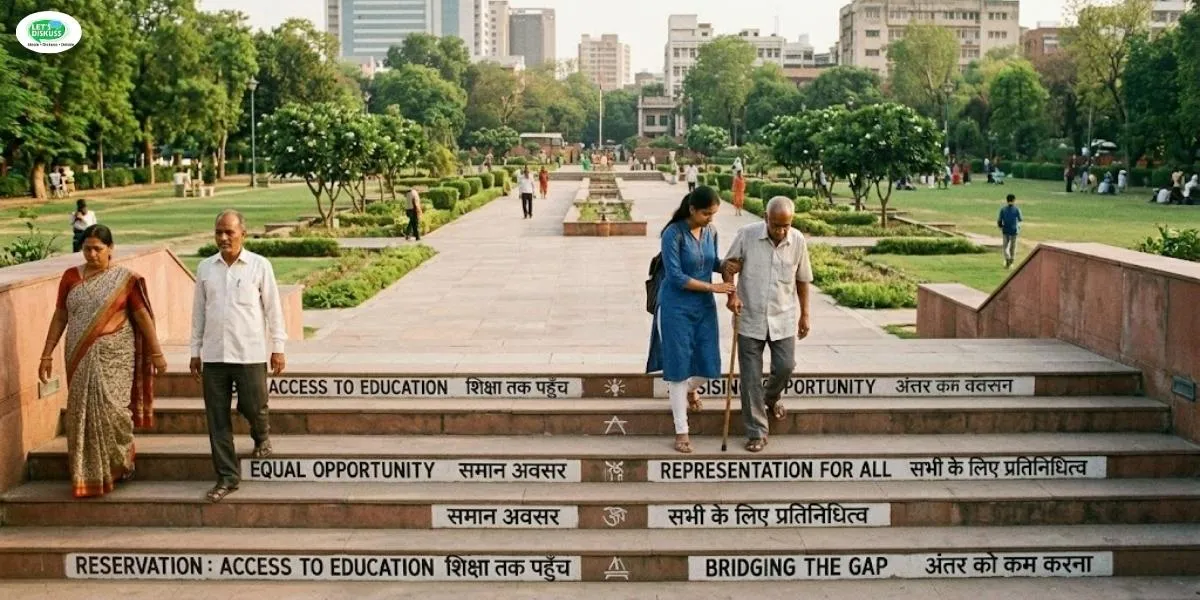
In short: Reservation aims to fix historical inequality, but it also raises questions about merit and fairness. This article explains both sides, its history, and what needs improvement.
You won't believe this, but the reservation system is probably the one topic that can start a full-on argument at any dinner table in India. Doesn't matter if it's a college common room, a family WhatsApp group, or a UPSC preparation class.
Table of Contents
Someone will defend it hard. Someone else will call it completely unfair. And both of them will have real reasons.
- See, the reservation system in India has been one of the most contested and emotionally charged debates since independence.
- On one side, it's a lifeline, a constitutional promise made to communities that were crushed for centuries under the caste system. On the other side, it's seen as an unfair advantage that punishes people purely based on birth and blocks merit-based selection.
- And I get why both sides feel strongly. I have seen people lose government jobs to the reservation quotas by just a few marks. I have also seen first-generation college students from SC communities who literally had no other shot at higher education without it.
- So instead of picking a side here, let's actually understand what this system is, where it came from, what it has achieved, what it has failed at, and where India should go from here.
- Because frankly, most debates around this topic happen without people knowing the actual history or legal framework. And that's exactly what this blog fixes.
The Roots of Systemic Inequality and Historical Context
Before we judge the reservation system, we need to understand why it exists at all. And for that, we need to go back in time.
India's caste system didn't just create social hierarchy. It created a locked ecosystem where certain communities were denied education, land, clean water, public spaces, and any chance at social mobility for literally thousands of years. This isn't just ancient history. As recently as the 1950s, Dalit children were barred from sitting in the same classroom as upper-caste children in many parts of India.
So when the Constitution was being written, Dr. B.R. Ambedkar and the framers had a choice. Either pretend everyone starts on an equal footing or acknowledge that centuries of oppression have left certain communities so far behind that formal equality alone won't work. They chose the second option. And that's where the reservation system was born.
Right to Equality in India:
The right to equality in India is guaranteed under Articles 14 to 18 of the Constitution. Sounds straightforward, right? Everyone is equal before the law. But here's the nuance that most people miss.
Real equality doesn't just mean treating everyone the same. Sometimes treating unequal people equally just preserves the inequality. If a person who has been denied education for generations competes on the same terms as someone from a privileged background, the competition is already rigged. Affirmative action, including reservations, is the corrective mechanism to fix that starting imbalance.
Articles 15 and 16 of the Indian Constitution:
Article 15 says the state cannot discriminate on grounds of religion, race, caste, sex, or place of birth. But Article 15(4) specifically allows the state to make special provisions for socially and educationally backward classes or for SC and ST communities.
Article 16 guarantees equality of opportunity in public employment. But Article 16(4) allows reservations in appointments for backward classes that are not adequately represented. These provisions are the constitutional backbone of the entire reservation system.
The Mandal Commission:
Here's where it got political. Fast forward to 1980, when the Mandal Commission submitted its report recommending 27% reservation for OBCs in government jobs and education. The report was literally shelved for a decade.
Then, in 1990, PM V.P. Singh announced the implementation of the Mandal recommendations. What followed was one of India's most intense social movements. Students protested across the country. Some self-immolated. The OBC reservation debate split the nation.
But it also forced India to acknowledge something real. That the so-called upper caste vs. lower caste binary was too simple. That OBC communities, which make up nearly 52% of India's population, were massively underrepresented in government and educational institutions. The Mandal Commission changed the reservation system permanently.
Why Caste-Based Reservation Exists
Constitutional Rights and Systemic Inequality:
Let's be honest about what systemic inequality actually looks like in India even today:
- First-generation learners from SC and ST communities are still navigating educational systems that were never designed for them.
- They often lack coaching, guidance, networks, and family support that many general-category students take for granted.
- Caste-based reservation in this context is not charity. It is a constitutional right backed by documented historical discrimination. The data backs this, too.
- Before reservations, the representation of SC and ST communities in higher education and public employment was nearly zero.
- Decades later, while still imperfect, the numbers have shifted meaningfully.
Think of it this way. If a 100-meter race has one runner who starts from the original line and another who starts 30 meters behind because their grandfather wasn't allowed to train, giving them a head start isn't unfair. It's correcting a pre-existing unfairness.
Gender Quota in Politics:
The reservation debate isn't just about caste. The push for a gender quota in politics, officially called the Women's Reservation Bill or Nari Shakti Vandan Adhiniyam, is now finally law. It reserves 33% of seats in Parliament and state assemblies for women.
This shows that reservation as a concept is broader than caste. It's about the representation of any group that has been historically excluded from power. Women, who make up 48% of India's population, hold barely 15% of Parliament seats without a quota. The gender quota is trying to fix that structural imbalance, with the same logic as caste-based reservation.
The Case Against: Reservation vs Merit
Merit-Based Selection and General Category Frustration:
- And now the other side. Which is also real. The reservation vs. merit debate hits hardest in competitive exams. A general category student scoring 95% may not get a seat, while a reserved category student with 72% does. From the outside, that looks deeply unfair. And honestly, if you're the student in that situation, it feels unfair too.
- The frustration around merit-based selection is legitimate. India needs competent doctors, engineers, bureaucrats, and judges. If the selection process doesn't prioritize competence, the consequences aren't abstract. They affect people's lives directly.
- But here's what the merit argument often misses. Merit is not born in a vacuum. A student who had access to private coaching, English-medium schooling, stable electricity, a quiet study space, and educated parents has a structural advantage that has nothing to do with inherent intelligence or hard work. Calling that situation pure merit is itself a flawed argument.
- Both things can be true. Reservation without merit standards has real costs. And merit without accounting for unequal starting points is also unfair. The debate needs both truths on the table.
Quota Politics and Vote Bank Politics:
This is the ugly side nobody wants to talk about openly, but everybody knows is real.
- Political parties in India have consistently used quota politics to consolidate vote bank politics rather than actually uplift communities.
- New caste groups get added to OBC lists right before elections. Demands for reservations are stoked during campaign season and then quietly shelved afterwards.
- The reservation system becomes a tool for electoral calculation rather than social upliftment. The result? Communities that genuinely need support get promises instead of progress.
- The actual gap in education quality, healthcare access, and employment creation never gets addressed. Reservation becomes a substitute for real policy work. And that is a betrayal of what the system was meant to do.
Modern Adjustments and Economic Factors
The Creamy Layer Concept:
One of the smarter tweaks in the reservation system is the creamy layer concept. The idea is simple. If a person's family has already crossed a certain income or social status threshold, they don't need reservation benefits anymore. For OBCs, the creamy layer currently excludes families earning above Rs 8 lakh per year from availing reservation benefits.
| Who is Excluded (Creamy Layer) | Why Excluded | Current Income Limit |
| Children of Class I & II govt. officers | Sufficient social standing assumed | Automatic Exclusion |
| Families above the income threshold | Economic disadvantage no longer applies | Rs 8 lakh per year |
| Constitutional post holders | Highest social/political status | Automatic exclusion |
| SC and ST communities | The creamy layer does not apply to them | No income limit |
Keep in mind that the creamy layer rule doesn't apply to SC and ST groups. The Supreme Court has held that historical discrimination for these groups is so deep that economic upliftment alone doesn't remove the social stigma they face. So, for the sake of reservations, they don't have to have a certain amount of money.
EWS Quota:
The 103rd Constitutional Amendment in 2019 introduced a new 10% EWS quota for Economically Weaker Sections from the general category. This was a big change. For the first time, a reservation was made based only on economic factors, not caste.
Families in the general category who make less than Rs 8 lakh a year and don't own a lot of property can apply for the EWS quota.
| Feature | Caste-based Reservation | EWS Quota |
| Basis | Historical caste discrimination | Economic weakness only |
| Who gets it | SC, ST, OBC communities | General category below the income limit |
| Percentage | 49.5% total (SC 15%, ST 7.5%, OBC 27%) | 10% |
| Legal basis | Articles 15(4) and 16(4) | 103rd Constitutional Amendment 2019 |
| Creamy Layer | Applies to OBC, not SC/ST | Income and property limits apply |
The EWS quota was challenged in the Supreme Court. In 2022, the Constitution Bench upheld it in a 3:2 majority. The dissenting judges raised concerns about it breaching the 50% reservation cap set in earlier judgments. It remains one of the most debated changes to the reservation system in recent years.
Conclusion
See, here's my actual take after going through all of this. The reservation system is neither perfect nor something that should be abolished overnight. That's the honest answer, even if it's not the satisfying one.
The historical basis for the reservation is real and documented. The caste system created deep and lasting inequality that formal equality alone can't fix. The reservation has helped. Representation has increased. Opportunities have opened up for communities that had none.
But the system also has problems that can't be ignored. Political misuse is rampant. The creamy layer gets evaded. The quality gap in education and infrastructure that actually drives inequality never gets addressed because reservation becomes the substitute for real reform. And the frustration of general category students competing under different cut-offs is genuine and should not be dismissed.
What India actually needs is this:
- Better implementation of the creamy layer
- Investment in education quality at the primary and secondary levels so fewer people need reservations by the time they reach competitive exams
- Regular review of which communities actually need reservation and removal of those who have achieved parity
- And most importantly, a separation of the reservation policy from the election strategy
The question is not reservation vs. no reservation. The question is how to make the system actually work for those who need it most, while keeping the overall quality and fairness of public institutions intact. That's a harder conversation. But it's the right one.
What do you think? Does the current reservation system achieve what it was meant to? Or has it drifted too far from its original intent? Drop your thoughts in the comments below. This is exactly the kind of debate that needs more informed voices, not just loud ones.