From AIIMS to MAMC to private options: real data on fees, NEET cutoffs, seats, and admission for every top medical college in Delhi.
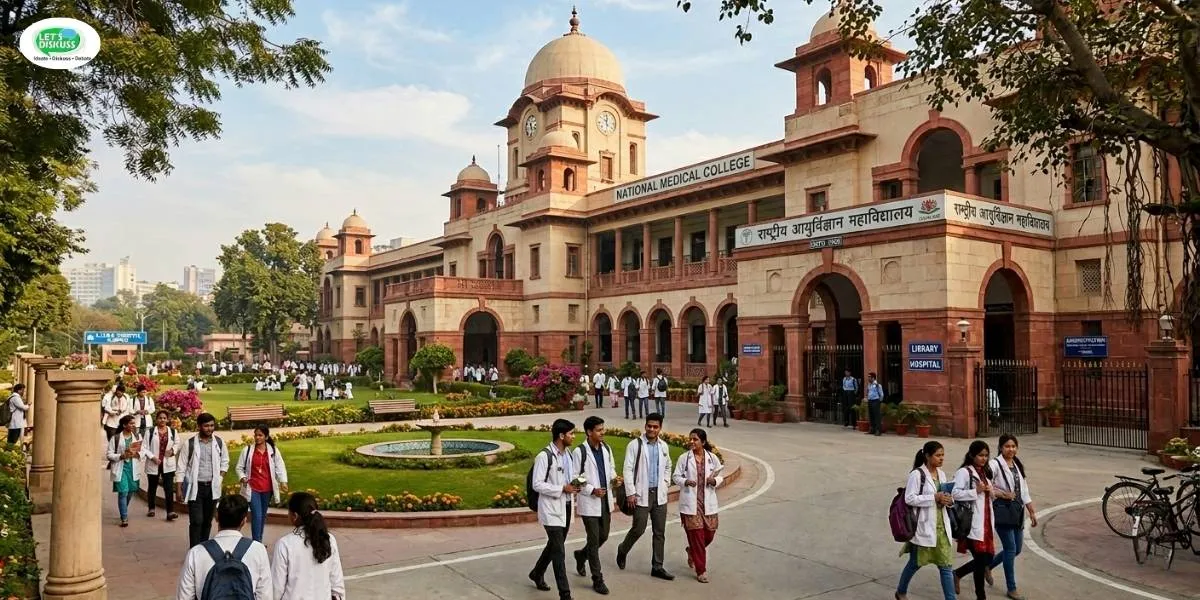
Lakhs of NEET aspirants dream about getting into a top medical college in Delhi. And why wouldn't they? Delhi has some of the best hospitals in the country, the most complex case mix, and a concentration of medical talent that very few cities can match.
But here's what I've noticed. Most students researching top medical colleges in Delhi end up on pages that throw a list of 15 colleges at them and leave. There is just no real data or an honest comparison. In fact, nobody tells exactly what NEET score you need or what you'll actually pay.
This guide fixes all those pain points of a student who’s searching for the best medical colleges in Delhi.
We're talking real NEET cutoffs from 2024 and 2025 counselling data, verified fee structures, seat counts, hospital affiliations, and a completely honest look at which colleges are worth your time. Whether you're targeting AIIMS or looking at private options after missing government cutoffs, everything is here.
Why Choose Delhi for Your Medical Studies?
Delhi is not just about college rankings. It's about what happens to you during those five and a half years of MBBS. And on that front, Delhi is genuinely hard to beat.
Unmatched Clinical Exposure
Take Sneha, a third-year MBBS student at UCMS. In her words, “In my first clinical posting, I saw a live trauma case, a dengue patient, and a suspected rabies case on the same day. That just doesn't happen everywhere.”
Delhi's government teaching hospitals, Safdarjung, GTB, LNJP, RML, and the AIIMS complex, collectively handle millions of OPD visits every year. Safdarjung Hospital alone has over 2,900 beds. GTB Hospital, attached to UCMS, has 1,500 beds. These are not just numbers. This is the kind of patient load that prepares you for anything you'll face in your career.
The Epicenter of NEET-PG Coaching
Delhi, specifically Mukherjee Nagar and Rajendra Nagar areas, is where most serious NEET-PG aspirants come to prepare. Institutes like DAMS and MedPG have been producing consistent top results. If you study MBBS in Delhi, you're already in the middle of the country's best PG preparation ecosystem. That's not a small thing.
Top-Tier Infrastructure and Subsidies
Government medical colleges in Delhi charge fees that would seem like a joke anywhere else. AIIMS charges approximately INR 5,856 for the entire MBBS course. MAMC and LHMC charge a few thousand rupees per year. These are central government subsidies that make world-class medical education accessible. And the infrastructure that comes with it, labs, simulation centers, libraries, is genuinely excellent at top government colleges.
Overview of MBBS Colleges in Delhi
As of 2026, Delhi has around 10 medical colleges, excluding AIIMS. These include both government and private institutions. The total MBBS seat count in Delhi across government colleges is approximately 1,497 seats for the 2025-26 academic session, according to state counselling data.
Admission to all these colleges requires NEET-UG. No MBBS college in Delhi admits students without NEET. Anyone claiming otherwise is simply misleading you.
The government colleges fall under two university affiliations: Delhi University (through the Faculty of Medical Sciences) and Guru Gobind Singh Indraprastha University. This matters because the counselling process is different for each.
Official Delhi Medical Colleges Ranking: Top Government Institutes
1. All India Institute of Medical Sciences (AIIMS), New Delhi
AIIMS New Delhi is India's No. 1 medical college. It has been ranked 1st under the Medical category in NIRF 2024 and India Today 2025. QS World University Rankings placed it at 127 in Medicine in 2024. There is no other medical institution in India that even comes close on research output, faculty quality, and patient complexity.
Established in 1956, AIIMS New Delhi offers 125 MBBS seats annually. The total fee for the entire MBBS course is approximately INR 5,856, which is practically free. This is a central government institution, and the subsidy is enormous.
For admission, you need NEET-UG. The closing rank for the General category in NEET 2024 counselling was AIR 47. In 2025, it closed at AIR 48. To put that in context, you need to be in the top 50 students in the entire country out of over 23 lakh who appeared. A safe score is generally considered 710 or above out of 720.
AIIMS does not have a separate entrance exam for MBBS anymore. The separate AIIMS exam was discontinued in 2020. PG admissions (MD/MS) are through INI-CET, not NEET-PG.
2. Maulana Azad Medical College (MAMC)
MAMC is the second most sought-after medical college in Delhi and one of the best in the country. Established in 1958 and affiliated with Delhi University, it was ranked 24th by NIRF 2024 and 5th by India Today in 2025 under the medical category.
MAMC has 250 MBBS seats. The first-year fee is approximately INR 4,445, and subsequent years are around INR 2,145. It is one of the most affordable yet prestigious options available. The college is attached to Lok Nayak Hospital, which is one of Delhi's largest government hospitals.
For General category students under the All India Quota, the closing rank in 2024 was around AIR 97 with approximately 704 marks. Under the Delhi state quota, the closing rank was in the range of AIR 1,461 for General. You need a NEET score well above 690 for a realistic shot at MAMC under the General category.
3. Vardhman Mahavir Medical College (VMMC) and Safdarjung Hospital
VMMC is attached to Safdarjung Hospital, one of the largest hospitals in Asia with over 2,900 beds. Established in 2002 and affiliated with Guru Gobind Singh Indraprastha University, VMMC has 170 MBBS seats annually.
The annual fee is approximately INR 37,000, still very affordable. VMMC is an IPU college, so the 85% state quota goes through IPU counselling and is only for students who studied Class 11 and 12 in Delhi. For the 15% All India Quota, counselling is through MCC, and that is open to students from any state.
The NEET General category cutoff for the Delhi state quota is roughly 685 marks and above. For AIQ, the cutoff is higher since competition is national, broadly in the same range as MAMC AIQ at around AIR 100-150.
The clinical exposure here is exceptional. Safdarjung Hospital is a super-specialty government hospital with departments across cardiology, oncology, neurosciences, nephrology, and trauma care. Students get exposed to a volume and variety of cases that are hard to replicate anywhere else.
4. Lady Hardinge Medical College (LHMC)
LHMC deserves special mention. It is exclusively for women, which makes it one of the few women-only medical colleges in India at this level of prestige. Established in 1916, it is one of the oldest medical colleges in Delhi and is affiliated with Delhi University.
LHMC has 200 MBBS seats. The annual fee is approximately INR 1,655 for the first year, making it extremely affordable. The college is attached to Smt. Sucheta Kriplani Hospital and Kalawati Saran Children's Hospital.
For General category women applying under the Delhi state quota, a NEET score of 680 and above is typically required. But if you are a female student from outside Delhi, you can still apply for the 15% All India Quota seats through MCC counselling. The AIQ cutoff at LHMC is higher than the state quota, generally requiring 690 marks and above for the General category women. So LHMC is not just for Delhi students. It is open to top-scoring women from anywhere in India via AIQ.
5. University College of Medical Sciences (UCMS)
UCMS was established in 1971 and is affiliated with Delhi University. It is attached to Guru Teg Bahadur (GTB) Hospital, which has 1,500 beds. UCMS currently has 170 MBBS seats (expanded from 150 under EWS quota provisions).
The fee structure is slightly higher than MAMC at around INR 31,340 for the first year, but still very affordable compared to any private college. For the General category under the Delhi state quota in 2024-25 counselling, the closing rank was around AIR 3,275.
For the 15% All India Quota at UCMS, the cutoff is tighter since it draws national competition, closing around AIR 390-500 for the General category based on 2024 data.
So if you're from outside Delhi, you need to be in the top 500 nationally to get UCMS through AIQ. Through the Delhi state quota, the range is more forgiving, but still means the top 3,275 out of 23 lakh.
UCMS was ranked 32nd by NIRF 2024. It's the most accessible of the top-tier DU medical colleges in terms of state quota cutoff. But whichever route you're taking, the competition is real.
Best Private Medical Colleges in Delhi NCR
If your NEET score didn't make it to government college cutoffs, Delhi NCR still has some private options worth considering. Just be clear about what you're paying and what you're getting.
1. Hamdard Institute of Medical Sciences and Research (HIMSR)
- HIMSR was established in 2012 and is affiliated with Jamia Hamdard University. It is NMC-recognized and was ranked 33rd by NIRF 2022 in Medical Sciences. The college is attached to the Hakeem Abdul Hameed Centenary Hospital, which has 740 beds and over 1,400 OPD patients daily.
- The MBBS fee at HIMSR is approximately INR 20.78 lakh for the first year, with a total course fee in the range of INR 60-72 lakh. This is significantly higher than government colleges but comparable to other private deemed colleges in the region.
- The NEET 2024 General category cutoff rank was around 68,155 for AIQ counselling, which made it more accessible than government colleges, but you still require a solid NEET score.
- HIMSR has separate hostels for boys and girls with modern facilities. Clinical training happens at Centenary Hospital with ICUs, modular OTs, and a 24/7 emergency department.
2. Army College of Medical Sciences (ACMS)
- ACMS is a special case. It was established in 2008 and is affiliated with Guru Gobind Singh Indraprastha University.
- Here's the thing about ACMS that most students don't know: admission is restricted to wards of serving and retired army personnel. If you don't have that background, this college is not an option for you.
- For those who are eligible, ACMS has 100 MBBS seats and decent clinical exposure through its attached hospital. The fee structure is significantly subsidized for eligible candidates compared to other private colleges.
3. Notable Mentions in NCR: Gurugram and Ghaziabad
Outside Delhi proper, the NCR has a few private colleges worth knowing about.
- Sharda University in Greater Noida has a medical school.
- SGT University in Gurugram offers MBBS.
SGT University is one of the best medical schools in Gurgaon. These are newer institutions with less established track records than HIMSR, but they offer NEET-based admission.
If you're considering these, research their NMC recognition status, hospital bed strength, and OPD patient load before committing. The quality of clinical exposure varies significantly among newer private medical colleges.
Top Medical Colleges in Delhi with Fee Structure
Here's the starkest difference in Indian medical education: government college fees vs. private college fees. It's not a small gap. It's a gap of 50-100x in some cases.
| College | Type | MBBS Seats | Annual Fee (Approx.) | NEET General Cutoff (2024-25) |
|---|---|---|---|---|
| AIIMS Delhi | Govt (Central) | 125 | ₹1,628/year | AIR 47-48 (710+ marks) |
| MAMC | Govt (DU) | 250 | ₹4,445 (Yr 1) | AIR ~97 (AIQ), ~1,461 (State) |
| VMMC | Govt (IPU) | 170 | ₹37,000/year | 685+ marks (State Quota) |
| LHMC (Women only) | Govt (DU) | 200 | ₹1,655 (Yr 1) | 680+ marks (State Quota) |
| UCMS | Govt (DU) | 170 | ₹31,340 (Yr 1) | AIR ~3,275 (State Quota) |
| HIMSR (Private) | Private (Deemed) | 150 | ₹20.78 lakh/year | AIR ~68,155 (AIQ) |
| ACMS (Army wards only) | Private (IPU) | 100 | Subsidised | Restricted eligibility |
Note: Fee data sourced from official college sites and verified counselling databases. Always confirm current fees directly with colleges before admission, as fees are subject to revision.
University Affiliations: Delhi University (DU) Medical Faculty vs. IPU
This is something most guides skip over, but it actually affects your counselling process, eligibility, and even exam structure.
Colleges Under the Delhi University (DU) Medical Faculty
DU medical colleges are governed by the Faculty of Medical Sciences, Delhi University. The three main ones are MAMC, LHMC, and UCMS. State quota counselling for these colleges is done by FMSC (Faculty of Medical Sciences Counselling Cell).
Critical point: For the 85% state quota seats at DU colleges, you must have completed Class 11 and 12 from a recognised school in Delhi. This is not a domicile requirement in the traditional sense. It's specifically about where you studied. If you studied in Delhi but are not a Delhi domicile holder, you are still eligible for DU state quota seats.
Colleges Under IP University (GGSIPU)
IPU colleges include VMMC, ACMS, ABVIMS, BSAMC, and NDMC Medical College. The state quota counselling for these is done by GGSIPU. The eligibility condition is the same: Class 11 and 12 from a Delhi school.
You can register separately for both DU and IPU counselling. But if you receive and accept a seat in one process, you must exit the other. AIIMS Delhi is a completely separate system managed through MCC alone.
Admission Process and Expected NEET-UG Cutoffs
Let's walk through how admissions actually work. Because the process has multiple layers, getting confused between them is very common.
85% State Quota vs. 15% All India Quota (AIQ)
Every government medical college in Delhi has 85% of its seats reserved for the Delhi state quota and 15% for the All India Quota. The AIQ seats are filled through MCC counselling. These cutoffs are generally higher because competition is national.
The Delhi state quota seats are only available to students who studied Class 11 and 12 in Delhi schools. If you're from outside Delhi, you can only compete for the 15% AIQ seats in DU and IPU colleges. This is why AIIMS Delhi is actually more accessible for students from outside Delhi because AIIMS is 100% AIQ with no state quota distinction.
Here's a quick summary of the 2025 NEET counselling cutoff expectations based on 2024 data and trend analysis:
| College | Quota | General Category Approximate Cutoff |
|---|---|---|
| AIIMS Delhi | All India (100%) | 710+ marks, AIR under 50 |
| MAMC | AIQ (15%) | 700+ marks, AIR under 103 |
| MAMC | Delhi State (85%) | 690+ marks, AIR under 1,461 |
| VMMC | Delhi State (85%) | 685+ marks |
| LHMC | Delhi State (85%) | 680+ marks (women only) |
| UCMS | Delhi State (85%) | 675+ marks, AIR under 3,275 |
| HIMSR (Private) | AIQ via MCC | AIR around 68,000 (varies) |
Students must aim for a minimum of 660 marks for a realistic chance at any top government college in Delhi under the General category. For AIIMS, the realistic target is 710 and above.
Conclusion
If you're a NEET aspirant with a genuine shot at 680+ marks, Delhi should be high on your priority list. The combination of affordable fees, excellent clinical exposure, and access to India's best medical infrastructure is hard to find anywhere else.
For students targeting top medical colleges in Delhi, the clear hierarchy is: AIIMS first, then MAMC, VMMC, LHMC (for women), and UCMS. Among private options, HIMSR is the most established choice in Delhi proper.
Prepare seriously for NEET. Delhi's government seats are worth every bit of effort. And if you miss the cutoff this year, the next attempt with better preparation is always a real option.
If you have questions about specific colleges, cutoffs, or counselling strategy, then drop them in the comments. Our team will assist you with your specific situation.